




Introduction
Digital Signage Statistics: Businesspeople who are smart and experienced know how important digital signage and digital signage software are. Digital signage is an excellent method for engaging with your customers and streamlining internal communications. Digital signage enables a business organization to communicate easily with its employees and customers, resulting in better productivity and profitability.
Digital signage plays various roles in various fields like retail, hospitality, transportation, healthcare, and corporate organizations because of the benefits it provides. These include higher engagement levels, customer satisfaction, and efficiency. However, there are certain challenges associated with digital signage.
Editor’s Choice
- 65% of digital signage users plan to invest more in acquiring more displays, while 42% plan increased investment in producing content.
- North America emerges as a dominant force, taking a considerable market share of 33.8%.
- The digital signage market for education purposes is expected to expand at a rate exceeding a CAGR of 10%.
- Digital signage allows for reducing perceived waiting time by 35%.
- 79% of customers feel that digital signage helps in making the restaurant visit better.
- According to surveys, 87% of clients perceive the bank as credible if its branch uses digital signage solutions.
- In fact, 56% of internal communication departments are thinking of using digital signage in the workplace more extensively.
- 52.9% of congregations use projectors and other types of digital signage for sermons.
- 80% of organizations witnessed significant growth in their sales figures after implementing digital signage.
General Digital Signage Statistics
- The digital signage in public places covers a larger population, with up to 10% of Americans aged above 12 viewing the information, against 41% of Facebook users and 43% internet users.
- Digital signage also helps in improving queue management, reducing wait times by over 35%.
- Up to 53% of digital signage end users predict increased investment in digital signage in the next two years.
- 65% of digital signage users plan to invest more in acquiring more displays, while 42% plan increased investment in producing content.
- 51% of users position their screens completely in front of the customers, while 9% have screens facing their employees.
- With the advancement in technology, the installation costs of digital signatures have reduced drastically. For instance, from 2004 to 2010, the cost of establishing a hundred-node digital network for three years dropped by 50%.
- The average attention span ranges from 2.8 to 8 seconds.
- Notably, 90% of the data that enters the brain is visual.
- It is fascinating that the human brain can recognize visuals shown for only 13 milliseconds.
- The visuals have 94% higher engagement compared to text-based content.
- Within three days, individuals will remember 65% of the data in visual format.
- In particular, digital signage has an impressive recall rate of 83%. The number is nearly twice the data recall rate in conventional advertising.
Digital Signage Market Size Statistics
- The digital signage industry has been witnessing steady growth in recent times.
- Whereby its revenues have been increasing on average by 7.7% per year.
- In 2022, the market’s revenue stood at USD 25.1 billion, and it is expected to touch USD 27.1 billion in 2023.
- The positive trend is likely to persist further, generating revenues of USD 28.9 billion in 2024, USD 31.8 billion in 2025, and USD 34.7 billion in 2026.
- By 2027, the market will be worth USD 37 billion, and this rate of growth does not seem to be diminishing any time soon. As revenues are expected to soar to USD 38.9 billion in 2028 and USD 41.9 billion in 2029.
- Entering the new decade, the market will witness steady revenue growth from USD 44.8 billion in 2030 to USD 48.4 billion in 2031 and USD 52.7 billion in 2032.

Digital Signage Market By Regional Statistics
- North America emerges as a dominant force, taking a considerable market share of 33.8%.
- Europe comes next, taking an important market share of 25.4%. Showing that there is a presence of digital signage solutions in the region.
- The Asia-Pacific (APAC) region also makes a mark with a market share of 30.1%.
- Signifying that digital signage solutions are increasingly being used in emerging markets.
- On the other hand, the Latin American and MEA regions take up a relatively small market share of 6.9% and 3.8%, respectively.

Digital Signage In Education Statistics
- The digital signage market for education purposes is expected to expand at a rate exceeding a CAGR of 10%.
- 73% of educational organizations believe digital signage is vital for communication in the future years.
- The concept of digital signage receives 5 times more recognition from students compared to conventional forms of explanations and demonstrations.
- 65% of students fall under the category of visual learners who learn through seeing.
- Thus, digital signage for education is an excellent tool for teaching kids.
- 96% of students instantly recognize digital signs and retain them in their minds.
- Therefore, using digital signage to help your students learn is highly beneficial for both parties.
Digital Signage In Healthcare Statistics
- Spending on digital technology has exceeded 1.3 trillion US dollars around the world.
- The growth trend is expected to continue each year, increasing by 10.4% annually.
- More than 39% of patients think that digital communication plays a significant role in shaping their experience and decision-making process. Interestingly enough, 26% would prefer changing their provider to receive the best digital solutions.
- Before the global pandemic, the telehealth adoption rate was slightly less than 11%. But when the pandemic began, it grew exponentially to reach an astounding 36% within just eight months of 2020.
- Deloitte research found that nearly 92% of healthcare professionals and organizations achieved improved performance through digital signage.
- Physicians are now examining 50 – 175X more patients compared to pre-pandemic levels due to telehealth.
Digital Signage In Retail Statistics
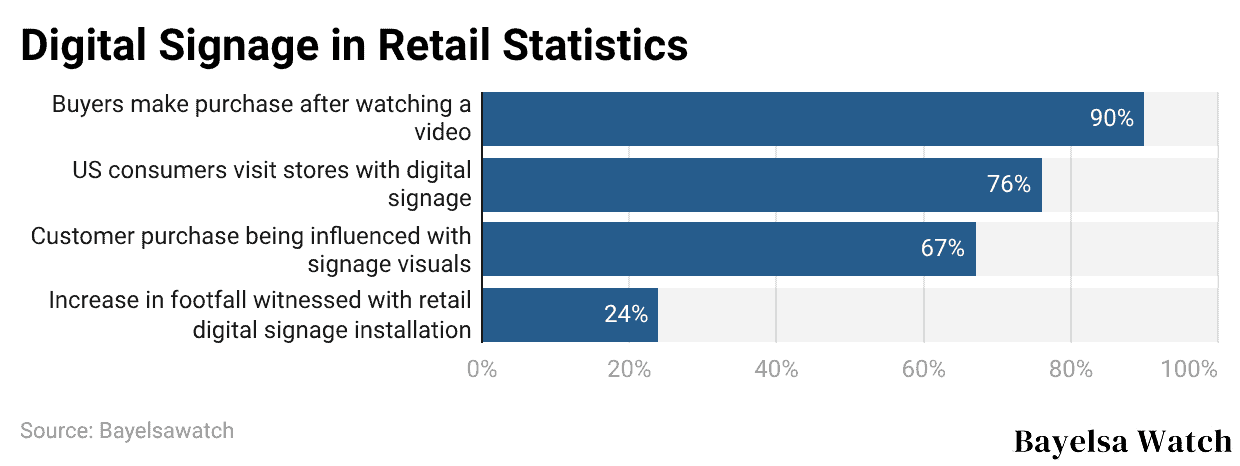
- 90% of customers find videos shown on the screen effective when buying their goods.
- Therefore, if you already own digital screens in your shop, you should not be afraid to display various video content in order to promote your brand more successfully.
- Also, it is worth noting that 76% of American consumers prefer visiting retail shops due to their digital signage attractiveness.
- Moreover, according to consumer surveys, 67% of consumers often buy goods because of the visuals shown on digital signage.
- In addition, retailers have noted an increase in foot traffic by 24% after installing digital signage.
- Also, among those who already used digital signage, 80% reported an increase in sales by 33%.
- Almost 80% of millennials like shopping in stores with mobile service portals or interactive kiosks.
- Digital signage allows for reducing perceived waiting time by 35%.
Digital Signage In Restaurants Statistics
- 95% of restaurateurs believe that technology has positively impacted their quality of service.
- 79% of customers feel that digital signage helps in making the restaurant visit better.
- Interestingly, the digital menu boards that are used by QSRs constitute 20% of the entire digital signage market.
- 51% of consumers made orders through the website of the restaurant in 2019, while 38% did so through an online ordering portal, and 29% made orders through the app. The percentage is obviously higher now.
- According to a survey, employing digital menu boards can boost annual store sales by USD16,000.
- 55% of consumers prefer to stay in those hotels that allow self-check-ins via digital kiosk signs.
- 30% of consumers feel that the digital menu or tariff cards impact their purchasing decisions.

Digital Signage In Banking and Finance Statistics
- According to surveys, 87% of clients perceive the bank as credible if its branch uses digital signage solutions.
- Moreover, surveys have revealed that 87% of consumers (wherein 97% belong to millennials) use mobile banking applications.
- Out of these, 75% of updates pertain to bank-related information, while 25% consist of other news displayed near the queue to engage the customers.
- The global economy of digital payments is expected to reach USD 12.55 trillion in 2027.
- The market will experience a CAGR of 10.9% during the period of 2021-2027.
- 9 out of 10 banks recognize the importance of digital signage in their in-branch marketing strategy.
Digital Signage In Social Media Statistics
- A social media ad campaign is associated with an improvement of 23% in terms of brand awareness, brand consideration, and emotional response.
- Following viewing social media posts related to products on digital displays, 87% of customers decided to take a certain action, including following the brand on social networks, visiting its retail store, and purchasing its products.
- Instagram usage is linked to 65% of visits to the websites or applications of the brand by users.
- According to 83% of teenagers, social media provides them with a sense of connectivity and informedness.
- Currently, the share of US citizens who have profiles on Instagram reaches 35%, meaning that digital signage may target both the adult and elderly population.
Digital Signage In Employee Communication Statistics
- In fact, 56% of internal communication departments are thinking of using digital signage in the workplace more extensively.
- 50% of communications specialists use digital signage as a means.
- Digital signage is used in the workplace for recognizing employees. Appreciated workers are 60% more motivated to be productive.
- For instance, digital signage facilitates internal communication and results in an increase in employee productivity by 25%.
- Indeed, companies that communicate well with staff members are 4x more likely to have highly engaged employees.
- 93% of communication in the world is non-verbal, and just 7% are the words being said.
- In fact, disengaged employees are 12x more likely to quit their jobs within the same year.
- Actually, presentations that make use of visual support are 43% more convincing than those without.
- Undoubtedly, 68% of US customer signage is related to the quality of business and its products.
- Furthermore, more than 25% of US businesses give a lot of importance to “multichannel campaign management” – including digital signage campaigns.
Digital Signage In Worship Venues Statistics
- The expenses for copying documents, printing, and purchasing paper might reach as high as USD 6,500 annually. Digital signage saves 76% in these expenses. Notably, there was a 72% increase in the incorporation of technology among churches led by Boomers.
- 52.9% of congregations use projectors and other types of digital signage for sermons.
- Four-fifths of places of worship have a website and are consistently upgrading their technology to attract a wider audience, particularly the youth. Websites can also be showcased using digital signage.
- 7 out of 10 practicing Millennial Christians read scriptures from a screen. Scriptures can also be displayed on digital signage during sermons.
- 46.1% of churches believe that social media outreach is the best approach for them. Social media updates can also be showcased on digital signage.
Digital Signage To Increase Sales Statistics
- 80% of organizations witnessed significant growth in their sales figures after implementing digital signage.
- 19% of customers made an impromptu decision to buy products advertised in the digital signs of the retailers.
- The digital menu boards help boost the impulsive purchase rate by 80%.
- By installing an on-site sign, an additional 4.75% annual sales income can be generated.
- Point-of-sale display systems facilitate more than 60% of purchasing decisions.
- Digital signs helped to generate a boost of 31.8% in sales volume.
Digital Signage Manufacturers Statistics
- Samsung Electronics Co. Ltd
- Panasonic Corporation
- Sony Corporation
- NEC Corporation
- LG Electronics Inc.
- BrightSign
- Stratacache
- Planar Systems Inc.
- Hitachi Ltd.
- Barco NV
- Goodview
- Cisco Systems Inc.
- Vistarmedia
- Pickcel
- Enplug
- Signagelive
- NoviSign
- Dotsignage
- Sharp Corporation
- Leyard Optoelectronics
- Scala
- Optima
- ViewSonic Corporation.
Digital Signage Recent Development Statistics
- BrightSign, one of the major providers of digital signage media players, acquired USD100 million in funding during 2023 in order to develop its product lineup as well as improve its software platform for greater efficiency.
- During the early months of 2024, SignageLive, an Internet-based digital signage system, received a USD 50 million investment in order to implement advanced functionality and achieve global reach in the international market.
- According to forecasts, the growth rate of the global market for digital signage solutions will be 7.5% annually from 2023 to 2028.
Conclusion
In summary, digital signage has proven itself as a crucial medium of communication within numerous industries, and there are multiple reasons for that, including increased interaction, cost-effectiveness, and enhanced consumer experience. Many people have already embraced this trend due to its promising prospects.
These figures highlight the importance of digital signage in the context of customer actions, employee engagement, and business results altogether. Being able not only to minimize costs associated with printing but also to widen the target audience, digital signage can be considered an important tool in today’s environment.
FAQ
Some of the benefits of digital signage include high customer engagement, increased sales, decreased costs of printing, easy update of information, and ROI measurement due to built-in analysis systems. Companies that make use of digital signs are able to attract 400% more views than traditional signs and even a 30% increment in sales.
Content Management System, or CMS, is software designed to help you present your digital content on your screen, regardless of where your server is located. It includes different apps and functionalities, which will allow you to work with different types of media like text, images, video clips, and even live streaming.
There are a number of business sectors that rely heavily on digital signage. These include banking, retail, healthcare, transportation, education, hotel and restaurant, manufacturing, entertainment, and real estate.