




Introduction
Linux Statistics: Although it continues gaining immense popularity, Linux is often considered a niche OS by desktop users. However, Linux faces almost no competition from other popular operating systems in hosting services, cloud computing, scientific calculations, IoT, and other applications. It might sound surprising to many, but in reality, Linux powers the vast majority of supercomputers on Earth and is the most common mobile OS as well.
Quite a success for the OS that many ignore, but that’s not even half of the story. While the above paragraph is primarily meant for novices who are interested in learning the ins and outs of Linux, more experienced users can also discover a great deal of useful information here, some of which could prove very valuable.
Editor’s Choice
- 47% of developers who work professionally prefer to use Linux-based operating systems.
- Enterprises switching to Linux as their main OS saw an impressive YoY growth of 9.8%, amounting to 61.4% penetration.
- The 18-24 year-old category accounts for 17.95% of the users.
- The number of Linux users is 48.07 million.
- The United States takes the first spot by generating traffic for Linux.com equal to 16.93%.
- As of May 2025, Linux accounted for 4.06% in terms of the desktop OS market share across the globe.
- Linux’s overall desktop OS share in July 2024 was 4.45% worldwide.
- Android, which is built on top of the Linux Kernel, was used in 70.6% of all smartphones on Earth in 2025.
- Linux is used for 49.2% of all cloud computing tasks, indicating its superiority in IaaS and PaaS.
- Linux kernel source code crossed the 40 million lines mark by the end of 2024.
General Linux Statistics
- 47% of developers who work professionally prefer to use Linux-based operating systems.
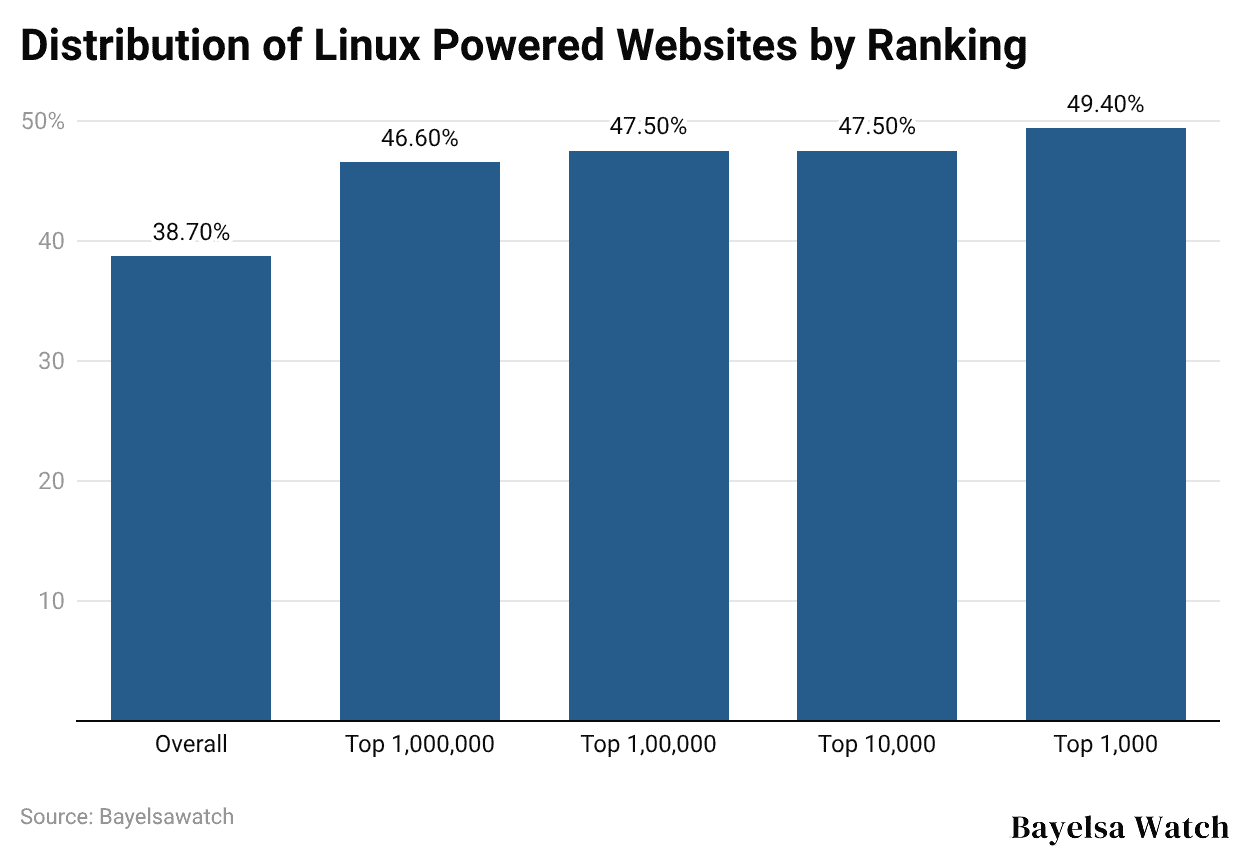
- Operating systems used by 39.2% of websites are based on Linux.
- Linux runs 85% of smartphones.
- Linux, the third most widely used operating system for desktop computers, holds a market share of 2.09%.
- The global Linux market is expected to grow to $15.64 billion by 2027.
- The world’s fastest 500 supercomputers are all powered by Linux.
- 96.3% of the one million fastest web servers operate on Linux.
- There are more than 600 varieties of Linux currently active.
Linux Market Size Statistics
- Linux has a market share of 2.88%, whereas macOS (OS X) has a market share of 7.3% and macOS has a market share of 4.92%, and Windows has a market share of 66.83%.
- When it comes to desktop games, Linux has a market share of 2.23% (with Arch Linux, Linux Mint, and Ubuntu being the leading three) in comparison to 1.16% for macOS (OS X) and 96.61% for Windows.
- The desktop market share for Linux was 2.76%, in contrast to 14.55% for macOS and 70.39% for Windows.
- 27.8% of people use the Ubuntu operating system for personal purposes, and 27.7% of people use the same for professional purposes.
- 11.4% of people use the Debian operating system for personal purposes, and 10.4% use it for professional purposes.
- There are a large number of Linux users who use Arch Linux, Red Hat, Fedora, NixOS, and Pop!_OS.
- 17.6% of people use different Linux distributions apart from those listed above for personal purposes, while 16.7% do so for professional purposes.

Linux Adoption Statistics
- Enterprises switching to Linux as their main OS saw an impressive YoY growth of 9.8%, amounting to 61.4% penetration.
- There was a 12.6% increase in the usage of Linux by desktop computer users in 2025.
- When it comes to the public sector IT transformation, 48.9% of system relocations involved the usage of Linux.
- Linux containers gained a 13.3% share of deployments, mainly due to the popularity of Kubernetes.
- Laptops running Linux became mandatory in more than 31 countries’ education sectors.
- Linux workloads run in virtual machines account for 66.5% of all workloads in hypervisors such as VMware and KVM.
- Automotive Linux saw a 32.4% YoY gain in cars in areas such as ADAS and infotainment.
- Linux deployments were reported at 45.8% increase in retail businesses related to POS and inventory systems.
Linux Users Statistics
- The number of Linux users is 48.07 million.
- Android has the largest number of users, which is 2.2 billion, while Windows has 1.5 billion users.
- 45% of the software developers in the world are using Linux.

Linux Website Users By Age Statistics
- The 25-34 year-olds form the biggest percentage of users at 21.15%, demonstrating their great level of engagement as young professionals.
- The 18-24 year-old category accounts for 17.95% of the users, signifying the increasing use of Linux by students and new professionals.
- The 45-54 year-olds comprise of 17.09%, illustrating significant use by more experienced professionals.
- The 35-44 and 55-64 year-old categories represent almost the same percentage, which is 15.33% and 15.45%, respectively.
- The last category is that of seniors who form 13.02%.

Linux Website Traffic By Country Statistics
- The United States takes the first spot by generating traffic for Linux.com equal to 16.93%.
- India occupies the second place, generating traffic at 4.67%, demonstrating a growing number of developers who use Linux.
- Brazil comes next by providing 3.97% traffic to Linux.com.
- Switzerland and Germany together generate 3.66% traffic to Linux.com, suggesting stable use of Linux in Central Europe.
- 67.11% of traffic to Linux.com originates from Other countries.

Linux Usage Statistics
- As of May 2025, Linux accounted for 4.06% in terms of the desktop OS market share across the globe.
- In the United States, the Linux desktop operating system market share amounted to 5.04% in June 2025.
- Linux desktop operating system market share across the globe was 4.45% as of July 2024, compared to 3.12% in July 2023.
- The usage of Linux OS websites amounts to 57.5% of all websites (Known OS).
- The share of Linux in the cloud is estimated to be 49.2% of all cloud workloads in Q2 2025.
- Desktop growth trend is observed with 4.03% in February 2024 4.44% in July 2024.
- Linux server OS market share is about 62.
Linux Desktop Statistics
- Linux’s overall desktop OS share in July 2024 was 4.45% worldwide.
- Globally, the Linux desktop OS share was 4.13% in December 2024 and 4.04% in November 2024.
- In the United States, Linux’s desktop OS share was recorded at 5.03% in June 2025.
- In some studies, the Linux desktop OS share globally is recorded as being 3.7% (2025).
- From January 2025 to April 2025, the Linux desktop OS share grew from 3.72% to 4.27% monthly.
- In India, Linux’s desktop OS share was estimated to be 16.21% in July 2024.
- The desktop OS share for Linux is considerably lower compared to that of Windows (over 70%).
Linux Mobile Statistics
- Android, which is built on top of the Linux Kernel, was used in 70.6% of all smartphones on Earth in 2025.
- LineageOS, an open source version of Android, had 1.2 million installs around the world.
- PinePhone and Librem 5, two open source Linux-based phones, occupy 0.06% of the total smartphone market share.
- PostmarketOS had seen an increase in installations of 19.4% from the previous year on legacy Android hardware.
- Wear OS (Google’s Linux-based smartwatch OS) controls 34.7% of all global smartwatch shipments.
- Linux-based systems have a 86.3% market share among tablets globally due to Android and ChromeOS hybrid devices.
- In developing countries, Android Go (a light Linux-based system) has penetrated 22.6% of the market for cheap smartphones.
- Mobile Linux development on GitHub was up by 15.2%, showing increasing interest in this area.
- KaiOS (a Linux-based operating system for feature phones) has 1.4% market share globally among mobile OSes.
| Android | 71.8% |
| Ios | 27.6% |
| KaiOS | 0.08% |
| Windows Phone | 0.02% |
| Series 40 (Nokia) | 0.01% |
| Symbian OS | 0% |
| Samsung | 0.34% |
| BlackBerry OS | 0% |
Linux In Supercomputers Statistics
- All 500 top supercomputers around the world use Linux operating systems in 2025; this trend has been going on since 2017.
- The fastest supercomputer today is the Frontier, which is located in America and uses an OS based on Linux.
- The European LUMI supercomputer uses Cray Linux, designed for hybrid computations using CPUs and GPUs.
- The Chinese Sunway TaihuLight supercomputer continues to use its own version of Linux, tailored for its architecture.
- The choice of Linux by supercomputers is associated with low latency in the kernel and high modularity of the OS.
- Community support is cited as a reason for choosing Linux by 73.2% of HPC organizations.
- Scientists rely on Linux in their simulations for scientific purposes in 96.7% of cases.
- Supercomputers with Linux OS achieve 25.3% higher FLOPS per watt efficiency compared to proprietary operating systems.
- Linux kernels have become 15.6% more customized in governmental HPC labs in 2025.
Linux Cloud Computing Statistics
- Linux is used for 49.2% of all cloud computing tasks, indicating its superiority in IaaS and PaaS.
- Linux operating systems are found on 83.5% of AWS EC2 instances, mainly Amazon Linux, Ubuntu, and Red Hat Enterprise Linux (RHEL).
- According to Azure, 61.8% of Linux VM usage is found across all active subscriptions in 2025.
- Google Cloud uses Linux VMs in 91.6% of all virtual machines.
- Linux is the platform for 96.4% of Kubernetes clusters in production by the Cloud Native Computing Foundation (CNCF).
- Linux helps SaaS providers launch 78.2% of their applications because of improved DevOps practices.
- Private clouds running OpenStack have 87.1% Linux deployments in 2025.
- Linux offers a 15.2% improvement in efficiency compared to proprietary operating systems for cloud providers.
Linux Code Statistics
- Systemd has almost reached 1.3 million lines of code.
- In 2019, there were 75,000 commits to the kernel code.
- The most frequent contributors through email domains included Intel Corporation and Red Hat Inc.
- Individual contributors leading in the contributions list included Linus Torvalds, contributing 3.19% of the commits.
- Total contributors for 2019 were 4,189.
- For systemd, there were 43,000 commits in 2019.
- The leading individual contributor was Yu Watanabe, contributing 26.94% of the commits.
Linux Kernel Statistics
- Linux kernel source code crossed the 40 million lines mark by the end of 2024.
- Release 6.15 had 14,612 changesets and was the most hectic since version 6.7.
- The number of unique authors in 2024 was 4,807, a slight decrease compared to earlier years.
- Linux kernel development has thousands of developers worldwide.
- More than 240,000 configurations have been indexed for kernel releases 4.13 → 5.8.
- Real-time patch set (PREEMPT_RT) has been incorporated into the mainstream kernel up to mid-2024.
- Leading corporations are responsible for significant contributions to the kernel development.
Linux In Gaming Statistics
- Steam Deck, featuring SteamOS (an Arch-based Linux OS), hit 4.5 million units in sales by mid-2025.
- 40.3% of Steam games are currently verified or playable using Linux thanks to Proton and Wine compatibility.
- In 2025, Valve’s Proton added compatibility support for another 225 titles.
- 5.9% of the total Steam MAU base uses Linux, which is the highest it has ever been.
- Lutris, an open gaming platform in Linux, gained 1.4 million users throughout the year.
- Vulkan API, popular in Linux platforms, became the default renderer in 72.6% of Linux- native games.
- Support for Linux game engines rose, as both Unity and Unreal Engine 5 introduced official Linux editor builds.
- There was a yearly increase of 36.8% for Flatpak games in terms of installation numbers.
- Linux-based handheld devices such as AYN Odin 2 and OneXPlayer Linux Edition contributed to the Linux gaming market by 18.7%.
Fun Facts About Linux
- 90% of Hollywood special effects are rendered using Linux.
- 90% of public cloud computing uses Linux.
- All major space missions use Linux.
- 96.3% of all one-million highest performing servers in the world use Linux.
- Sony’s PlayStation 4 game console uses the Orbis operating system, which is based on the Linux kernel.
- In 2018, 75.16% of all smartphones globally used Linux.
Linux Recent Statistics
- Linux operating system market share in desktop OS increased to 4.44% in July 2024 from 3.12% in July 2023. In June 2025, the Linux operating system market share in the U.S. was estimated at 5.03% of desktop OS usage.
- Linux desktop operating system share by month was 3.72% (January 2025), 3.81% (February), 3.98% (March), 4.27% (April), 4.09% (June) worldwide.
- In February 2024, Linux OS market share exceeded 4% in desktop computers for the first time worldwide. According to the forecast, the Linux operating system market share in desktops may reach 5% by early 2025.
- Linux operating systems are used extensively in cloud computing and infrastructure segments; Linux is responsible for 49.2% of cloud workloads worldwide as of Q2 2025.
- Linux web server market share is also high; about 57.5% of websites (operating system identified) use Linux servers. Linux operating system market share worldwide and forecasts indicate strong growth, from $21.97 billion in 2024 to $26.41 billion in 2025.
Conclusion
Linux is no longer a marginal OS used only by enthusiasts. On the contrary, Linux serves as the base for critical infrastructure in the cloud, server environment, web hosting, and embedded systems; it is embraced widely by professional software developers; and the OS kernel keeps advancing thanks to community support.
Linux has made less progress on desktops and gaming, but shows promise in these markets too. At the same time, Linux is making good strides in enterprise environments, governments, and web infrastructure markets.
FAQ
Current statistics of Linux suggest that 2.68% of personal computers and laptops globally operate using this operating system. The total number of Linux users amounts to more than 32.8 million besides 1.6 billion Android users.
As per statistics about Linux usage, some examples of what works on this OS include various web browsers, games, open-source software, PDF readers, and video players. In short, everything that you can run on your browser can be run on Linux. Though, it is not possible to use some proprietary applications like Microsoft’s or Apple’s as they do not function on this OS, open-source alternatives that run smoothly on Linux exist. However, many closed-source applications made through web-based platforms are accessible for Linux – such as Spotify, Slack, Minecraft, and Skype.
Linux is better when it comes to security, privacy, customization, and performance on old computers, but Windows 11 is better in terms of usability, compatibility with paid software (for example, Adobe products, Microsoft Office) and gaming. Linux is an open source operating system that does not require users to update and collects no data.