




Introduction
Artificial Intelligence Statistics: Artificial Intelligence (AI) is changing the way businesses and people work every day. It helps companies improve productivity, save time, and deliver better customer experiences. Many industries, such as healthcare, finance, retail, and manufacturing, are now using AI to stay competitive and grow faster. AI is also shaping jobs, teamwork, and decision-making. It is creating new opportunities while changing existing roles.
This article shares key AI statistics to provide a clear, simple view of how AI is growing and impacting businesses and the global market.
Editor’s Choice
- The global AI market size is expected to reach approximately USD 553.2 billion in 2026.
- The National University blog stated that in 2026, people who know more about Artificial Intelligence are Asians (40%), men (38%), and people aged 30-49 (38%).
- According to Demand Sage, more than 99% of Fortune 500 companies use AI, and around 78% have already adopted it in their operations.
- The TwinStrata report stated that around 52%-74% of telecom companies use AI-powered chatbots and virtual agents.
- Industries such as manufacturing lead with an additional AI contribution of USD 3.78 trillion, followed by wholesale and retail at USD 2.23 trillion, and professional services at USD 1.85 trillion.
- The most common uses of AI include replying to texts or emails (45%), answering money-related questions (43%), and planning travel (38%).
- Over 90% of organizations believe AI is important for gaining a competitive advantage, about 80% consider it a top business strategy, and more than 83% actively prioritize its use, according to Fullview.
- The most common use of AI in daily life is for cooking or meal planning, with about 45.15% of people using it for this purpose.
- Azumo’s report further stated that Artificial Intelligence has significantly improved productivity, with AI-driven industries achieving about 27% growth compared to 7% before AI adoption, showing a nearly 4-fold increase.
- As of January 2026, Gemini 1.5 Pro (Preview) leads the benchmark with the highest score of 44.7%, followed by GPT-4.1 at 41.6%.
- According to the World Economic Forum, AI is expected to replace around 92 million jobs by 2030, while creating about 170 million new jobs, resulting in a net gain of 78 million jobs.
Key Takeaways
- In 2026, Artificial Intelligence I usage has reached a large scale, with approximately 1.5-2 billion people worldwide interacting with AI-powered systems, according to Quetext.
- Daily adoption of AI is increasing quickly, with around 250-350 million users using AI tools for tasks such as writing, coding, and research.
- Businesses are also adopting AI at a fast pace, with about 78% of organizations using AI in at least one business function.
- The National University report also stated that approximately 77% of devices currently in use include some form of AI technology.
- AI is expected to have a major economic impact, with projections showing it could contribute around USD 15.7 trillion to the global economy by 2030.
- In terms of employment, AI was projected to replace about 85 million jobs by 2025.
- Still, it is expected to create around 97 million new jobs, resulting in a net increase of 12 million.
- Around 63% of organizations worldwide are planning to adopt AI within the next three years.
- The AI market is growing rapidly and is expected to expand by at least 120% year over year.
- Despite this growth, 88% of people who do not currently use AI are unsure about how generative AI will affect their lives.
- Only 33% of consumers believe they use AI platforms, whereas actual usage is closer to 77%.
- The Demand Sage report further stated that over 55% of people in the United States regularly use AI in their daily lives.
- Around 65% of organizations use generative AI in at least one part of their business operations.
- Nearly 90% of businesses adopt AI to stay competitive in the market.
- Approximately 64% of businesses are confident that AI can improve productivity.
Artificial Intelligence Market Size

(Source: market.us)
- The global AI market size is expected to reach approximately USD 553.2 billion in 2026.
- The market’s compound annual growth rate will be 30.3% from 2024 to 2033.
- By 2033, the global AI market is projected to reach around USD 3,527.8 billion.
AI Demographics Statistics
- The National University blog stated that in 2026, people who know more about Artificial Intelligence are Asians (40%), men (38%), people aged 30-49 (38%), those with postgraduate degrees (53%), people with high incomes (52%), and Democrats (34%).
- Across all age groups, the most commonly used AI each week is virtual assistants like Siri and Alexa, with usage rates of 30.8% for people aged 61+, 14% for ages 41-60, 25.3% for ages 26-40, and 29.9% for ages 18-25.
- Over 80% of people aged 18-25 have never used a large language model, and 68% of non-users are Gen Xers or Baby Boomers.
- Moreover, men have slightly higher awareness of AI than women (38% vs 23%), and they also use spam filters daily a bit more often (29.7% vs 29.2%).
- Women use some AI tools more often in daily life, such as playlist recommendations and monthly technologies like virtual assistants and wearable fitness trackers. They are slightly more likely than men to have tried technologies like autonomous vehicles (85.6% vs 84.7%), large language models (79.4% vs 78.9%), and smart cleaning machines (67.9% vs 67.5%).
AI Adoption Statistics
- According to Demand Sage, more than 99% of Fortune 500 companies use AI, and around 78% have already adopted it in their operations.
- Around 55% of Americans say they regularly use AI, while 44% report not using AI tools.
- 90% of businesses have invested in AI, but only 14.6% use it daily.
- Approximately 27% of Americans interact with AI several times a day, while 28% use AI once a day or a few times per week.
- About 20% of C-suite executives use machine learning, and 63% of businesses worldwide plan to adopt AI within the next three years.
By Industry
- The TwinStrata report stated that around 52%-74% of telecom companies use AI-powered chatbots and virtual agents.
- About 75.7% of digital marketers rely on AI tools for their work, and nearly 55% of B2B marketers use chatbots to generate leads and improve marketing performance.
- Nearly 55% of B2B marketers use chatbots to generate leads and support marketing activities.
- About 80% of retail executives had planned to adopt AI automation by 2025 to improve operations and the customer experience.
- AI adoption varies by industry, with around 12% of companies in healthcare, information services, and manufacturing using AI technologies.
- In comparison, only about 4% of companies in the construction and retail sectors currently use AI.
- 25% of companies in the travel and hospitality industry have implemented chatbot technology.
- The automotive industry has experienced a 48% increase in the adoption of machine learning technologies.
- About 36% of executives say their main goal in adopting AI is to optimize and automate internal business processes.
- Approximately 38% of medical professionals use AI-assisted tools for diagnosis.
- At the same time, companies like Netflix have saved about USD 1 billion, and the banking sector is expected to generate USD 1 billion in AI-related revenue by 2027.
AI Contribution Across Industry Sectors

(Source: buttercms.com)
- Industries such as manufacturing lead with an additional AI contribution of USD 3.78 trillion, followed by wholesale and retail at USD 2.23 trillion, and professional services at USD 1.85 trillion.
| Industry | Valuation (USD) | Additional AI Contribution (USD) |
| Accommodation and Food Services | 8.4 trillion | 3.78 trillion |
| Wholesale and Retail | 6.18 trillion | 2.23 trillion |
| Professional Services | 7.47 trillion | 1.85 trillion |
| Financial Services | 3.42 trillion | 1.15 trillion |
| Information and Communication | 3.72 trillion | 951 billion |
| Public Services | 3.99 trillion | 939 billion |
| Transportation and Storage | 2.13 trillion | 744 billion |
| Construction | 2.76 trillion | 520 billion |
| Accommodation and Food Services | 1.5 trillion | 489 billion |
| Healthcare | 2.26 trillion | 461 billion |
| Utilities | 962 billion | 304 billion |
| Social Services | 1.08 trillion | 216 billion |
| Agriculture, Forestry, and Fishing | 554 billion | 215 billion |
| Education | 1.06 trillion | 109 billion |
| Other Services | 535 billion | 95 billion |
| Arts, Entertainment, and Recreation | 453 billion | 87 billion |
Consumer Use Of AI
- The most common uses of AI include replying to texts or emails (45%), answering money-related questions (43%), and planning travel (38%).
- People also use AI to write emails (31%), prepare for job interviews (30%), create social media posts (25%), and summarize long content (19%).
- About 55% of Americans say they regularly use AI, while 44% say they do not use it often.
- In work and personal life, AI is widely used in email spam filters (78.5%), customer service chatbots (62.2%), virtual assistants (61.4%), fitness trackers (50.6%), and music or content recommendations (48.5%).
Company-Wide AI Centralization Insights
- According to Exploding Topics, companies are most likely to centralize AI in areas like risk and compliance (57%) and data governance (46%).
- In comparison, moderate centralization is seen in AI strategy (36%) and product development roadmaps (35%).
- Fewer companies fully centralize AI in areas such as tech talent (29%) and overall AI adoption (23%), indicating a more distributed approach in these functions.
AI In The Workplace Statistics
- Over 90% of organizations believe AI is important for gaining a competitive advantage, about 80% consider it a top business strategy, and more than 83% actively prioritize its use, according to Fullview.
- SurveyMonkey’s report further stated that around 73% of companies in the United States have already integrated AI into some part of their business operations, and 54% started using it within one year of ChatGPT’s launch.
- Approximately 64% of business owners believe AI improves productivity, and 44% of business leaders have already seen increased productivity after adopting AI.
- Businesses that use AI report an average revenue growth of 6% to 10%, showing a clear financial benefit.
- According to the Board of Governors of the Federal Reserve System, about 33% of business tasks are now automated, and employee productivity is expected to increase by 1.5% over the next decade due to AI adoption.
- Around 85.1% of users use AI tools to create blog content, while 9% of workers in the United States use generative AI daily.
- About 35% of businesses are concerned about the lack of technical skills and knowledge needed to use AI effectively.
AI And User Trust
| Insight Area | Specifications |
| Student Interest | 90% of students say they want to learn more about AI in school. |
| Content Awareness | About 54% of people can tell the difference between human-made and AI-generated content. |
| AI vs Search Engines | Nearly 67% of people say they would use ChatGPT instead of Google. |
| General Opinion | About 50% of consumers feel optimistic about AI technology. |
| Customer Experience | 54% of consumers believe AI can improve customer experience. |
| Trust in Businesses Using AI | 65% of consumers trust companies that use AI. |
| Lack of Trust | 14% of consumers do not trust businesses that use AI. |
| Neutral Opinion | 21% of consumers feel neutral about businesses using AI. |
| Benefits vs Risks | About 78% of people believe the benefits of generative AI outweigh the risks. |
| Safety Perception | Only 39% of people think current AI technology is safe and secure. |
| Gender Difference | About 51% of men and 40% of women say they are more excited than concerned about AI. |
| Age Difference | 57% of Gen Z and 62% of millennials feel positive about AI, compared to only 30% of baby boomers. |
| Cybersecurity Concerns | About 80% of people worry about AI being used in cyberattacks. |
| Identity Theft Concerns | 78% are concerned about AI being used for identity theft. |
| Political Misuse | 74% worry about AI being used to create misleading political advertisements. |
| Content Quality | 54% of consumers think AI will improve written content. |
| No Benefits Belief | Only 4.1% of people believe AI will not provide any benefits. |
| No Risks Belief | 12.4% think AI will not have any drawbacks. |
| AI in Healthcare Acceptance | 39% of adults are comfortable with healthcare providers using AI. |
| Healthcare Improvement | 38% believe AI can improve healthcare outcomes. |
| Error Reduction | 40% think AI can help reduce medical errors. |
| Bias Reduction | 51% believe AI can reduce racial and ethnic bias in healthcare. |
Popular Artificial Intelligence Function Statistics
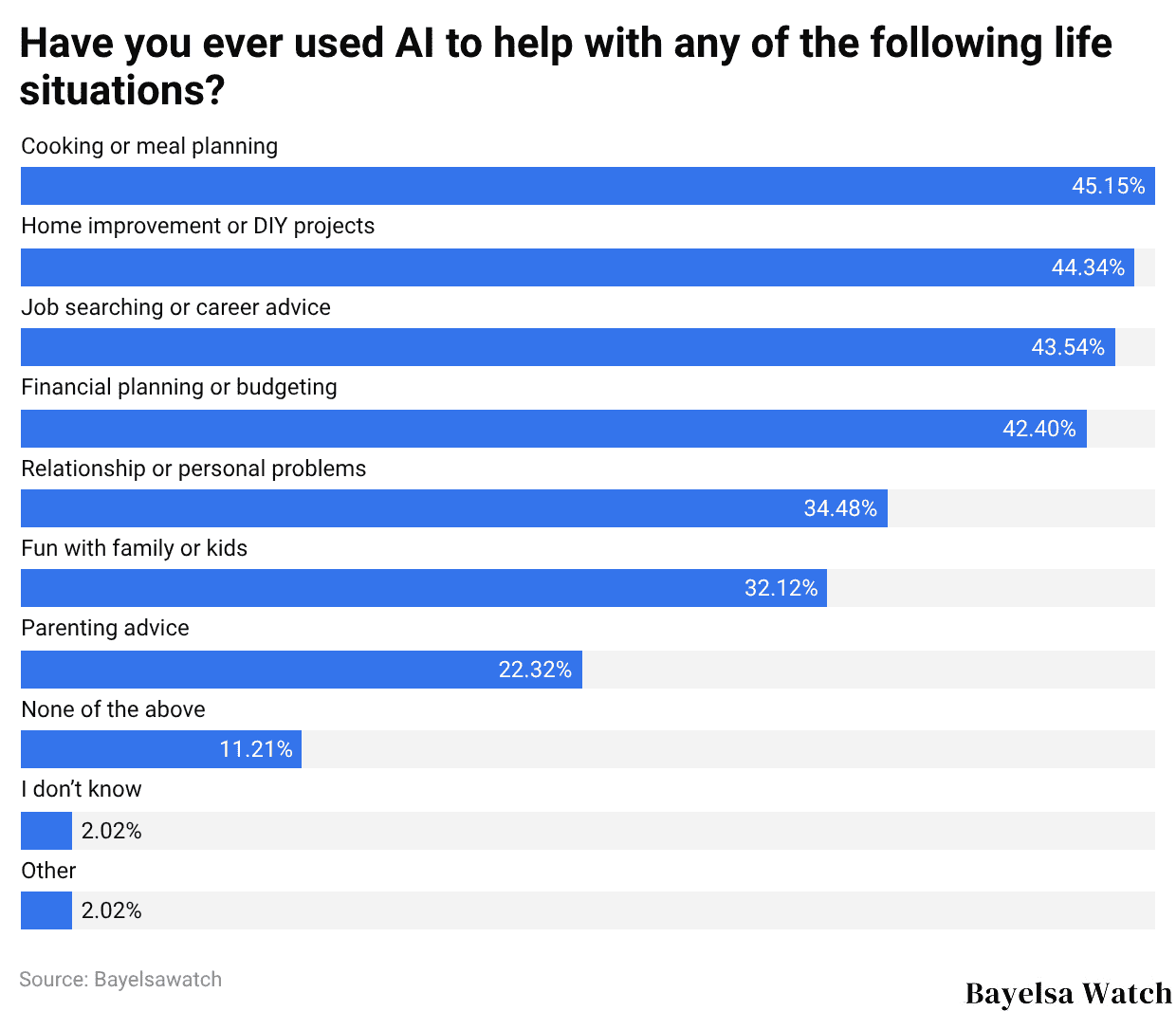
(Reference: buttercms.com)
- The most common use of AI in daily life is for cooking or meal planning, with about 45.15% of people using it for this purpose.
- Data indicates that many individuals also use AI for home improvement or DIY projects (44.34%) and for job searching or career advice (43.54%).
- AI is widely used for financial planning and budgeting, with around 42.40% of users relying on it to manage their finances.
- Additionally, some people use AI for personal matters such as relationship advice (34.48%) and spending time with family or kids (32.12%).
- Moreover, fewer users turn to AI for parenting advice (22.32%), while 11.21% report not using AI for any of these activities, and only 2.02% are unsure or use it for other purposes.
AI Diffusion Over Time By Country (H1 2025 Vs H2 2025)

(Source: microsoft.com)
- The United Arab Emirates remains the global leader, with AI diffusion increasing from 59.4% to 64%.
- Singapore stays in second place, improving from 58.6% to 60.9%.
- Norway holds third position, with a small increase from 45.3% to 46.4%.
- Ireland shows great improvement, rising from 41.7% to 44.6%.
- France records notable growth, moving from 40.9% to 44%.
AI Impact On Productivity, Collaboration, And Performance
- Azumo’s report further stated that Artificial Intelligence has significantly improved productivity, with AI-driven industries achieving about 27% growth compared to 7% before AI adoption, showing a nearly 4-fold increase.
- AI skills earn a 56% higher wage premium, while job opportunities in AI-related roles have increased by 38%.
- AI tools greatly enhance efficiency, as support agents handle 13.8% more inquiries, business professionals produce 59% more documents, and programmers complete 126% more coding projects; additionally, tools like GitHub Copilot improve task speed by 55.8%.
- Strengthens teamwork, increasing communication by 137%, improving productivity by 60%, reducing redundant work by 35%, and speeding up knowledge access by 70%.
- Also improves performance management, boosting feedback frequency by 40%, increasing efficiency by 35%, and helping organizations achieve 25% better performance outcomes.
AI Model Performance Results

(Source: artificialanalysis.ai)
- Gemini 1.5 Pro scored roughly 5.0% on this extremely difficult benchmark. It is Gemini 3.1 Pro (released in early 2026) that achieved approximately 44.4% score.
| AI Model | Score |
| Claude 3 Opus | 36.7% |
| Gemini 1.5 Flash | 34.7% |
| Claude 3 Sonnet | 30.0% |
| Grok-2 | 30.0% |
| Kimi K2 | 29.4% |
| MiniMax Pro | 28.3% |
| MiniMax AI | 28.1% |
| Qwen 2.5 72B | 27.3% |
| GLM-4 | 27.2% |
| GPT-3.5 Turbo | 26.6% |
| DeepSeek V2 | 22.2% |
| Mistral Medium | 20.0% |
| Nemo AI | 19.2% |
| Grok-1 | 18.5% |
| Gemini 1.0 | 16.2% |
| K-EVAL | 13.1% |
| NeMo Guard | 10.2% |
| GPT-3 | 9.8% |
| Claude Instant | 9.7% |
| K2 Think | 9.5% |
| Nova Pro | 8.9% |
| Premium 2.5 | 7.7% |
| Llama 2 | 4.8% |
| Mistral Large | 4.1% |
Artificial Intelligence Impact On Jobs And Employment Trends
- The World Economic Forum’s Future of Jobs report projected that 85 million jobs would be displaced and 97 million created by 2025.
- Roles such as cashiers and ticket clerks (over 12 million jobs), administrative assistants (6 million+), and cleaners (2.5 million+) face the highest risk of job loss between 2025 and 2030.
- Clerical roles like stock-keeping (2 million+) and accounting (1.5 million+) jobs are at risk, while even professional roles like accountants may lose over 500,000 jobs.
- Despite these risks, demand for new skills is rising, with over 200,000 enterprise enrollments in AI courses as companies reskill workers.
Conclusion
Artificial Intelligence is changing how we work, live, and do business. It helps companies work faster, improve results, and stay ahead of competitors. While some jobs may change, AI also creates new opportunities and supports innovation.
In the future, AI will continue to grow and become more important. Businesses and individuals who learn and adapt to AI will have a strong advantage.
FAQ
John McCarthy is known as the father of Artificial Intelligence.
The United States ranks No. 1 globally in artificial intelligence leadership.
AI improves efficiency, automates tasks, enhances decision-making, reduces costs, boosts productivity, enables innovation, supports data analysis, improves customer experience, and accuracy.
The five types of AI are reactive machines, limited memory, theory of mind, and self- aware AI.
AI is growing rapidly due to more data, improved technology, greater computing power, and strong demand for automation and efficiency.

Sources