










Market Size
According to Market.us, The global AI in Nanotechnology market is entering a phase of very rapid expansion as artificial intelligence becomes more deeply integrated into nanoscale sensing, biomedical research, materials discovery, and precision diagnostics. The market generated USD 622.5 Million in 2024 and is projected to grow from USD 859.7 Million in 2025 to about USD 25,725.8 Million by 2034, reflecting a CAGR of 45.9% over the forecast period. This growth is being supported by stronger commercialization of nanoscale health technologies, increasing demand for high-precision detection systems, and wider use of AI models for complex pattern recognition in nano-enabled data environments.
The AI in Nanotechnology Market refers to the integration of artificial intelligence techniques with nanoscale science to accelerate material discovery, design, and manufacturing at the atomic and molecular level. This market is evolving as AI models are increasingly used to simulate complex nanoscale interactions, predict material properties, and optimize fabrication processes. The convergence of AI with nanotechnology is enabling faster experimentation cycles, reducing research costs, and improving precision in applications such as healthcare, electronics, and energy systems.
Find additional highlights on the growth strategies adopted by vendors and their product offerings, Buy Sample Report.
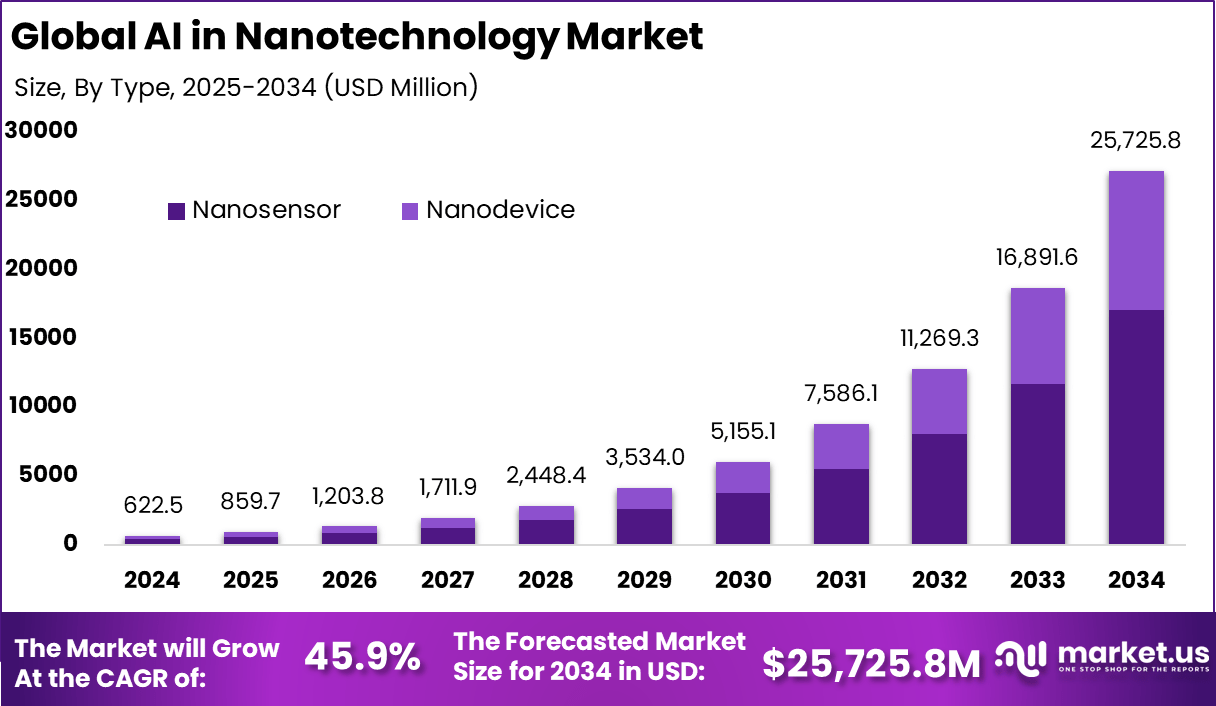
Top driving factors for this market are closely linked to the growing complexity of nanoscale research and the need for faster innovation. Traditional experimental methods in nanotechnology are time intensive and require extensive trial and error. AI driven simulation and predictive modeling can significantly reduce development timelines by identifying optimal material structures and properties in advance. Research studies indicate that AI assisted material discovery can reduce experimental cycles by over 50%, highlighting its strong impact on research efficiency.
Key Takeaways
- The global AI in Nanotechnology market is expected to rise from USD 622.5 Million in 2024 to about USD 25,725.8 Million by 2034.
- Nanosensors led the market with 62.8% share in 2024.
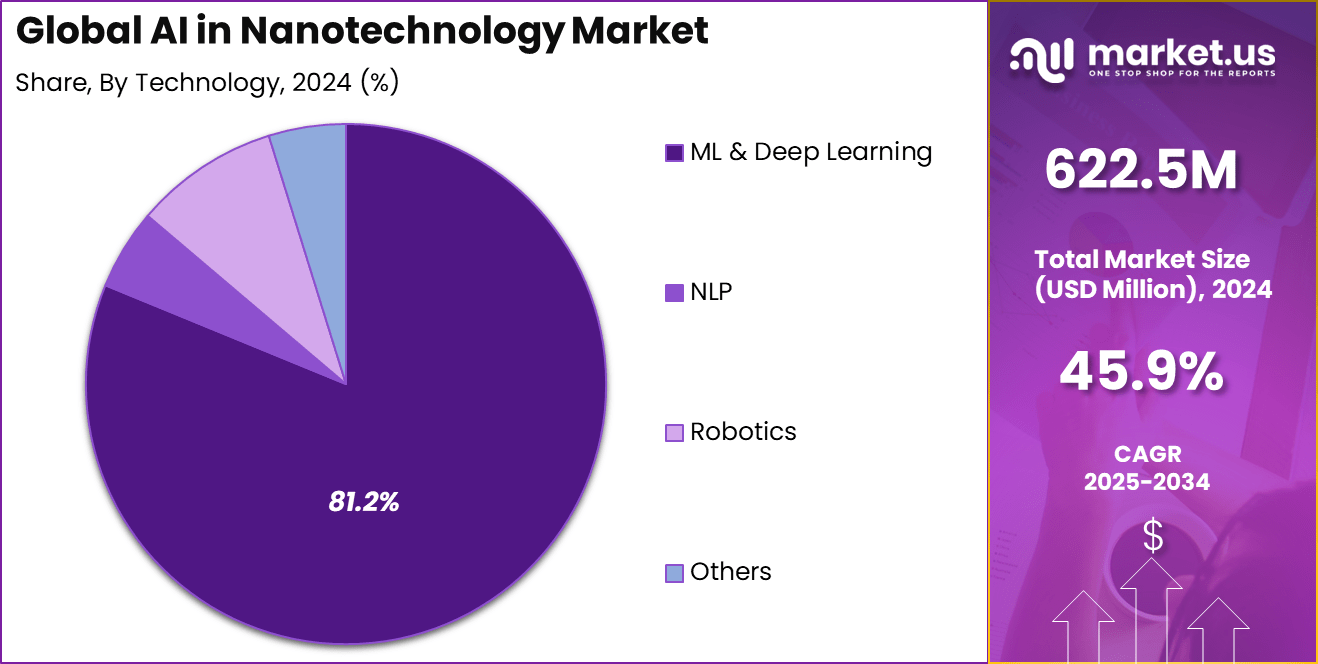
- Machine learning and deep learning accounted for 81.2% share in 2024.
- Biomedical applications captured 43.5% share in 2024.
- Healthcare and pharmaceuticals represented 29.5% of market demand in 2024.
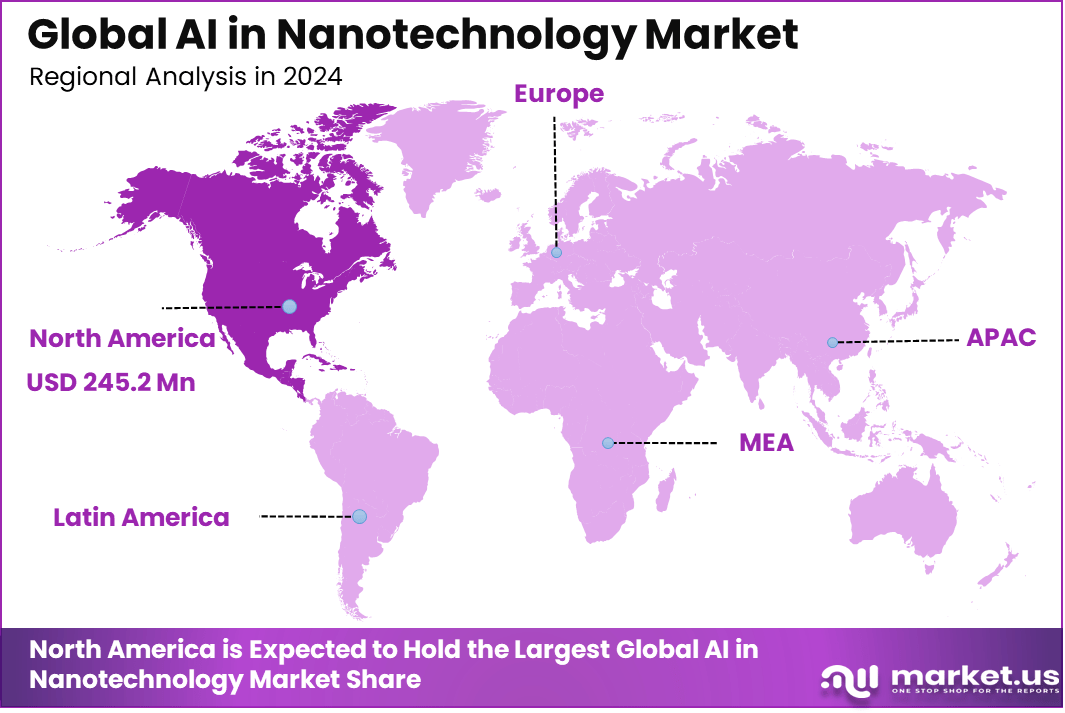
- North America led with 39.4% share, while the U.S. reached USD 227.2 Million in 2024.
AI in Nanotechnology Statistics
Broader AI adoption trends continue to support the growth of specialized markets such as AI in nanotechnology. Stanford HAI reported in its 2025 AI Index that 78% of organizations said they were using AI in 2024, up from 55% the year before. The same report also noted strong private investment momentum in AI, with U.S. private AI investment reaching USD 109.1 billion in 2024, indicating that the commercial environment for advanced AI applications remains highly active.
Within nanotechnology, public funding and scientific activity also show strong momentum. The U.S. National Nanotechnology Initiative stated that the FY2025 budget request was the highest ever, at more than USD 2.2 billion, and cumulative federal nanotechnology funding has now surpassed USD 45 billion. At the same time, FDA guidance and scientific reviews indicate growing movement of nano-enabled systems toward practical healthcare and pharmaceutical use, especially in diagnostics and product development.
Business AI Adoption and Usage
Business adoption patterns are important for this market because AI in nanotechnology depends on organizations that can process complex data, automate interpretation, and integrate advanced analytics into research or commercial workflows. Stanford HAI’s 2025 AI Index shows that AI use across organizations has become much more widespread, confirming that enterprises and research-driven sectors are increasingly prepared to adopt AI-enabled tools in specialized applications. This broader business readiness supports demand for AI across nanoscale sensing, biomedical modeling, and materials analysis.
Sector-specific demand is also strengthening adoption. Healthcare and pharmaceutical organizations accounted for 29.5% of this market in 2024, which aligns with the growing role of nanotechnology in diagnostics, therapeutic delivery, and precision medicine. FDA guidance on drug products containing nanomaterials shows that nanotechnology is no longer limited to early-stage research and is moving further into regulated product development, which improves the commercial relevance of AI-enabled nanotechnology platforms.
Request a custom report or consultation – write to us at sales@market.us
How AI is Reshaping the Future of Nanotechnology Market?
Artificial intelligence is reshaping nanotechnology by making it possible to interpret highly complex nanoscale data with greater speed and accuracy. Machine learning and deep learning held 81.2% of the market in 2024, showing that advanced AI models are becoming central to pattern recognition, classification, and predictive analysis in this space. These models are especially useful when large volumes of sensor, imaging, or biomarker data must be analyzed in ways that are too slow or too difficult for manual review.
AI is also improving the practical value of nanosensors in biomedical applications. Scientific reviews indicate that AI-assisted nanosensors can enhance sensitivity, specificity, and real-time diagnostic capability, especially in clinical settings where early detection and continuous monitoring are critical. This helps explain why biomedical applications captured 43.5% of the market in 2024 and why nanosensors remained the leading segment with 62.8% share.
By Type
In 2025, nanosensors held a dominant 62.8% share in the AI in Nanotechnology Market, reflecting their strong role in high-precision detection and real-time monitoring. Their adoption increased across research and commercial settings because they can identify extremely small physical, chemical, and biological changes with high sensitivity. This made them highly suitable for applications where fast and accurate response is essential. The segment’s leadership showed how important sensing accuracy has become in nanotechnology-driven systems.
The strong position of nanosensors was also supported by their broad use in diagnostics, environmental monitoring, and industrial process control. When combined with AI, these systems were able to deliver faster interpretation of signals and improved decision support. Their ability to operate in compact and data-intensive environments strengthened their value across multiple end uses. As a result, nanosensors remained the leading technology segment in this market.
Market Share (%), By Type (2020-2024)
| By Type | 2020 | 2021 | 2022 | 2023 | 2024 |
| Nanosensor | 60.70% | 61.20% | 61.80% | 62.30% | 62.80% |
| – Optical Nanosensor | 13.40% | 13.40% | 13.30% | 13.30% | 13.30% |
| – Chemical Nanosensor | 23.70% | 23.60% | 23.40% | 23.20% | 23.00% |
| – Physical Nanosensor | 7.60% | 7.40% | 7.20% | 7.00% | 6.80% |
| – Biosensors | 50.40% | 50.90% | 51.50% | 52.10% | 52.70% |
| – Others | 4.90% | 4.70% | 4.60% | 4.40% | 4.20% |
| Nanodevice | 39.30% | 38.80% | 38.20% | 37.70% | 37.20% |
| – Nanomanipulator | 18.20% | 18.30% | 18.40% | 18.50% | 18.50% |
| – Test Instruments | 23.20% | 23.00% | 22.90% | 22.80% | 22.70% |
| – Infrared Spectrometers | 31.10% | 31.60% | 32.10% | 32.60% | 33.10% |
| – Others | 27.50% | 27.10% | 26.60% | 26.10% | 25.70% |
By Technology Analysis
In 2025, machine learning and deep learning accounted for a leading 81.2% share in the market, confirming that advanced AI models are central to nanotechnology data processing and pattern recognition. These models were widely used to analyze complex nanoscale datasets, identify hidden correlations, and improve predictive accuracy. Their role became more important as nanotechnology applications generated larger and more complex streams of scientific and operational data. This helped establish machine learning and deep learning as the core intelligence layer in the market.
Market Share (%), By Technology Analysis (2020-2024)
| By Technology | 2020 | 2021 | 2022 | 2023 | 2024 |
| Machine Learning | 79.80% | 80.10% | 80.50% | 80.80% | 81.20% |
| Natural Language Processing | 9.10% | 9.00% | 8.80% | 8.60% | 8.40% |
| Robotics | 6.50% | 6.40% | 6.30% | 6.30% | 6.20% |
| Others | 4.60% | 4.50% | 4.40% | 4.30% | 4.30% |
The segment’s dominance was further driven by the need for better automation in material discovery, nanosensor interpretation, and biomedical analysis. Deep learning models, in particular, supported image analysis, molecular behavior assessment, and anomaly detection with greater precision. Institutions and companies increasingly preferred these methods because they reduced manual interpretation and improved analytical speed. This kept machine learning and deep learning at the center of AI adoption in nanotechnology.
By Application
In 2025, biomedical applications captured a dominant 43.5% share in the AI in Nanotechnology Market, reflecting growing demand for early diagnosis, continuous health monitoring, and precision treatment. Nanotechnology supported the development of highly sensitive systems that can detect disease markers at very early stages. When combined with AI, these systems offered stronger diagnostic accuracy and more informed clinical decision-making. This made biomedical use the most significant application area in the market.
The growth of this segment was also supported by increasing interest in personalized medicine and real-time patient monitoring. AI-enabled nanotechnology tools helped improve treatment targeting, disease tracking, and response evaluation across medical settings. Their use expanded in areas such as cancer detection, drug delivery, and biosensing. As healthcare systems moved toward more precise and preventive care, biomedical applications continued to lead market demand.
| By Application | 2020 | 2021 | 2022 | 2023 | 2024 |
| Biomedical Applications | 41.70% | 42.20% | 42.60% | 43.10% | 43.50% |
| Energy Storage and Systems | 9.10% | 8.90% | 8.80% | 8.70% | 8.60% |
| Electronics and Sensors | 18.20% | 18.20% | 18.10% | 18.10% | 18.00% |
| Advanced Materials | 26.50% | 26.30% | 26.20% | 26.00% | 25.80% |
| Others | 4.50% | 4.40% | 4.30% | 4.20% | 4.10% |
By End-User Industry Analysis
In 2025, the healthcare and pharmaceutical industry accounted for a leading 29.5% share in the market, driven by rising investments in smart diagnostics and digital therapeutics. These industries increasingly used AI-enabled nanotechnology to improve drug development, laboratory analysis, and patient-focused care solutions. The demand for faster diagnosis and more targeted treatment approaches supported stronger adoption across this vertical. This helped healthcare and pharmaceuticals maintain a leading market position.
Market Share (%), By End-User Industry Analysis (2020-2024)
| By End-User Industry | 2020 | 2021 | 2022 | 2023 | 2024 |
| Electronics and Semiconductors | 17.80% | 17.80% | 17.80% | 17.70% | 17.70% |
| Healthcare and Pharmaceuticals | 28.70% | 28.90% | 29.10% | 29.30% | 29.50% |
| Biotechnology | 18.10% | 18.50% | 19.00% | 19.50% | 19.90% |
| Textile | 0.70% | 0.60% | 0.60% | 0.60% | 0.60% |
| Chemicals and Advanced Materials | 17.00% | 16.90% | 16.80% | 16.60% | 16.50% |
| Automobiles | 5.30% | 5.20% | 5.00% | 4.90% | 4.70% |
| IT & Telecom | 3.60% | 3.50% | 3.40% | 3.40% | 3.30% |
| Aerospace | 4.40% | 4.30% | 4.20% | 4.10% | 4.00% |
| Others | 4.40% | 4.20% | 4.10% | 3.90% | 3.80% |
The segment’s strength was further reinforced by the need for innovation in drug delivery systems, disease detection platforms, and treatment monitoring tools. Pharmaceutical companies and healthcare providers focused on technologies that can improve clinical precision while reducing inefficiencies. AI in nanotechnology offered value by supporting better interpretation of complex biological data and enabling more adaptive therapeutic strategies. As a result, this industry vertical remained one of the most commercially active areas in the market.
Request a custom report or consultation – write to us at sales@market.us
Emerging Trends
One major trend is the growing role of nanosensors in high-precision and real-time monitoring systems. Since nanosensors held 62.8% of the market in 2024, this segment clearly represents the strongest near-term commercial direction. Scientific literature also shows that nanosensors are becoming increasingly important in biomedical detection, wearable diagnostics, and non-invasive monitoring applications.
Another important trend is the concentration of demand in biomedical use cases. Biomedical applications accounted for 43.5% of the market in 2024, reflecting stronger use of AI-enabled nano platforms for early diagnosis, continuous health monitoring, and precision treatment support. Recent reviews on AI-assisted nanosensors for clinical diagnostics support this direction by highlighting their growing relevance in precise medicine and healthcare decision-making.
Drivers
A major driver is the strong level of public funding and institutional support for nanotechnology. The National Nanotechnology Initiative’s FY2025 request of more than USD 2.2 billion and cumulative funding above USD 45 billion demonstrate that nanotechnology remains a strategic research and innovation priority in the United States. This scale of investment supports research infrastructure, product development, and long-term commercialization potential for AI-enabled nanotechnology solutions.
Another driver is the growing need for faster and more accurate biomedical analysis. AI-assisted nanosensor systems are becoming valuable because they can process highly complex biological signals with greater precision and speed. As healthcare systems place greater emphasis on early diagnosis, precision medicine, and continuous monitoring, the use of AI in nanotechnology becomes more relevant for practical clinical and life science applications.
Restraints
One important restraint is regulatory and validation complexity. Nano-enabled products, particularly in healthcare and pharmaceuticals, face strict requirements around characterization, safety, stability, and product quality. FDA guidance makes clear that nanomaterial-based products can present unique risks and therefore require careful evaluation, which can lengthen development timelines and increase compliance demands.
Another restraint is technical integration difficulty. AI in nanotechnology often depends on combining advanced sensing hardware, high-quality datasets, specialized algorithms, and domain-specific interpretation. Scientific reviews continue to point to challenges such as limited datasets, privacy concerns, model reliability, and the difficulty of translating strong laboratory results into scalable real-world systems.
Opportunities
A major opportunity lies in healthcare and pharmaceutical commercialization. Since this industry accounted for 29.5% of the market in 2024, it already represents the largest end-use base. The combination of AI with nanosensors, nano-diagnostics, and smart therapeutic platforms creates strong potential in early disease detection, precision treatment, and next-generation clinical monitoring systems.
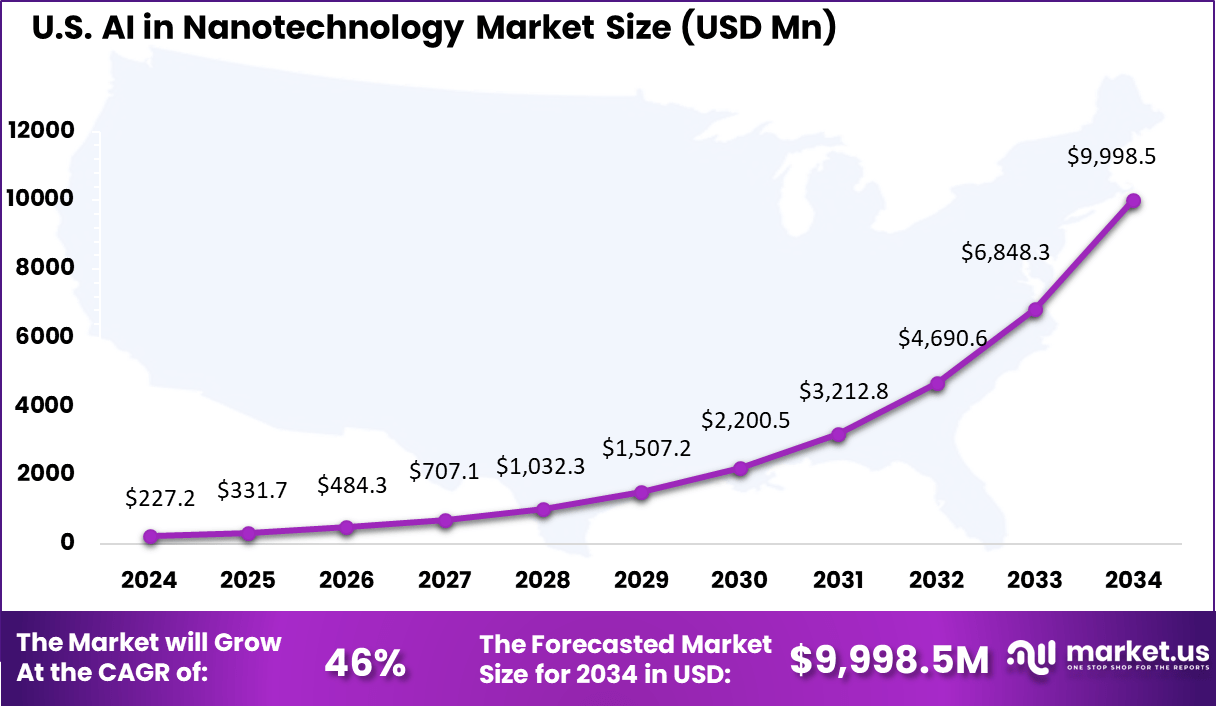
Another opportunity comes from continued U.S.-led commercialization and scaling. The U.S. market reached USD 227.2 Million in 2024, and the country continues to benefit from a large nanotechnology research base, strong federal support, and active healthcare innovation. This makes the U.S. an important launch market for AI-enabled nanotechnology solutions in diagnostics, life sciences, and advanced sensing.
Regional Analysis
In 2024, North America held a dominant market position with more than 39.4% share, generating about USD 245.2 Million in revenue.
The U.S. market alone reached USD 227.2 Million, indicating a strong base of research activity and early commercialization. This regional strength is supported by sustained public investment in nanotechnology research, as the U.S. National Nanotechnology Initiative requested more than USD 2.2 billion for FY2025 and reported cumulative funding of overUSD 45 billion since its launch.
Conclusion
The AI in Nanotechnology market is moving into a very strong growth phase, supported by expanding public research investment, higher healthcare demand, and the increasing ability of AI systems to interpret nanoscale data quickly and accurately. The strongest momentum is visible in nanosensors, machine learning-led analysis, and biomedical applications, where the value of precision detection and real-time interpretation is especially high. North America remains the leading region, with the U.S. continuing to act as a major commercialization center.
Looking ahead, the market is likely to be shaped by how effectively scientific advances are translated into scalable products for healthcare, pharmaceuticals, and other high-value sectors. AI will remain central because it improves speed, pattern recognition, and usability across nanotechnology workflows. As regulatory pathways, validation standards, and real-world deployment models become more mature, the market is positioned for sustained long-term expansion.

Sources