










Introduction
Wearable Technology Statistics: Wearable technology refers to smart devices that people can wear, such as smartwatches, fitness bands, and smart glasses. These gadgets track your steps, heart rate, sleep, and more right in real time. Wearables have grown from simple fitness trackers into powerful tools for health, safety, and daily life. They can remind you to move, help you train better, and even spot early signs of health problems.
As sensors get smaller and smarter, wearables are becoming faster, lighter, and more personal. But they also raise big questions about privacy and data safety. This article explores what wearable tech is, why it matters, and where it’s heading next.
Editor’s Choice
- The global wearable technology market is expected to reach USD 109 billion by 2026 and around USD 231 billion by 2032.
- By device category, smartwatches accounted for around 46% of wearable-market share in 2025, while head-mounted displays are expected to grow at a roughly 19% CAGR through 2031.
- North America leads the market with a 33.8% share, followed by APAC at 30.1% and Europe at 25.4%.
- Sony Corp. leads the market with a 15% share, while Apple Inc. and Alphabet Inc. each hold 12%.
- In 2026, the global smart wearable market is forecast at USD 175.0 billion, rising to USD 383.5 billion by 2032.
- Wearable ownership is highest in India (57% vs 43%), China (Mainland) (53% vs 47%), and the United Kingdom (52% vs 48%).
- Among people aged 18-34, 10.20% say they use wearable technology, while 16.58% say they do not.
- Statista forecasts global wearable device shipments to rise from about 590.7 million units in 2025 to roughly 614.1 million units by 2026.
- In 2026, earwear is expected to ship 382.40 million units (382,400 in 1,000s), taking 39.33% of total wearable shipments.
- Health and fitness remain the main reasons people buy wearables, with 70% of consumers prioritising features such as ECG, blood oxygen saturation tracking, and heart monitoring.
- AI features are moving into the mainstream, with about 40% of newly launched wearables expected to include AI-enabled functions by 2026.
- Across all respondents, more than 75% said they are open to using a wearable device in the future.
Wearable Technology Market Size

(Source: market.us)
- The global wearable technology market is expected to reach USD 109 billion by 2026 and around USD 231 billion by 2032.
- From 2026 to 2032, the market is expected to expand at a 14.6% CAGR.
- According to Mordor Intelligence, by device category, smartwatches accounted for around 46% of wearable-market share in 2025, while head-mounted displays are expected to expand at roughly a 19% CAGR through 2031.
| Segment | Leading share, 2025 | CAGR (From 2025 to 2031) |
| Key parts (components) | Sensors (29%) | Solid-state batteries (20%) |
| Connectivity | Bluetooth/BLE (61%) | Cellular 5G (19%) |
| End use (industry) | Consumer electronics (57%) | Healthcare (20%) |
| Region | North America (32%) | Asia-Pacific (20%) |
By Region
- According to market.us, North America leads the market with a 33.8% share, followed by APAC at 30.1% and Europe at 25.4%.
- Latin America and the Middle East & Africa (MEA) remain smaller markets, with shares of 6.9% and 3.8%, respectively.
By Country
| Market | 2025 (USD billion) | 2033 (USD billion) | CAGR (2025 to 2033) |
| Luxembourg | 0.169 | 0.369 | 10.227% |
| Qatar | 0.402 | 1.026 | 12.415% |
| Peru | 0.486 | 1.253 | 12.558% |
| Nigeria | 0.544 | 1.370 | 12.236% |
| Egypt | 0.586 | 1.470 | 12.187% |
| UAE | 0.638 | 1.747 | 13.419% |
| Chile | 0.662 | 1.755 | 12.959% |
| Turkey | 0.789 | 2.099 | 13.019% |
| Argentina | 0.875 | 2.401 | 13.441% |
| Denmark | 0.975 | 2.366 | 11.719% |
| Switzerland | 1.074 | 2.533 | 11.324% |
| Saudi Arabia | 1.114 | 2.911 | 12.761% |
| Colombia | 1.123 | 2.848 | 12.340% |
| South Africa | 1.214 | 3.161 | 12.700% |
| Singapore | 1.247 | 3.465 | 13.626% |
| Taiwan | 1.328 | 3.527 | 12.982% |
| Australia | 1.347 | 3.351 | 12.070% |
| Russia | 1.390 | 3.138 | 10.718% |
| Sweden | 1.603 | 4.019 | 12.177% |
| Spain | 1.948 | 4.933 | 12.314% |
| Italy | 1.968 | 4.733 | 11.591% |
| Brazil | 2.178 | 5.636 | 12.618% |
| South Korea | 2.251 | 5.852 | 12.687% |
| Mexico | 2.625 | 6.559 | 12.130% |
| United Kingdom | 3.138 | 7.982 | 12.377% |
| India | 3.157 | 9.289 | 14.441% |
| France | 3.396 | 8.110 | 11.494% |
| Africa | 3.425 | 8.469 | 11.982% |
| Canada | 3.552 | 9.271 | 12.738% |
| Japan | 4.389 | 11.404 | 12.678% |
| Germany | 4.483 | 11.721 | 12.763% |
| China | 8.149 | 22.544 | 13.564% |
| Europe | 22.417 | 55.548 | 12.011% |
| United States | 27.688 | 67.614 | 11.807% |
By Brands
- Sony Corp. leads the market with a 15% share, while Apple Inc. and Alphabet Inc. each hold 12%, remaining major competitors.
- Huawei Technologies Group Co., Ltd. follows with 11%, and Samsung Electronics Co., Ltd. and Xiaomi Corp. add 10% and 9%, respectively, showing a competitive mid-tier.
- Adidas AG holds 8%, and Nike, Inc. holds 9%, while the remaining 14% is shared among other players.
Smart Wearable Market Analyses

(Source: market.us)
- In 2026, the global smart wearable market is forecast at USD 175.0 billion, rising to USD 383.5 billion by 2032.
- From 2026 to 2032, this implies an increase of about USD 208.5 billion, or roughly 119.1%.
- Overall, the chart indicates the market is expected to expand at a 15.3% CAGR from 2022 to 2032.

(Source: technavio.com)
- North America is expected to drive the wearable technology market, contributing about 42.1% of incremental growth.
- By product type, wristwear leads the global smart wearables market, holding the largest 35% share.
By Type Statistics

(Source: market.us)
- In 2026, the global smart wearables market is forecast at USD 350 billion (100%).
- Moreover, USD 99.05 billion (28.3%) in wearable products and devices, and USD 75.95 billion (21.7%) in wearable smart textiles.
By Product Type

(Reference: market.us)
- Wristwear holds the largest share of the global smart wearables market at 35%, followed by headwear at 23% and eyewear at 17%.
- Neckwear accounts for 14%, footwear contributes 8%, and bodywear represents the smallest share at 3%.
Wearable Device Ownership By Country
(Reference: market.us)
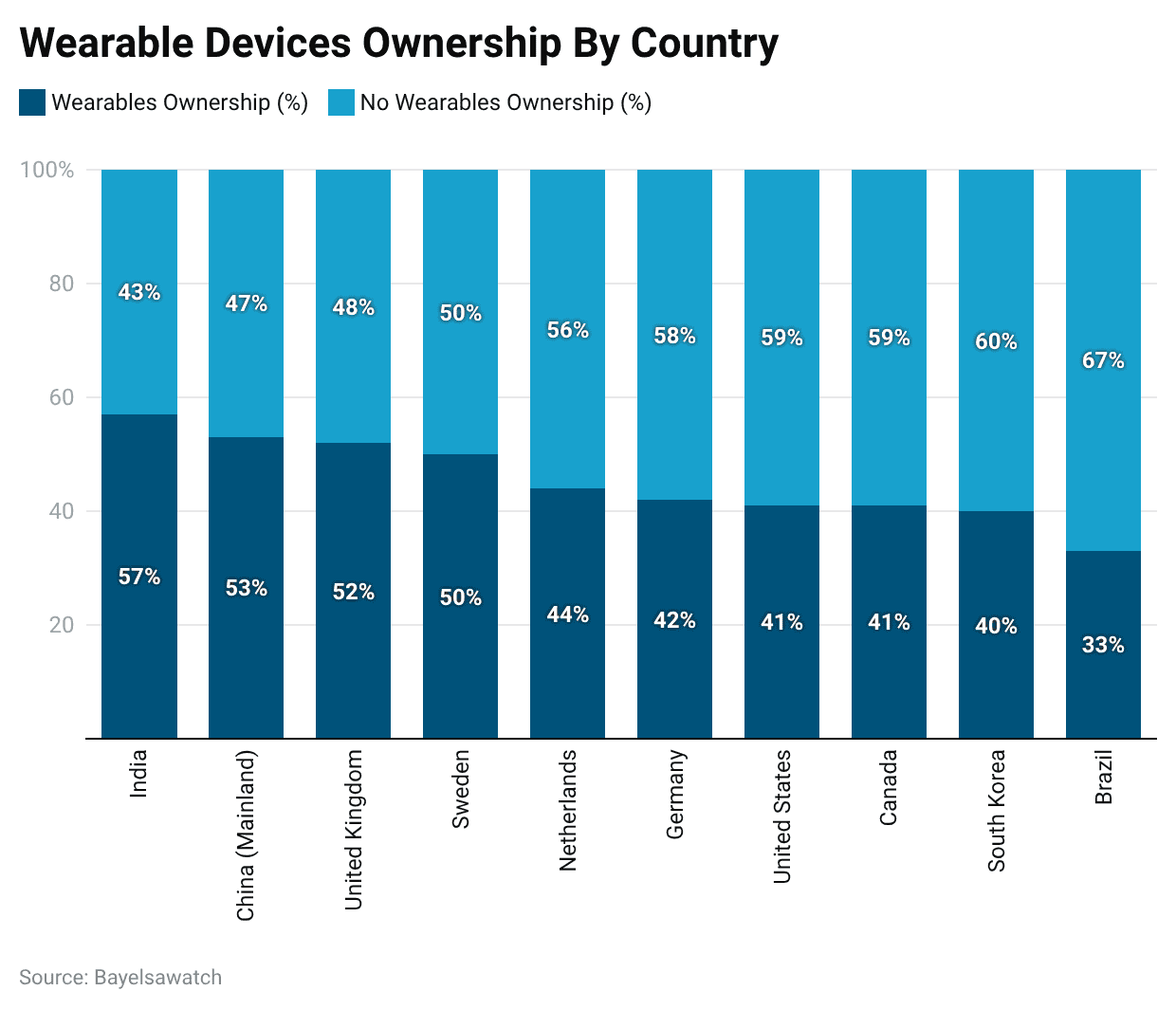
- Wearable ownership is highest in India (57% vs 43%), China (Mainland) (53% vs 47%), and the United Kingdom (52% vs 48%).
- Sweden shows an even split, with 50% of people owning wearables and 50% not.
- The Netherlands has mid-level adoption, with 44% of people owning wearables and 56% not.
- Germany also shows mid-level adoption, with 42% owning wearables and 58% not owning them.
- The United States and Canada are tied at a lower level, with 41% of people owning wearables and 59% not owning them in both countries.
- South Korea and Brazil have the lowest adoption, with South Korea at 40% owning vs 60% not owning, and Brazil at 33% owning vs 67% not owning.
Utilisation Of Wearable Technology By Age Group
- According to Market.us Scoop, among people aged 18-34, 10.20% say they use wearable technology, while 16.58% say they do not.
- Wearable adoption declines with age: 35-49 at 9.32% users vs 17.18% non-users, and 50-64 at 7.93% users vs 22.84% non-users.
- This gap continues at older ages, with 65-74 at 2.00% users vs 8.47% non-users and ≥75 at 0.80% users vs 4.68% non-users.
Adoption Of Wearable Technology By Gender
- Women are more likely to use wearables: 16.41% said “Yes” and 34.25% said “No.”
- Men are less likely to use wearables: 13.54% said “Yes” and 35.80% said “No.”
By Education
| Education level | Yes | No |
| At least a college graduate | 12.85% | 19.21% |
| Some college | 12.75% | 28.54% |
| High school | 3.49% | 18.24% |
| Less than high school | 0.78% | 4.14% |
Wearables Device Unit Shipments
- Market.us Scoop report estimated that the global wearable device shipments will reach 972.23 million units by 2026.
- Market.us data shows that smartwatches rank second in wearables, with shipments rising and 2029 revenue projected above USD 80 billion.
- IDC reported that smartwatch shipments dropped by roughly 3% in 2024, before rebounding with nearly 5% growth in 2025.
Wearable Device Shipments And Market Share By Category
- In 2027, total wearable device shipments are projected at 644.5 million units, led by earwear at 404.0 million units (62.7%) and smartwatches at 205.3 million units (31.9%).
- In the same period, wristbands are forecast at 31.7 million units (4.9%), while other wearables are expected to total 3.5 million units (0.5%).
By Product Category

(Reference: market.us)
- In 2026, earwear is expected to ship 382.40 million units (382,400 in 1,000s), taking 39.33% of total wearable shipments.
- Clothing wearables are forecast at 358.46 million units (358,460 in 1,000s), accounting for 36.87% of total shipments.
- Smartwatches are projected to reach 196.66 million units (196,660 in 1,000s), representing 20.23% of total shipments.
- Wristbands are estimated at 29.79 million units (29,790 in 1,000s), equal to 3.06% of total shipments.
- Rings are forecast at 2.72 million units (2,720 in 1,000s), contributing 0.28% of total shipments.
- Smart glasses are expected to ship 1.89 million units (1,890 in 1,000s), making up 0.19% of total shipments.
- Other wearable categories are projected at 0.31 million units (310 in 1,000s), which is 0.03% of total shipments.
Key Purchase Drivers And Buying Preferences For Wearable Devices
- Market Biz report further stated that health and fitness remain the main reasons people buy wearables, with 70% of consumers prioritising features such as ECG, blood oxygen saturation tracking, and heart monitoring.
- Everyday usability also matters, as 25% of buyers are influenced by features such as alerts, tap-to-pay, and voice control.
- E-commerce leads the sales mix at 60% of purchases, which is 20% higher than in-store retail at 40% (about 1.5 times larger).
- Trust is a clear barrier, with 45% of consumers worried about the safety of their personal and health information.
- Power performance is still a key decision factor, with 30% of users favouring devices that last longer between charges.
Consumer Response To Wearable Technology
- In McKinsey’s wellness survey, about one-third of current wearable users said they use their devices more often than they did a year ago.
- Across all respondents, more than 75% said they are open to using a wearable device in the future.
- Data privacy is a key condition, with 30% of consumers saying they would use wearables only if biometric data stays private.
- Gartner’s consumer tracking suggests that device drop-off remains meaningful, with smartwatch and fitness-tracker abandonment rates historically at around 29%-30%.
- In early-adopter markets such as the United States, the United Kingdom, and Australia, smartwatch adoption was around 7%-12% at the time of measurement.
- National Library of Medicine findings indicate that roughly 30% of Americans use some form of wearable medical technology.
Industry Impact Of Wearable Technology Trends And Future Outlook
- In healthcare-focused wearables, wearable medical devices alone are projected to reach USD 117.41 billion in 2026, indicating strong demand from clinical and remote-monitoring use cases.
- On the technology side, newer wearable chips are targeting efficiency gains, including up to 40% lower GPS power consumption and up to 30% longer battery life, thereby improving product performance and adoption.
- From a sustainability perspective, only 22% of global e-waste is recycled, so rising wearable volumes can put pressure on recycling systems and compliance efforts.
(Reference: market.biz)
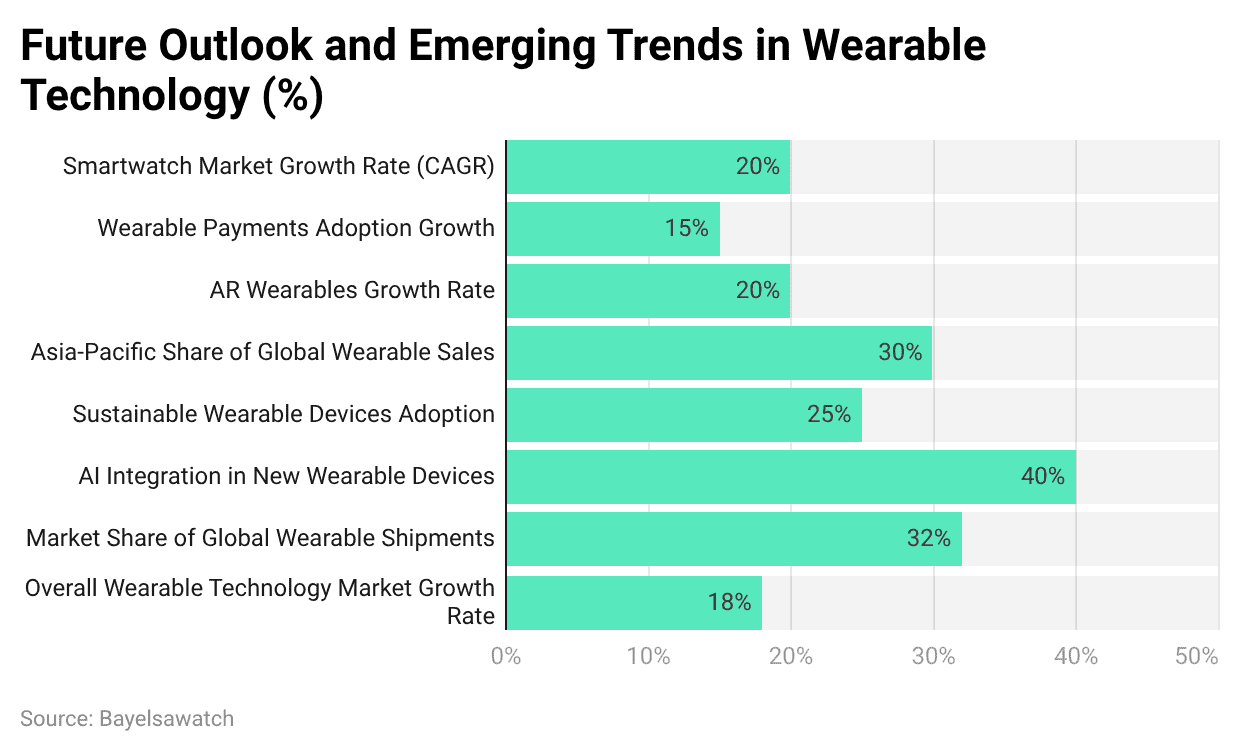
- AI features have moved into the mainstream, with roughly 40% of newly launched wearables in 2026 including AI-enabled functions.
- Sustainability became a stronger design priority, with 25% of current wearables utilising eco-friendly materials.
- Asia-Pacific is forecast to account for nearly 30% of global wearable sales by 2026.
- AR wearables are expected to expand by about 20%.
- Wearable payments are projected to gain traction, with adoption expected to rise from 15% to 20% of global consumers by 2026 as contactless use cases spread.
- The global smartwatch market is projected to grow at a 19.5% CAGR from 2021 to 2028, and wearable health and fitness devices are expected to reach USD 75 billion by 2026.
Conclusion
Wearable technology is no longer just a trend. It is now useful in daily life. It helps us
track health, stay connected, and work smarter. As sensors improve and devices get
lighter and more comfortable, wearables will support early health checks, safer
workplaces, and better fitness plans. But this progress must be safe.
Companies and Governments should protect user data, improve security, and use technology fairly. If Privacy is respected and innovation is responsible, wearables can guide people to make better choices and live healthier, more informed lives every day.
FAQ
Wearables use sensors to collect body data and send it to apps via Bluetooth/Wi-Fi.
Common wearables include smartwatches, fitness bands, smart rings, smart earbuds, smart glasses, VR headsets, and medical monitors.
Wearables are used for tracking health and fitness, receiving alerts, navigation,
payments, and safety monitoring.

Sources