








Introduction
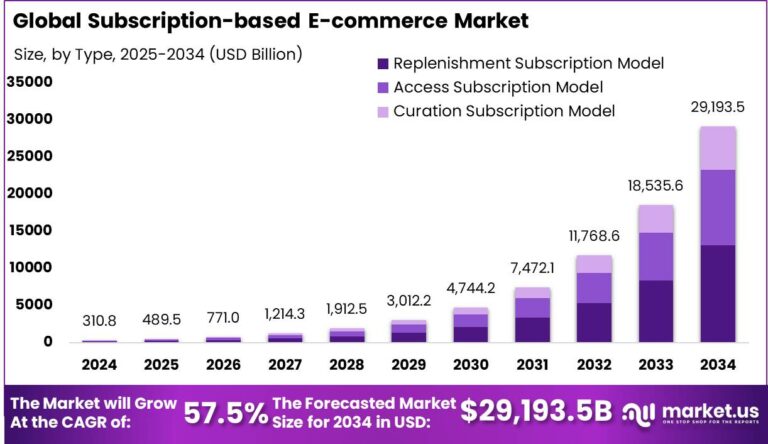
The Global Subscription-based E-commerce Market is projected to reach USD 29,193.5 Billion by 2034, rising from USD 310.8 Billion in 2024, at a CAGR of 57.50% during 2025–2034.
This strong growth is driven by increasing consumer preference for convenience, personalized shopping experiences, and recurring delivery models. Businesses are rapidly shifting toward subscription frameworks to secure predictable revenue and improve customer retention.
Get lastest insights and updates at @ https://market.us/report/subscription-based-e-commerce-market/request-sample/
Market Overview
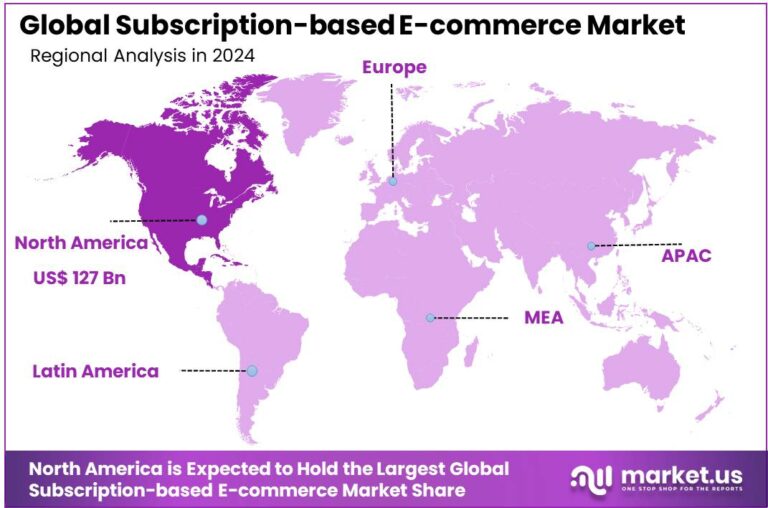
According to Market.us, the subscription-based e-commerce market is undergoing a transformative expansion, fueled by changing consumer buying behavior and the rapid adoption of digital commerce platforms. In 2024, North America emerged as the dominant region, accounting for more than 41% share and generating approximately USD 127 billion in revenue.
The US alone contributed nearly USD 119.5 billion, supported by strong digital infrastructure and widespread subscription adoption across retail categories. The market is increasingly shaped by demand for automated purchasing, curated product experiences, and seamless digital payments, positioning subscription commerce as a core pillar of modern retail ecosystems.
The surge in recurring revenue models reflects a broader shift toward customer lifetime value strategies. Companies are prioritizing long-term engagement rather than one-time transactions, leading to deeper customer relationships and higher retention rates. Subscription commerce is also benefiting from advancements in logistics, payment automation, and consumer data analytics, which collectively enhance service efficiency and personalization.
Key Takeaways
- Global Market Size 2024: USD 310.8 Billion
- Forecast Market Size 2034: USD 29,193.5 Billion
- CAGR (2025–2034): 57.50%
- North America Share (2024): 41%+
- North America Revenue (2024): USD 127 Billion
- US Market Value (2024): USD 119.5 Billion
- US CAGR: 52.8%
- Dominant Model: Replenishment Subscription Model (45%+)
- Leading Application Segment: Food & Beverage (30%+)
Connect with expert @ [email protected]
Report Scope
| Report Features | Description |
|---|---|
| Market Value (2024) | USD 310.8 Bn |
| Forecast Revenue (2034) | USD 29,193.5 Bn |
| CAGR (2025-2034) | 57.5% |
| Base Year for Estimation | 2024 |
| Historic Period | 2020-2023 |
| Forecast Period | 2025-2034 |
| Report Coverage | Revenue forecast, AI impact on market trends, Share Insights, Company ranking, competitive landscape, Recent Developments, Market Dynamics and Emerging Trends |
| Segments Covered | By Type (Access Subscription Model, Replenishment Subscription Model, Curation Subscription Model), By Product (Food & Beverage, Beauty & Personal Care, Health & Wellness, Fashion & Apparel, Entertainment & Media, Others) |
| Regional Analysis | North America – US, Canada; Europe – Germany, France, The UK, Spain, Italy, Russia, Netherlands, Rest of Europe; Asia Pacific – China, Japan, South Korea, India, New Zealand, Singapore, Thailand, Vietnam, Rest of APAC; Latin America – Brazil, Mexico, Rest of Latin America; Middle East & Africa – South Africa, Saudi Arabia, UAE, Rest of MEA |
| Competitive Landscape | Amazon.com Inc., Blue Apron Holdings, Dollar Shave Club, Farmhouse Delivery, Netflix Inc., Personalized Beauty Discovery Inc., HelloFresh, Stitch Fix, BarkBox, Ipsy, FabFitFun, The Honest Company, Other Key Players |
| Customization Scope | Customization for segments, region/country-level will be provided. Moreover, additional customization can be done based on the requirements. |
| Purchase Options | We have three license to opt for: Single User License, Multi-User License (Up to 5 Users), Corporate Use License (Unlimited User and Printable PDF) |
How AI is Reshaping the Future of the Subscription-based E-commerce Market?
Artificial intelligence is playing a critical role in redefining subscription-based commerce by enabling highly personalized and predictive customer experiences. AI-driven recommendation engines analyze user behavior, purchase history, and browsing patterns to deliver tailored product suggestions, improving customer satisfaction and retention.
Retailers are increasingly using AI to optimize subscription cycles. Predictive analytics allows companies to anticipate when customers need replenishment, reducing churn and enhancing convenience. For example, AI systems can identify consumption patterns and automatically adjust delivery schedules, creating a frictionless experience for users.
AI is also transforming inventory management and demand forecasting. By analyzing real-time data, businesses can better align stock levels with subscriber demand, minimizing waste and improving operational efficiency. In addition, AI-powered chatbots and virtual assistants are enhancing customer service by providing instant support, managing subscriptions, and resolving queries.
Another important application is dynamic pricing and offer optimization. AI tools enable companies to adjust subscription pricing based on user behavior, loyalty, and engagement levels. This approach helps maximize revenue while maintaining customer satisfaction.
Overall, AI is shifting subscription-based e-commerce from a static model to a highly adaptive ecosystem, where businesses continuously refine offerings based on real-time insights.
Segmentation Deep Dive
By Type
The replenishment subscription model dominates the market, accounting for over 45% share in 2024. This dominance is driven by its practicality and consistent demand across everyday consumer goods. Customers prefer automatic delivery of essential items such as groceries, personal care products, and household supplies, reducing the need for repeated purchases.
Curation-based subscriptions are also gaining traction, particularly in lifestyle and fashion segments. These models offer personalized product selections, creating a sense of discovery and enhancing customer engagement. However, they require advanced data analytics and strong brand positioning to maintain relevance.
Access-based subscriptions, which provide exclusive benefits or services, are expanding in digital platforms and premium product categories. These models appeal to consumers seeking convenience, exclusivity, and value-added services.
By Application
The food and beverage segment leads the market, holding over 30% share in 2024. This growth is driven by rising demand for convenience, health-focused products, and direct-to-consumer delivery models. Subscription services for meal kits, organic produce, and specialty beverages are becoming increasingly popular among urban consumers.
Personal care and grooming products also represent a significant segment, supported by recurring demand and brand loyalty. Subscription models in this category often focus on customization and routine-based consumption, making them highly suitable for recurring purchases.
The apparel and fashion segment is witnessing growth through curated subscription boxes and rental services. These models cater to consumers seeking variety and affordability without committing to full ownership.
Other applications, including entertainment, pet care, and digital services, are also contributing to market expansion, reflecting the versatility of subscription-based models across industries.
By End-User
Individual consumers represent the largest end-user segment, driven by the increasing adoption of online shopping and digital payment systems. The convenience of automated deliveries and personalized offerings is encouraging more consumers to subscribe to recurring services.
Small and medium-sized enterprises are also adopting subscription models to enhance customer engagement and generate stable revenue streams. These businesses benefit from predictable income and improved demand forecasting.
Large enterprises are leveraging subscription commerce to diversify revenue channels and strengthen brand loyalty. They are investing heavily in technology and logistics to scale their subscription offerings and compete in a rapidly evolving market.
Regional Analysis
North America continues to lead the subscription-based e-commerce market, capturing more than 41% share in 2024. This dominance is supported by high digital penetration, strong consumer purchasing power, and widespread acceptance of subscription services. The region benefits from advanced logistics networks and seamless payment systems, which enable efficient delivery and customer experience.
The US market plays a central role in this growth, driven by a mature e-commerce ecosystem and a strong culture of convenience-driven consumption. Consumers in the region are highly receptive to subscription models across categories such as food, personal care, and digital services.
Additionally, the presence of major e-commerce platforms and technology providers in North America accelerates innovation and adoption. Companies in the region are continuously introducing new subscription models and enhancing personalization through data-driven strategies.
Market Leaders
- Amazon.com Inc.
- Walmart Inc.
- Dollar Shave Club
- Blue Apron Holdings Inc.
- HelloFresh SE
- Netflix Inc.
- Spotify Technology S.A.
- Birchbox Inc.
- FabFitFun
- Chewy Inc.
Recent Developments
- In 2024, Amazon expanded its Subscribe & Save program by integrating AI-driven recommendations to enhance customer retention.
- Walmart introduced new subscription benefits under its membership platform, focusing on grocery delivery and exclusive discounts.
- HelloFresh continued its global expansion in 2023 by entering new regional markets and enhancing meal customization options.
- Dollar Shave Club strengthened its product portfolio by launching new grooming products tailored for subscription customers.
- Chewy enhanced its auto-ship subscription service with improved personalization features for pet owners in 2024.
Conclusion
The subscription-based e-commerce market is entering a phase of rapid and sustained expansion, driven by evolving consumer expectations and technological advancements. The strong growth trajectory reflects a fundamental shift in how consumers engage with brands, favoring convenience, personalization, and long-term value.
Businesses that effectively leverage data analytics, AI, and customer-centric strategies are expected to gain a competitive edge in this dynamic landscape. As subscription models continue to expand across industries, the market presents significant opportunities for innovation, investment, and sustained revenue growth.