










Introduction
Smart Ring Statistics: Smart rings are small wearable devices that track your health, including heart rate, sleep, and daily activity, all from your finger. Unlike bulky smartwatches, they are light, stylish, and easy to wear all day. The demand for smart rings is growing fast as more people focus on health and fitness. Big tech brands are also entering this space, making these devices more popular than ever.
This article shares key statistics on smart rings, including market growth, user trends, and how they are changing the future of wearable technology.
Editor’s Choice
- As of 2026, the smart rings market is on an upward trajectory, surpassing USD 307.9 million.
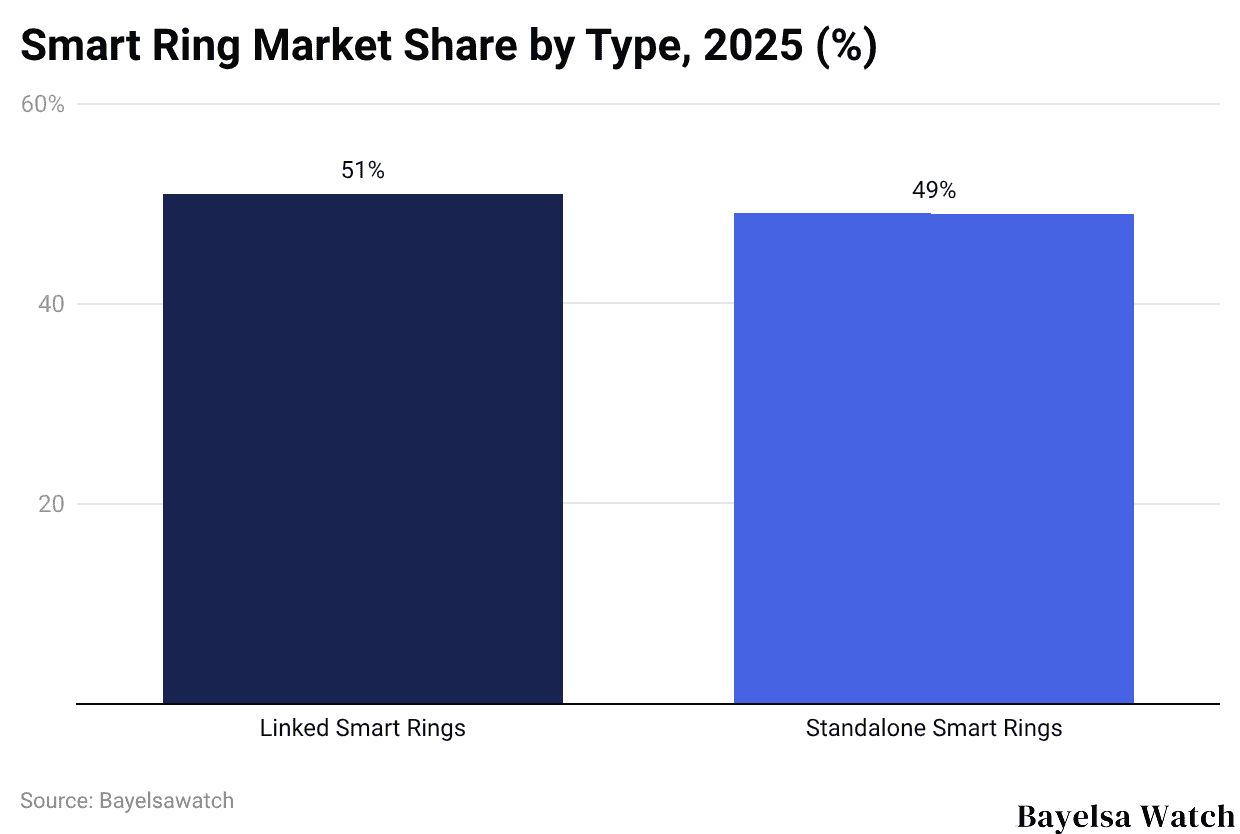
- In 2025, the linked smart rings segment dominated the market at 51%, while standalone smart rings accounted for 49%.
- According to Wi-Fi Talents, 76% of smart ring users wear their devices primarily to track sleep.
- 15% of users stop wearing their smart ring within the first 6 months.
- In 2026, 55% of users are willing to pay for a monthly subscription to advanced health insights.
- About 55% of smart ring users are male, while 45% are female.
- The largest group of smart ring users is aged 25-44, accounting for 50% of the total users.
- The United States alone is projected to reach USD 137 million by 2026.
- Oura Health (Oura Ring) sales are forecasted to reach USD 1.5-2 billion.
- A report by Byteiota found that wearable ring shipments are rising much faster than wrist wearables, with units expected to exceed 8 million by 2026.
Smart Ring Market Size

(Source: marketresearch.biz)
- As of 2026, the smart rings market is on an upward trajectory, surpassing USD 307.9 million.
- By the end of the forecast period in 2033, the global smart rings market is projected to reach USD 1,427.9 million.
- The market will grow at a CAGR of 26% from 2023 to 2033.
Segmental Analyses
(Reference: precedenceresearch.com)
- In 2025, the linked smart rings segment dominated the market at 51%, while standalone smart rings accounted for 49%.
- Furthermore, Android-compatible smart rings led the market with 40%, followed by iOS-compatible (35%), Windows Phone-compatible (5%), and Compatible systems (20%).
- According to Precedence Research, in 2025, North America led the smart rings market, capturing around 39% of the market.
- In 2025, the Bluetooth-enabled segment led the global market with a 68% share, while the NFC-enabled segment accounted for 32%.
- Meanwhile, health and wellness monitoring dominated applications at 50%.
Smart Ring User Statistics
- According to Wi-Fi Talents, 76% of smart ring users wear their devices primarily to track sleep.
- 60% of users prefer smart rings over smartwatches for sleep tracking because they are more comfortable.
- On average, smart ring users check their health data 4 times per day.
- Female users account for 55% of growth in the smart ring market.
- Around 45% of users rely on smart rings to manage stress using HRV (heart rate variability) data.
- Smart ring owners are 30% more likely to keep a consistent sleep schedule.
- 25% of buyers are purchasing a wearable for the first time.
- 70% of users prioritize battery life longer than 4 days.
- Fitness tracking is the second most-used feature, with 68% of users engaging regularly.
- About 40% of users in supported regions use smart rings for contactless payments.
- Remote patient monitoring with smart rings has increased by 20% in clinical trials.
- Menstrual cycle tracking is used by 85% of female Oura users.
- Users of smart rings report a 12% increase in daily step counts, and 10% of professional athletes use them to monitor recovery.
- Around 30% of consumers prefer smart rings over watches for their discreet design.
- In 2026, 55% of users are willing to pay for a monthly subscription to advanced health insights.
- 90% of users rely on skin temperature sensors for health alerts, and 50% of consumers integrate smart ring data with Apple Health or Google Fit.
By Demographics

(Source: grandviewresearch.com)
- About 55% of smart ring users are male, while 45% are female.
- The largest group of smart ring users is aged 25-44, accounting for 50% of the total users.
- Moreover, users aged 45 and older account for 30%, while those aged 18-24 account for 20%.
Usage Trends
- According to aabo.in, by 2025, approximately 35.9% of smart ring use is for health and wellness, including tracking heart rate, sleep, stress, and daily activity.
- Across all wearables, around 75% of consumers report that health and fitness tracking is a key reason for buying the device.
- Strategic Market Research stated that individual consumers and professionals make up about 45.89% of the smart ring market by 2026. They use smart rings for personal fitness, athletic performance, and productivity monitoring.
- Companies and institutions are increasingly using smart rings for biometric authentication, secure access control, and identification, though this remains a smaller share compared with personal health applications.
Smart Ring Regional Outlook
- Fortune Business Insights further stated that in 2025, North America contributed approximately USD 190 million to the global smart ring market, accounting for about 45% of the total. This is expected to grow to approximately USD 238 million in 2026.
- The United States alone is projected to reach USD 137 million by 2026.
- Europe’s smart ring market is estimated to reach USD 75 million in 2026.
- The United Kingdom is expected to generate around USD 25 million, accounting for roughly 7% of the global market. Germany’s market is projected at USD 19 million.
- The Asia-Pacific region is forecast to reach USD 155 million in 2026.
- Japan’s smart ring market is estimated at USD 15 million, while China is projected to reach USD 57 million, making it one of the largest in the world.
- India’s market is expected to be around USD 42 million.
- The Middle East and Africa are projected to reach USD 33 million in 2026, and Latin America is projected to reach around USD 18 million.
Top Smart Ring Brands Statistics
Oura Health (Oura Ring)
- According to a BusinessWire report, Oura is the global leader, having sold over 5.5 million rings since 2015.
- In 2024, revenue surpassed USD 500 million; in 2025, sales reached USD 1 billion, with a 2026 forecast of USD 1.5-2 billion.
- It holds more than two-thirds of the smart ring market and serves customers in 150+ countries, with 4,000+ retail locations.
- Oura launched its AI Knowledge Boost and Women’s Health AI in February 2026.
Ultrahuman (Ring AIR)
- Ultrahuman generated USD 64 million in revenue in 2025, a 5.4x increase from 2024, with USD 8.2 million in net profit.
- Its smart rings accounted for 91.3% of revenue.
- Techcrunch reported that it has 700,000 daily active users.
- Following a successful Series B in 2024, Ultrahuman saw hyper-growth in 2025, accounting for an estimated 9-10% global market share.
Samsung Electronics (Galaxy Ring)
- According to SamMobile, Samsung launched the Galaxy Ring in 2024 and quickly produced over 1 million units.
- North America contributed USD 188.1 million to the market in 2025, according to a report by Fortune Business Insights.
- The ring integrates with Samsung Health, offers 6-7-day battery life, and is part of a top-5 market-share group.
RingConn
- Vertu’s report further stated that this Chinese brand offers advanced health tracking with no subscription fee, up to 10 days of battery life, and IP68 water resistance.
- It competes in the mid-range segment alongside Ultrahuman and is among the top 5 global players.
Noise (Luna Ring)
- Fortune Business Insights reported that India-based Noise leads in the domestic market, with affordable smart rings that track sleep, heart rate, and activity.
- India’s smart ring market is projected at USD 42 million in 2026, with Noise competing against Ultrahuman (48.4% market share) and Pi Ring (27.5%).
Brand Comparison Table
| Brand & Model | Approximate Price (USD) | Battery Life | Key Features |
| Oura Ring 4 | 349-499+ | Up to 7 days | Holistic wellness & recovery scores, sleep, HRV, body temperature, SpO2, readiness & recovery insights. |
| Ultrahuman Ring AIR | 349 | 6-7 days | Sleep & recovery tracking, heart rate, movement data. |
| Samsung Galaxy Ring | 399 | Health metrics via Samsung Health, gesture/energy scores, heart rate, SpO2. | |
| RingConn Gen 2 / Air | Gen 2 (299); Gen 2 Air (199) | Air (10 days); Gen 2 (12 days) | Heart rate, SpO2, sleep stages, stress levels, (Gen 2: sleep apnea). |
| Noise Luna Ring (Gen 2) | 329 | 6 days | Sleep tracking, heart rate, SpO2, step count, and activity tracking. |
Key Players In The Smart Ring Industry
Youhong Medical (Founded 2004, China)
- Youhong Medical manufactures mobile medical devices and smart wearables, including health-tracking rings.
- The company’s products also cover sleep monitoring, chronic disease detection, and rehabilitation devices.
- Youhong offers customized R&D, production, medical registration, and maintenance services, providing one‑stop solutions tailored to client needs.
Shenzhen EasyUs Technology (Founded 2017, China)
- EasyUs Technology specializes in ODM and OEM services for precision electronics.
- Its smart ring applications include overall health monitoring, sports tracking, sleep management, and women’s health features like menstrual cycle monitoring.
- EasyUs provides flexible production, collaborative development, and tailored solutions to meet diverse customer requirements.
Wuxi Yongxin Technology (Founded 2018, China)
- Yongxin Technology focuses on chip‑level solutions for the AIoT market.
- Using customized Chiplet chips and highly integrated packaging reduces Bill of Materials costs by 30% and improves product manufacturing yield by 20%.
- The company’s contributions include interactive smart rings and gesture-interaction technologies that support VR/AR glasses control, in‑car entertainment, and large-screen interaction.
Smart Rings Set To Outpace Smartwatches
- A report by Byteiota published that wearable ring shipments are rising much faster than wrist wearables, with units expected to jump from about 5 million in 2025 to over 8 million in 2026, far outpacing wrist device growth.
- Smart rings are expected to generate around USD 450 million in revenue in 2026 and are projected to exceed USD 3.5 billion by 2035.
- About 58% of wearable users now prefer smaller, less noticeable devices, such as rings, over traditional wrist-based wearables.
- Nearly 47% of users focus on tracking sleep and recovery, which smart rings excel at because they can be worn comfortably overnight.
- In 2025, 163 million smartwatches were shipped globally, compared to only 4.3 million smart rings, highlighting the current smaller but growing market for rings.
- Despite lower total shipments, rings are growing 8 times faster than wrist-based devices.
Medical Accuracy and FDA Clearance Landscape
| Device | Metric Validated | Accuracy Result | Regulatory Status |
| Wearable Ring | SpO₂ vs. SaO₂ | RMSE 1.8% (finger), 1.6% (fingertip) | Meets FDA & ISO standards |
| SOXAI Smart Ring | SpO₂ | RMSE 3.55% | Meets ISO; borderline FDA |
| Oura Ring Gen3 / Ring 4 | HRV vs. ECG | CCC = 0.99 | Consumer device (no FDA clearance) |
| Oura Ring (Brigham & Women’s / Sensors, 2024) | 4-stage sleep accuracy | 79% agreement with PSG | Consumer device; clinical-trial validated |
| Ultrahuman Ring Air + FibriCheck | AFib detection (PPG) | Sensitivity 91.86%, Specificity 97.59% | FDA-cleared FibriCheck algorithm |
| Movano EvieMED Ring | SpO₂ pulse oximetry | Exceeds FDA RMSE <3.5% threshold | FDA 510(k) cleared, Dec 2024 |
| Happy Ring (Happy Health) | SpO₂, HR, sleep, temperature, and brain activity. | Medical-grade with ML/AI platform | FDA cleared, Oct 2024 |
| RPM clinician adoption | Remote monitoring usage | 20%-81% from 2021 to 2023 | – |
Conclusion
Smart rings are becoming more popular every day. They are small, comfortable, and easy to use. People like them because they track health without being bulky. The numbers show fast growth and rising interest.
More companies are making better smart rings, adding new features. In the future, smart rings will play a big role in health tracking. They are a simple and smart way to stay aware of your health.
FAQ
A smart ring is a wearable device that tracks health, handles notifications, and handles payments.
Smart rings track heart rate, sleep, physical activity, body temperature, and stress levels.
Yes, they are lightweight, unobtrusive, and designed for comfortable daily wear.
With moderate daily use, the battery can last up to 18 hours.
Yes, smart rings pair with smartphones via Bluetooth to monitor health, notifications, and activity.

Sources