









Introduction
Nike Statistics: Nike is one of the most popular sports brands in the world, known for its simple Swoosh logo and powerful message, “Just Do It.” The company started in 1964 as a small shoe business and later became Nike. Over the years, it has grown into a global brand that manufactures shoes, apparel, and sports equipment. Nike focuses on new ideas, comfort, and style to help athletes perform better.
It works closely with high-profile athletes and teams, which builds strong trust among consumers. Today, Nike is not just about sportswear; it stands for confidence, hard work, and the courage to chase dreams.
Editor’s Choice
- In 2025, Nike’s full-year revenues were USD 46.3 billion, representing a 10% decline on a reported basis and a 9% decline on a currency-neutral basis.
- The footwear segment accounted for approximately 66% of Nike’s total revenue.
- In the year ended May 31, 2025, North American’s Nike generated USD 19,572 million in revenue, representing approximately 42% of total global sales.
- In the same period, Nike operated 1,034 retail stores worldwide, 11 fewer than the previous year.
- In 2025, Nike earned USD 25,883 million from sales to wholesale customers.
- Nike generated 57% of its revenue from markets outside the U.S. and 43% from the U.S.
- As of February 3, 2026, Nike’s total market capitalisation is approximately USD 87.995 billion.
- Nike’s logo and brand name are recognised by about 96% of U.S. consumers in 2025.
- Approximately 68% of Nike’s shares are held by institutional investors, underscoring significant institutional influence in the company.
- Nike achieved 96% renewable electricity in its owned global operations and aims to reach 100% by 2025.
About Nike
| Metrics | Details |
| Company Name | Nike, Inc. |
| Logo | The famous Swoosh logo has been used since 1971. |
| Main Office | Nike World Headquarters, Washington County, Oregon, USA. |
| Headquarters | Near Beaverton, Oregon, USA. |
| Founded | January 25, 1964 |
| Founders | Bill Bowerman and Phil Knight. |
| Key People | Philip Knight (Chairman Emeritus), Mark Parker (Executive Chairman), Elliott Hill (President & CEO), and John Hoke III (Chief Innovation Officer). |
| Original Name | Blue Ribbon Sports, Inc. (1964–1971). |
| Company Type | Public |
| Stock Info | NYSE: NKE (Class B), part of DJIA, S&P 100, and S&P 500. |
| ISIN | US6541061031 |
| Industry | Apparel, sports equipment, accessories. |
| Area Served | Worldwide |
| Products | Athletic shoes, sports clothes, sports gear, accessories. |
| Subsidiaries | Converse |
| Website | nike.com |
Key Takeaways
- Nike, Inc. is an American company that manufactures athletic shoes, apparel, and equipment. Its main office is near Beaverton, Oregon, USA.
- In 2022, Nike generated revenue of over USD 46 billion.
- The company was founded on January 25, 1964, as “Blue Ribbon Sports” by Bill Bowerman and Phil Knight and officially became Nike, Inc. on May 30, 1971.
- According to Wikipedia, as of 2024, Nike employed 83,700 people globally.
- In 2020, the Nike brand was valued at over USD 32 billion, making it the most valuable brand in the sports industry.
- In 2017, the Nike brand value was USD 29.6 billion.
- Nike ranked 89th in the 2018 Fortune 500 list, based on total revenue in the United States.
- In 2024, Nike ranked 239th on the Forbes Global 2000 list of the world’s largest companies.
Nike Financial Performance
- According to Nike’s investor report, Nike’s full-year revenues were USD 46.3 billion, representing a 10% decline on a reported basis and a 9% decline on a currency-neutral basis.
- In the fourth quarter, revenues were USD 11.1 billion, down 12% on a reported basis and down 11% on a currency-neutral basis.
- NIKE Direct revenues for the fourth quarter totalled USD 4.4 billion, declining 14% on both a reported and currency-neutral basis.
- Wholesale revenues for the fourth quarter were USD 6.4 billion, a 9% decrease on both reported and currency-neutral measures.
- Converse reported revenues of USD 357 million, declining 26% on both a reported and currency-neutral basis.
- The company’s gross margin for the fourth quarter fell 440 basis points to 40.3%.
- Diluted earnings per share (EPS) for the fourth quarter were USD 0.14, a decrease of 86%.
- Selling and administrative expenses increased by 1% to USD 4.1 billion.
- Demand-creation expenses increased by 15% to USD 1.3 billion.
- Operating overhead decreased 3% to USD 2.9 billion.
- The effective tax rate was 33.6%, up from 13.1% in the same quarter last year.
- Net income was USD 0.2 billion, down 86% compared to the prior year.
Global Revenue Of Nike Statistics
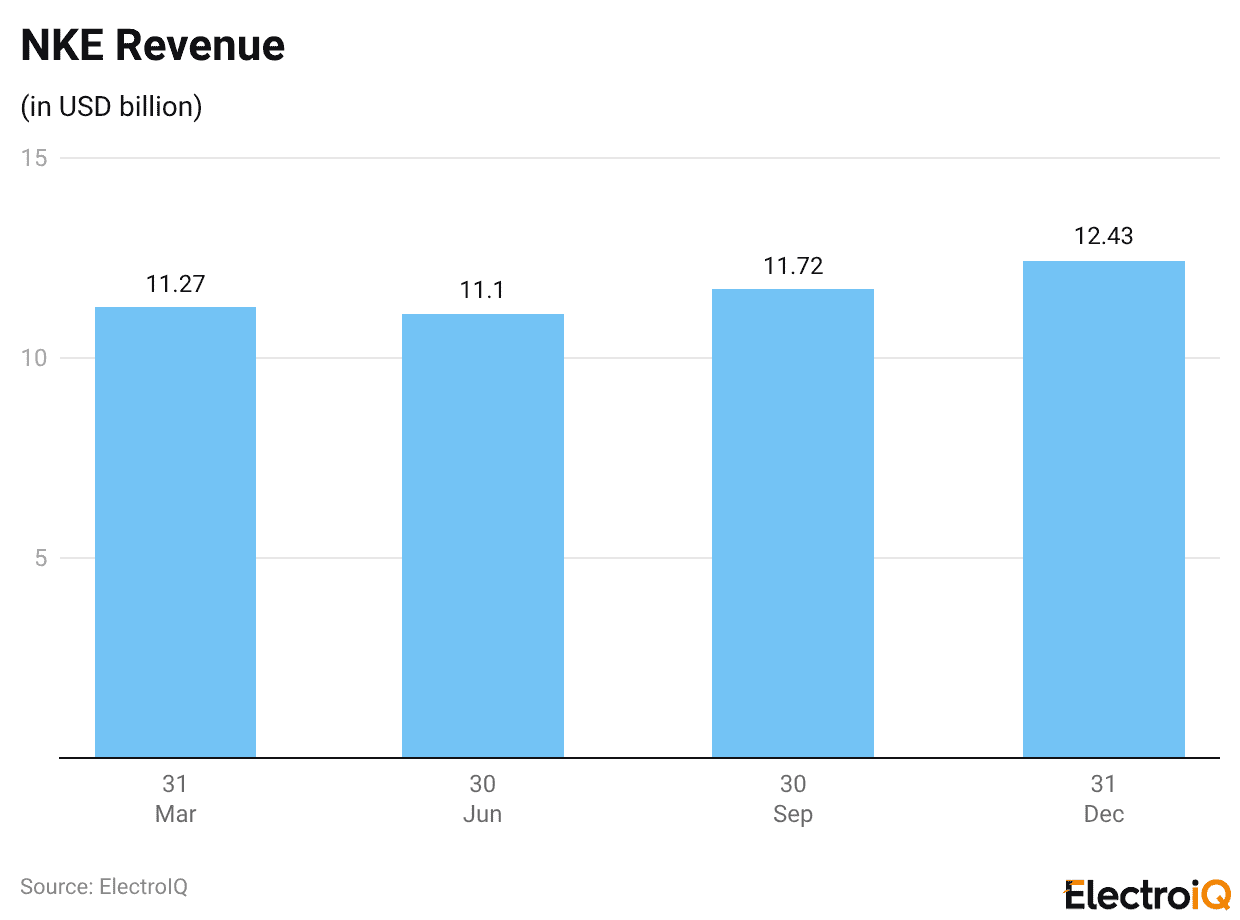
(Reference: financecharts.com)
- Q2 2025 (March 31, 2025): Nike reported revenue of USD 11.27 billion.
- Q3 2025 (June 30, 2025): Revenue slightly declined to USD 11.10 billion, reflecting a 1.5% decrease compared to the previous quarter.
- Q4 2025 (September 30, 2025): Revenue rebounded to USD 11.72 billion, marking a 5.7% increase from the prior quarter.
- Q1 2026 (December 31, 2025): Nike posted USD 12.43 billion in revenue, a 6.1% increase from the previous quarter.
By Products Share
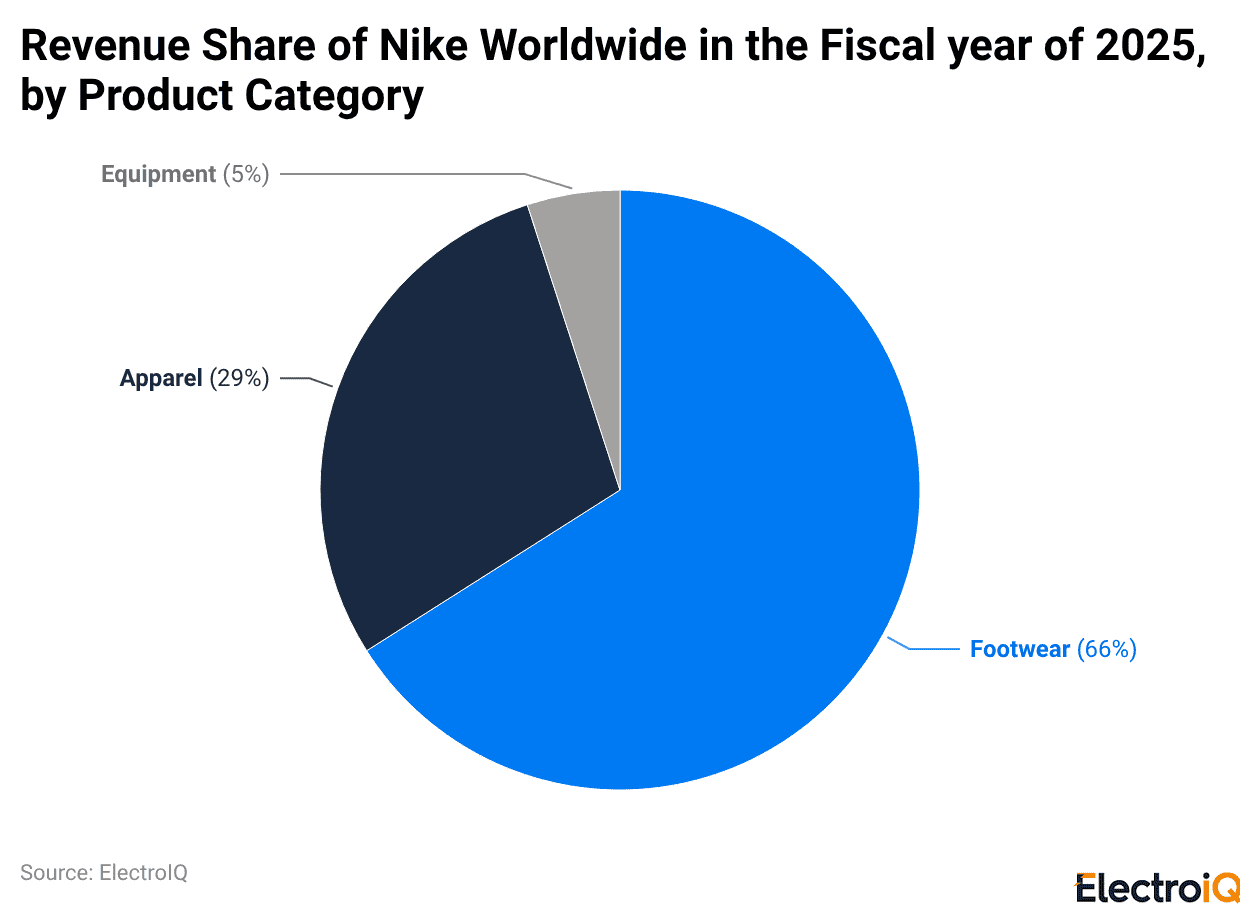
(Reference: statista.com)
- As of 2025, the footwear segment accounted for approximately 66% of Nike’s total revenue.
- Meanwhile, Nike’s revenue share from apparel and equipment was 29% and 5%, respectively.
By Region
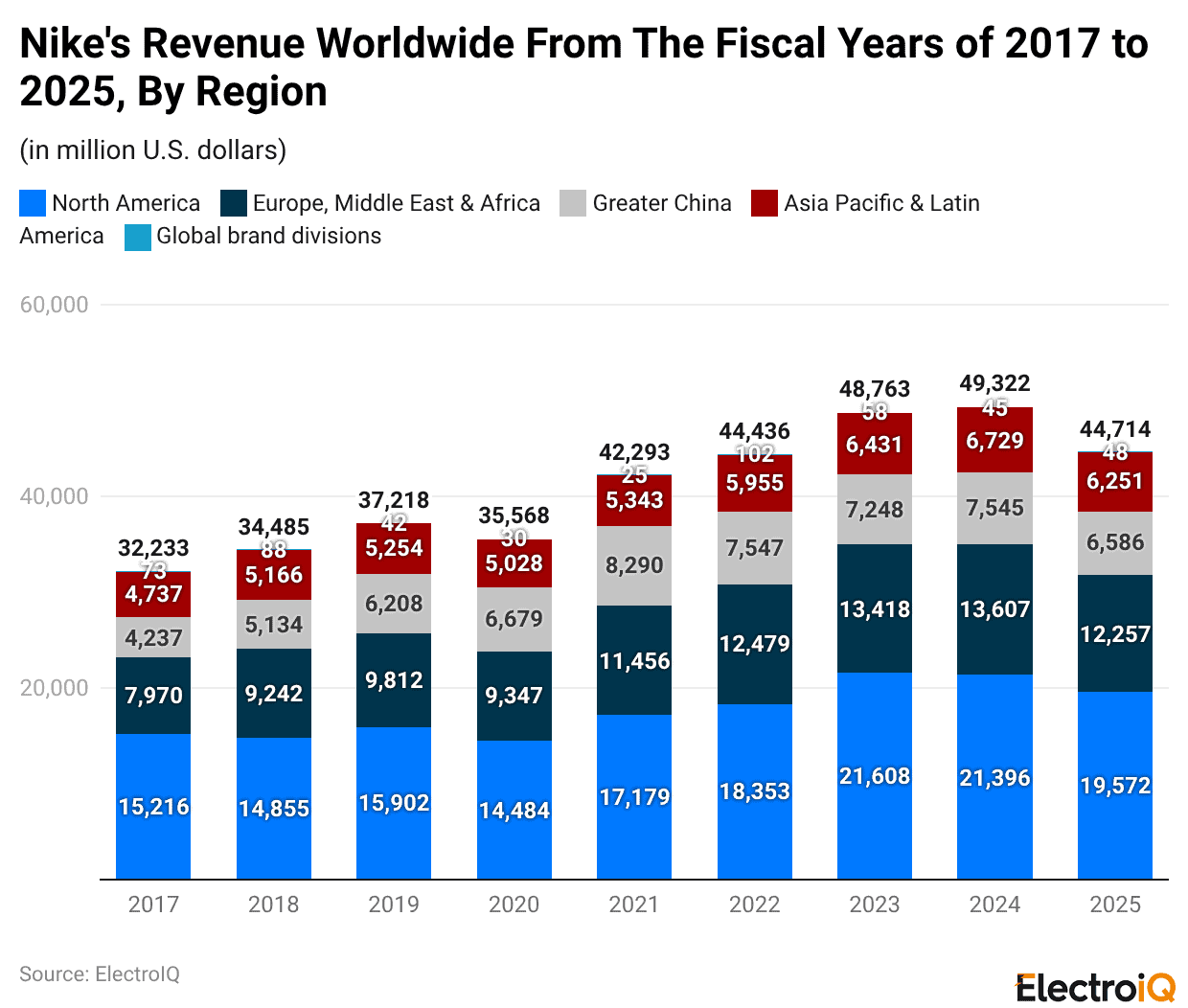
(Reference: statista.com)
- In the year ended May 31, 2025, North American’s Nike generated USD 19,572 million in revenue, representing approximately 42% of total global sales.
- Revenue from the Europe, Middle East, and Africa (EMEA) region was USD 12,257 million, accounting for around 26% of total sales.
- Nike earned USD 6,586 million in Greater China, accounting for approximately 14% of the company’s total revenue.
- Revenue from the Asia-Pacific and Latin America regions was USD 6,251 million, representing approximately 13% of total global sales.
Segmental Revenue In North America
(Reference: statista.com)
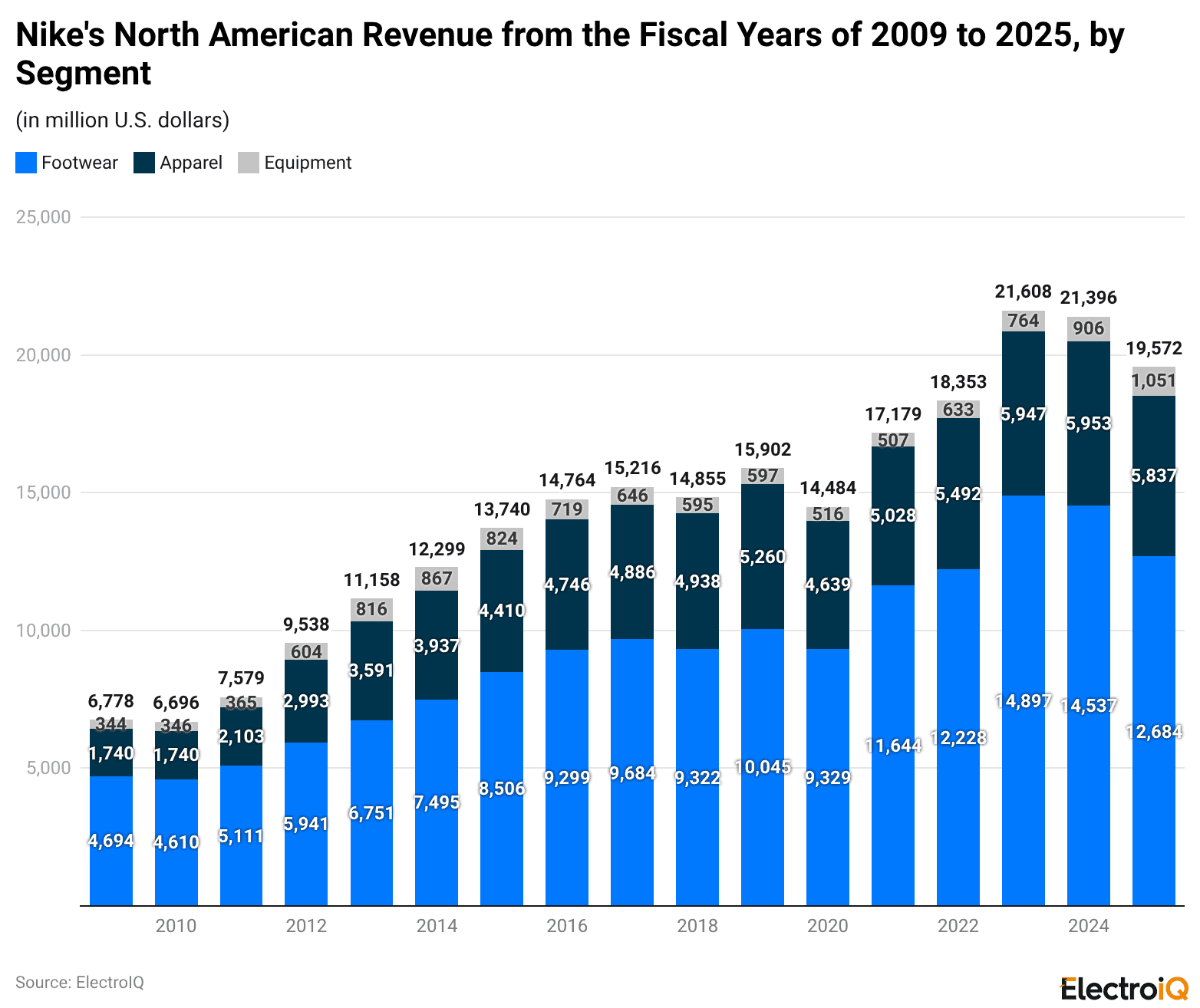
- In the year ended May 31, 2025, Nike’s North American footwear revenue totalled USD 12,684 million, making it the largest product category in the region, accounting for approximately 65% of North American revenue.
- North American apparel sales reached USD 5,837 million (30% of the region’s revenue), while equipment generated USD 1,051 million (5%).
In Europe, the Middle East and Africa (EMEA)
(Reference: statista.com)
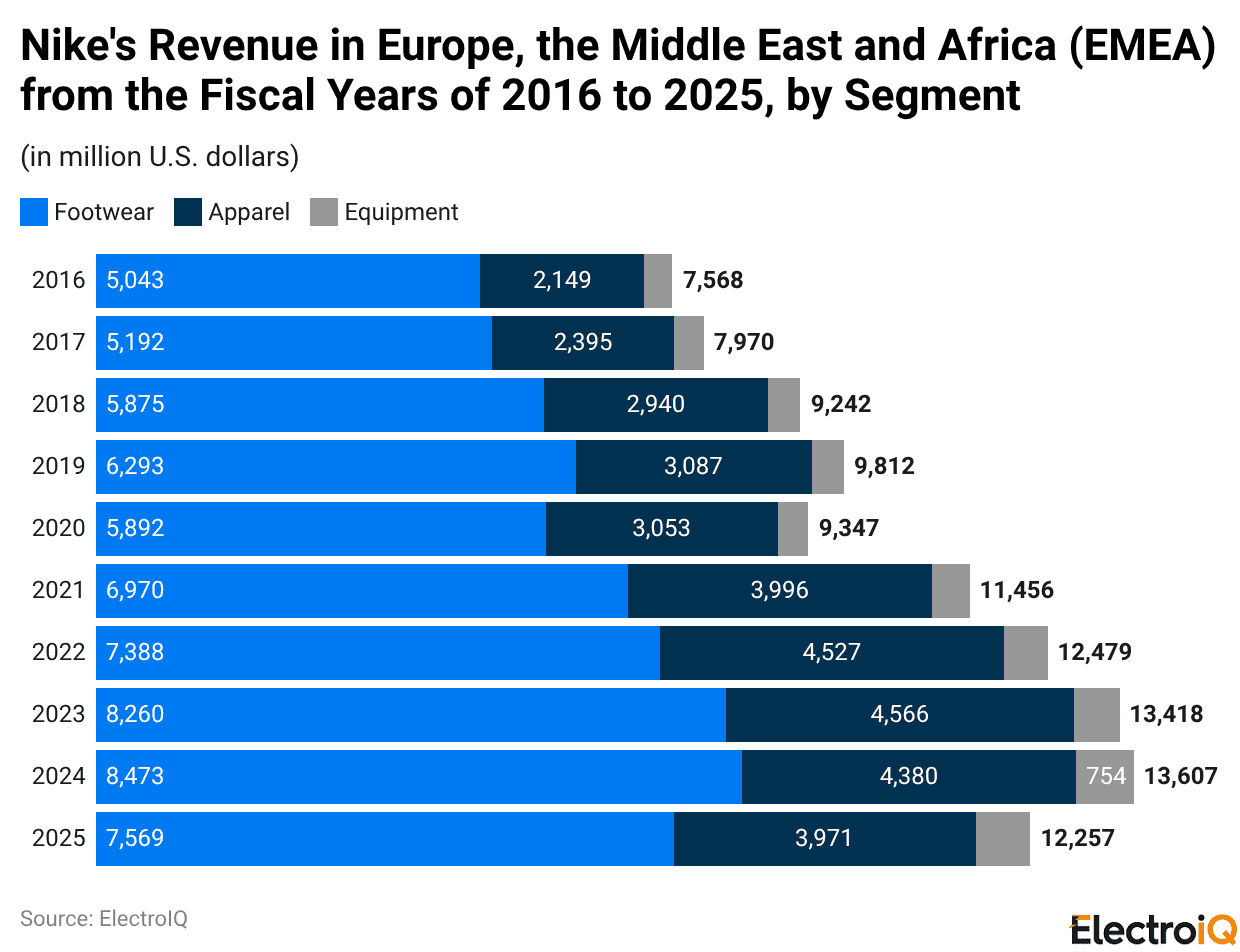
- In fiscal 2025, Nike generated approximately USD 7,569 million from footwear sales in the EMEA region, resulting in the largest product category at 62%.
- Revenue from apparel totalled USD 3,971 million (about 33% of the region’s sales), while equipment contributed USD 717 million (approximately 6%).
In Greater China
(Reference: statista.com)
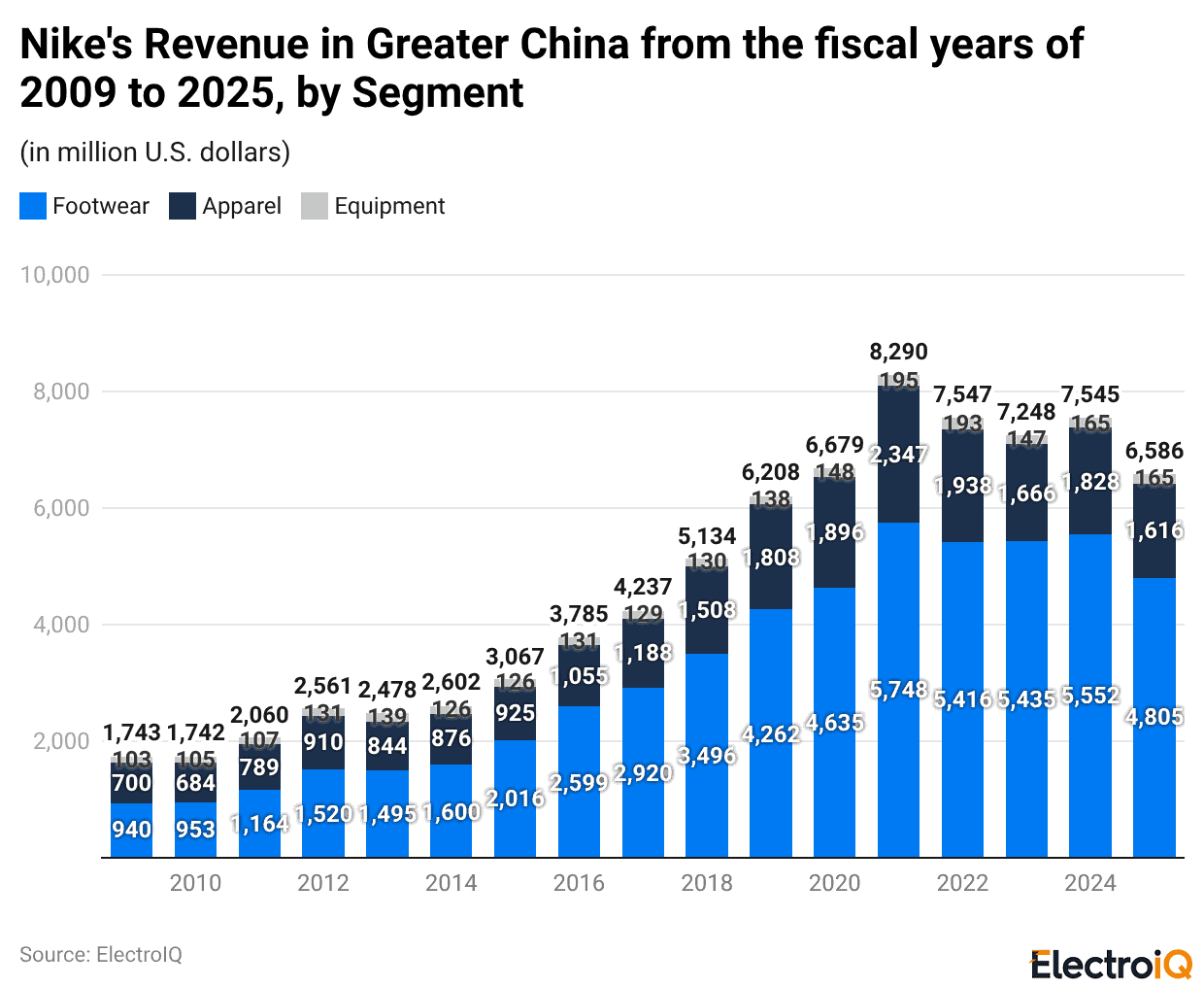
- As of 2025, Nike generated USD 4,805 million from footwear sales in Greater China, accounting for approximately 73% of the region’s total revenue.
- Revenue from apparel reached USD 1,616 million (25%), while equipment accounted for USD 165 million (2%) of Greater China’s total sales.
In Asia Pacific and Latin America
(Reference: statista.com)
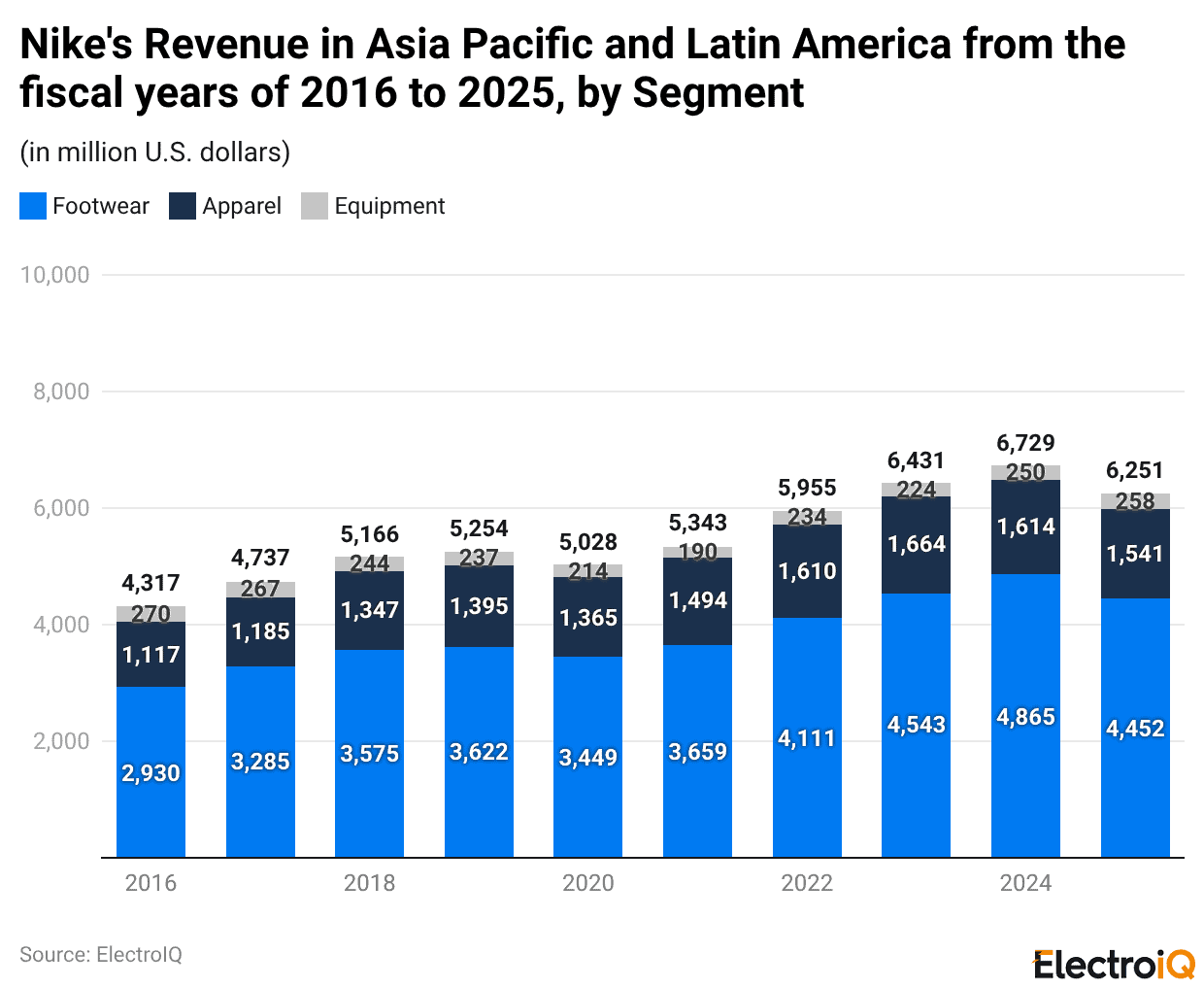
- In 2025, Nike generated USD 4,452 million in footwear revenue in the Asia-Pacific and Latin America region, accounting for 71% of the region’s total sales.
- Revenue from apparel reached USD 1,541 million (25% of regional sales), while equipment contributed USD 258 million (4%).
By Sales Channel
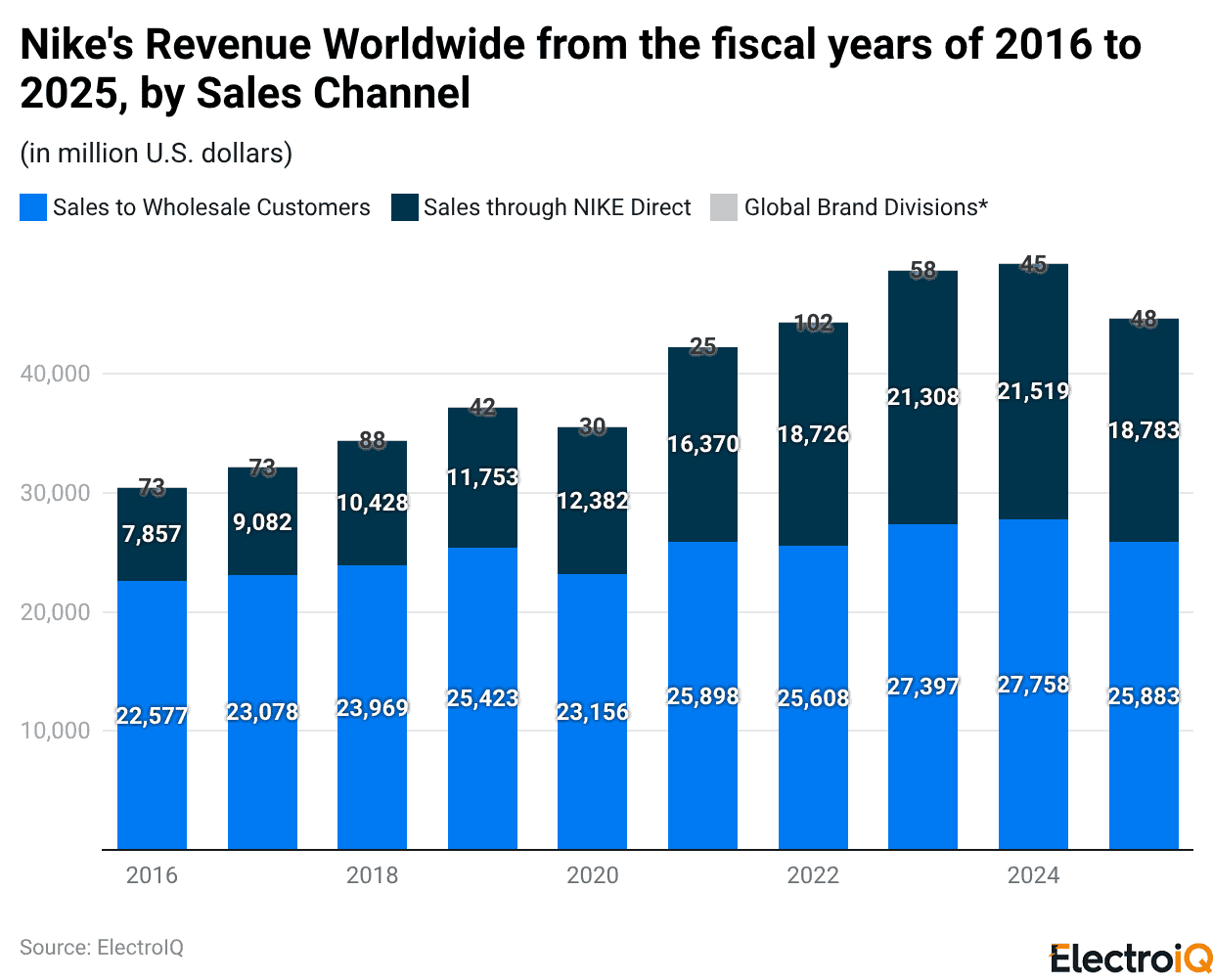
(Reference: statista.com)
- In 2025, Nike earned USD 25,883 million from sales to wholesale customers.
- Sales through Nike Direct accounted for approximately USD 18,783 million.
- The global brand division generated USD 48 million in revenue.
By Domestic Sales Share
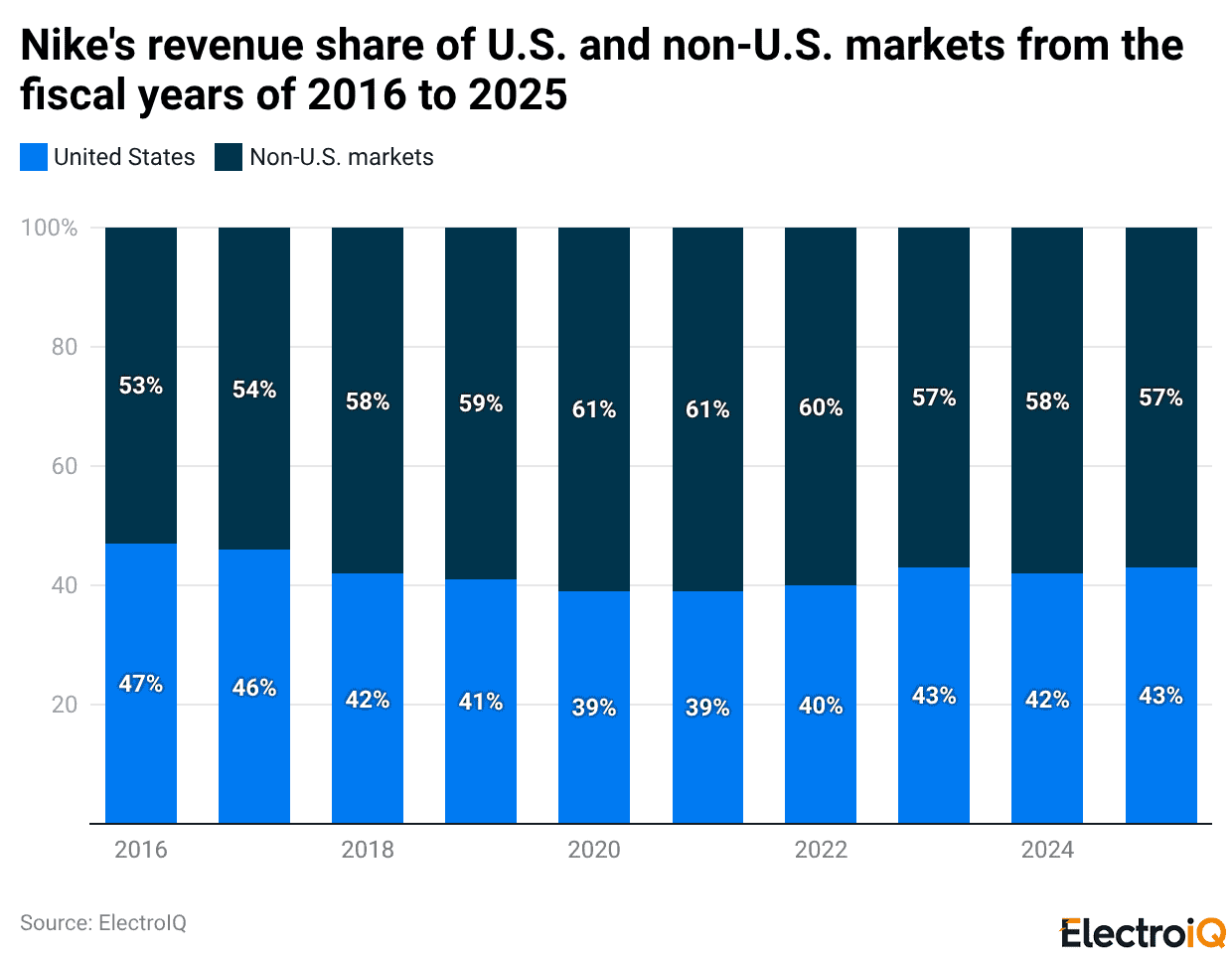
(Reference: statista.com)
- In 2025, Nike generated 57% of its revenue from markets outside the U.S. and 43% from the U.S.
By Market Capitalisation
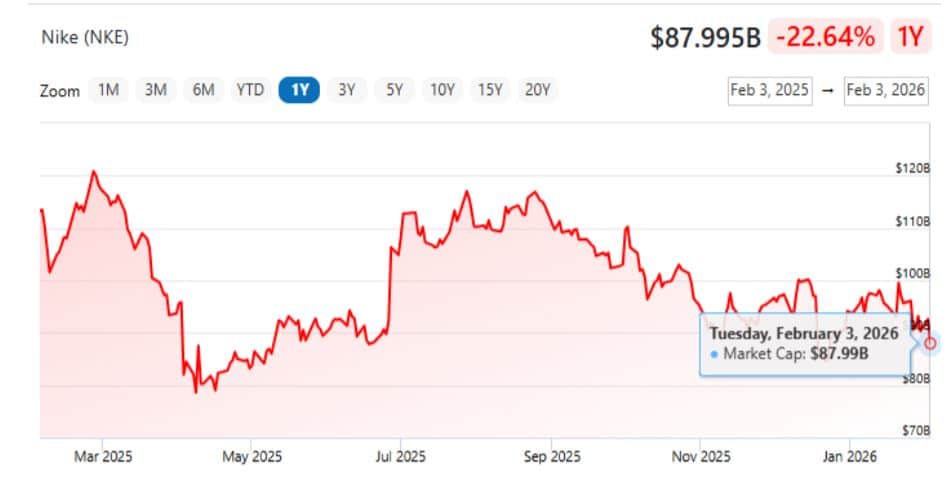
(Source: financecharts.com)
- As of February 3, 2026, Nike’s total market capitalisation is approximately USD 87.995 billion.
- Over the past 30 days, Nike’s market cap has decreased by 7.89%.
- Over the last 12 months, Nike has lost 22.32% of its market capitalisation.
- Nike is currently the 232nd largest company in the world by market capitalisation.
Nike’s Key Products And Pricing Statistics
| Product | Category | Price (USD) | Key Features |
| Nike Men’s Structure 26 Road Running Shoes | Running | 170 | ReactX cushioning for stability, smooth running, and daily training |
| Nike Air Force 1 ’07 Sneakers | Lifestyle/Casual | 160-170 | Cushioned midsole, durable leather upper, and classic streetwear design |
| Nike Court Vision Mid Next Nature Shoes | Basketball/Retro | 90 | Recycled materials under the Next Nature program, sustainable, and everyday comfort |
| Nike Men’s Air Max Dn Roam Shoes | Lifestyle/Casual | 220 | Air Max cushioning, all-day comfort, and modern urban style. |
| Nike Air Max Ishod Men’s Shoes | Skate/Street | 160 | Air cushioning, versatile street performance. |
| Nike Men’s Uplift SC Shoes | Casual | 70 | Lightweight, casual, ideal for everyday wear. |
| Nike Mercurial Superfly 11/Vapour 17 | Soccer/Performance | 300 | FlyWeave Ultra uppers, ZoomX foam sockliners, and enhanced traction studs. |
| Jordan Brand 2026 Releases (Air Jordan 4 “Flight Club”, Air Jordan 17 Low) | Lifestyle/Collector | 220-230 | Premium designs, targeting collectors and enthusiasts. |
Nike Brand Metrics Among U.S. Sneaker Owners
- According to Statista, Nike’s logo and brand name are recognised by about 96% of U.S. consumers in 2025.
- Approximately 65% of U.S. sneaker owners report having a favourable opinion of Nike.
- 58% of U.S. sneaker owners currently own Nike sneakers.
- 84% of Nike sneaker owners plan to repurchase Nike sneakers.
- In the past three months, about 50% of U.S. sneaker owners have seen Nike in the media.
Nike Institutional Ownership and Top Shareholders
- Approximately 68% of Nike’s shares are held by institutional investors, underscoring significant institutional influence in the company.
- The top shareholders include Phil Knight at 17.4%, followed by Vanguard (7.23%), BlackRock (5.93%), and other major institutional and family stakeholders, including State Street Global Advisors, Travis Knight, and the Knight Foundation.
Nike Stores Statistics
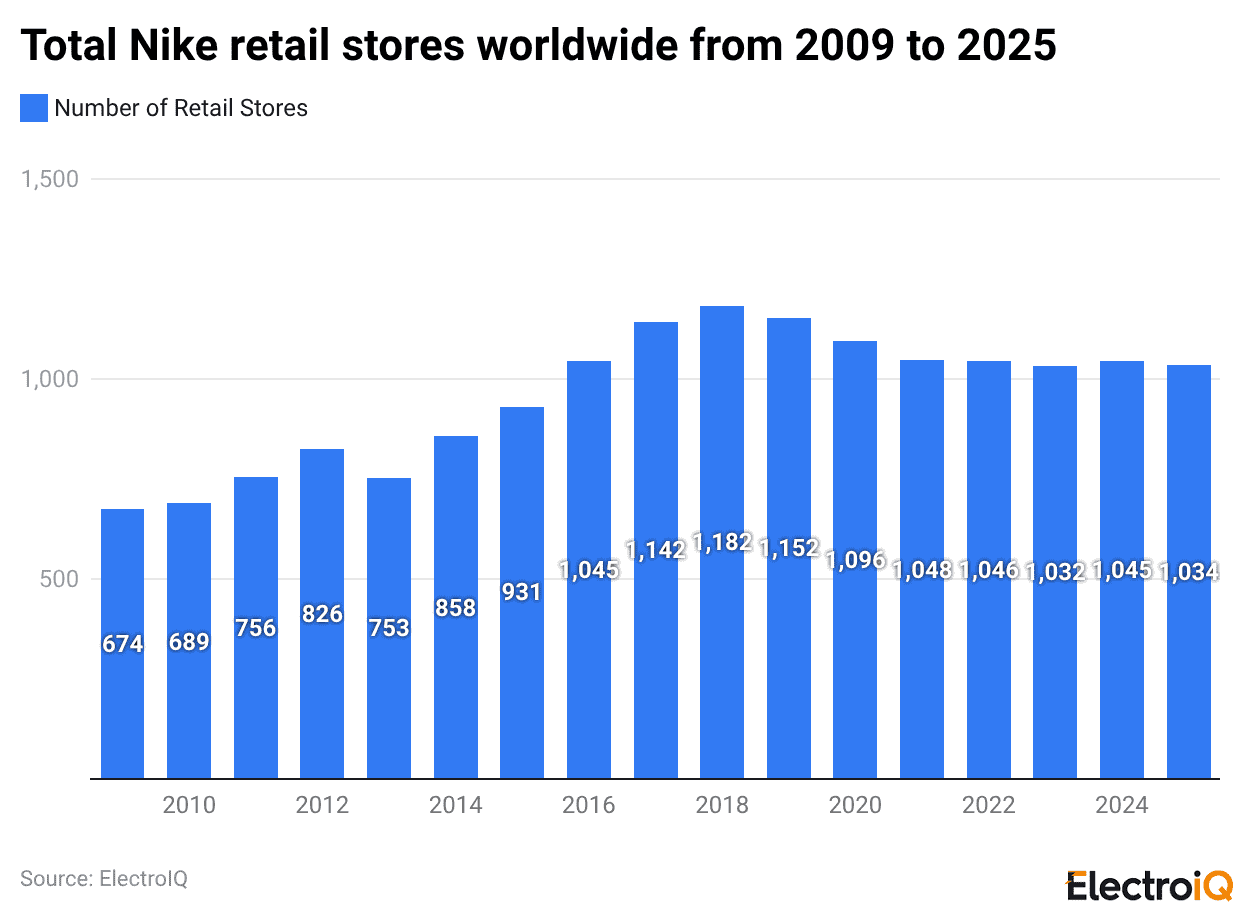
(Reference: statista.com)
- As of May 31, 2025, Nike operated 1,034 retail stores worldwide, 11 fewer than the previous year.
- As of 2025, in the United States, Nike operated 213 Nike Brand Factory stores, 85 Nike Brand in-line stores, and 78 Converse stores.
- During the same period, Nike’s non-U.S. retail stores consisted of Nike Brand Factory stores (543), Nike Brand in-line stores (61), and Converse stores (54).
Nike’s Sustainability Initiatives
- Nike’s main sustainability strategy, Move to Zero, aims for zero carbon emissions and zero waste to protect the environment and the future of sport.
- Nike achieved 96% renewable electricity in its owned global operations and aims to reach 100% by 2025.
- Nike has set science-based targets to reduce carbon emissions by 65% in its own operations and 30 % across its supply chain by 2030.
- By the end of fiscal year 2024, Nike’s Scope 3 emissions had fallen by 29% since 2020, and over 60% of production volume came from suppliers with science-aligned emissions targets.
- Nike aims to use environmentally preferred materials in 50% of all key materials (polyester, cotton, leather, rubber) by 2025.
- Nike targets 100% waste diversion from landfills across its extended supply chain by 2025, with at least 80% of waste recycled into products or other goods.
- Nike plans to reduce the per-kilogram freshwater usage in textile dyeing and finishing by 25% by 2025.
- More than 50% of Nike’s global headquarters vehicle fleet is now electric.
Conclusion
Ultimately, Nike is not just a company that sells sports apparel and shoes. It represents hard work, energy, and confidence. With new ideas and strong branding, Nike remains popular worldwide. Despite challenges, it continues to improve and motivate people to stay active, dream big, and never give up.
FAQ
Nike supports sports like football, basketball, running, tennis, and more.
Sign up for a Nike membership, use student or birthday discounts, watch seasonal sales, apply promo codes, and shop during special events.
Nike’s #1-selling shoe is the Air Force 1; sneakers are the brand’s best-selling item worldwide, loved for their timeless design.
Nike’s largest sponsor in 2026 is its NFL partnership, valued at about USD 200 million annually as the official apparel and uniform supplier to all 32 teams.
Nike’s largest supplier is Pou Chen (Yue Yuen), which accounts for about 30% of Nike’s global footwear production.

Sources