










Introduction
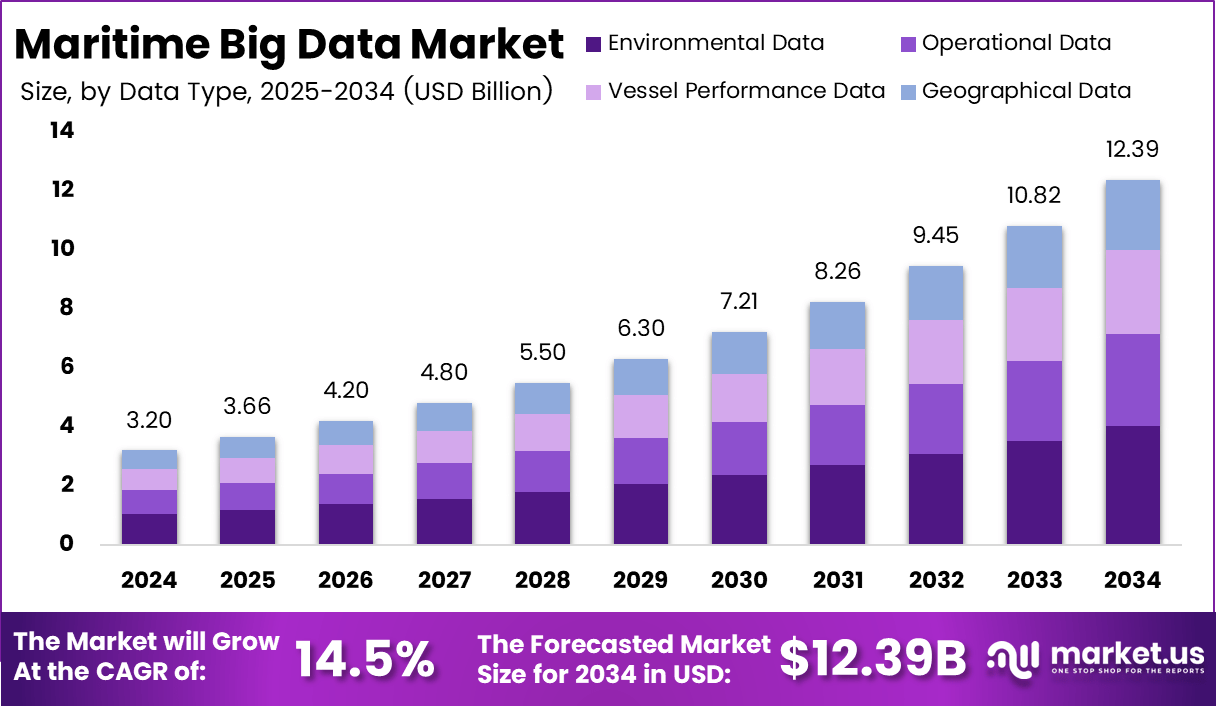
The global Maritime Big Data Market is projected to reach approximately USD 12.39 billion by 2034, rising from USD 3.2 billion in 2024, reflecting a CAGR of 14.5% over the forecast period from 2025 to 2034. In 2024, Asia-Pacific emerged as the leading region, accounting for over 36.5% of the market and generating around USD 1.15 billion in revenue, with strong momentum driven by digital transformation across shipping operations.
The market is expanding at a notable pace as shipping companies increasingly rely on data-driven decision-making, predictive analytics, and operational optimization. Growth is fueled by rising global trade volumes, demand for fuel efficiency, and the need to comply with environmental regulations.
Market Overview
According to Market.us, the Maritime Big Data Market is experiencing steady expansion as the shipping industry undergoes a digital shift toward intelligent operations. Asia-Pacific leads the global landscape with a dominant 36.5% share, supported by strong maritime trade activity and infrastructure investments. China alone contributes USD 0.46 billion, reflecting its rapid adoption of data-driven maritime solutions and expanding at a CAGR of 11.8%.
Get the latest insights and updates at @ https://market.us/report/maritime-big-data-market/request-sample/
Increasing deployment of analytics platforms for route optimization, cargo monitoring, and predictive maintenance continues to reshape operational efficiency across fleets. The integration of IoT sensors, satellite communication, and cloud platforms enables real-time insights, making maritime big data a critical component of modern shipping ecosystems.
Key Takeaways
- Environmental Data: 32.6% share
- Fleet Management: 28.8% share
- On-premises Deployment: 62.8% share
- Commercial Shipping: 42.8% share
- Asia-Pacific Region: 36.5% share
- China Market Value: USD 0.46 Billion
- Global Market Value: USD 1.15 Billion
Connect to sales team for smooth navigation @ [email protected]
Report Scope
| Report Features | Description |
|---|---|
| Market Value (2024) | USD 3.2 Bn |
| Forecast Revenue (2034) | USD 12.39 Bn |
| CAGR(2025-2034) | 14.5% |
| Base Year for Estimation | 2024 |
| Historic Period | 2020-2023 |
| Forecast Period | 2025-2034 |
| Report Coverage | Revenue forecast, AI impact on Market trends, Share Insights, Company ranking, competitive landscape, Recent Developments, Market Dynamics, nd Emerging Trends |
| Segments Covered | By Data Type (Environmental Data, Operational Data, Vessel Performance Data, Geographical Data), By Application (Fleet Management, Navigation Optimization, Predictive Maintenance, Regulatory Compliance, Environmental Monitoring), By Deployment Model (Cloud-based, On-premises), By End-user (Commercial Shipping, Fishing Industry, Naval Forces) |
| Regional Analysis | North America – US, Canada; Europe – Germany, France, The UK, Spain, Italy, Russia, Netherlands, Rest of Europe; Asia Pacific – China, Japan, South Korea, India, New Zealand, Singapore, Thailand, Vietnam, Rest of Latin America; Latin America – Brazil, Mexico, Rest of Latin America; Middle East & Africa – South Africa, Saudi Arabia, UAE, Rest of MEA |
| Competitive Landscape | Microsoft Corporation, Amazon Web Services, Inc., KONGSBERG, Fugro NV, Inmarsat Global Limited, Iridium Communications Inc., Siemens, Planet Labs PBC, Digital Ocean Holdings, Inc., International Business Machines Corporation (IBM), Oracle Corporation, Schneider Electric SE, Google LLC, Others |
| Customization Scope | Customization for segments, region/country-level will be provided. Moreover, additional customization can be done based on the requirements. |
| Purchase Options | We have three licenses to choose from: Single User License, Multi-User License (Up to 5 Users), Corporate Use License (Unlimited Users, Printable PDF) |
Segmentation Deep Dive
By Data Type
Environmental Data leads the market with a 32.6% share, driven by the growing need to monitor weather conditions, ocean currents, and emissions. Shipping companies rely heavily on environmental insights to optimize routes and reduce fuel consumption. Regulatory pressure to limit carbon emissions further strengthens demand for environmental data analytics solutions.
By Application
Fleet Management dominates with a 28.8% share, reflecting its critical role in optimizing vessel performance and operational efficiency. Companies utilize big data platforms to monitor fleet movements, track fuel usage, and improve maintenance schedules. The increasing complexity of global shipping networks continues to push demand for advanced fleet management systems.
By Deployment
On-premises deployment holds a leading 62.8% share, as maritime operators prioritize data security and control over sensitive operational information. Large shipping enterprises prefer on-premises systems to ensure compliance with strict data governance policies and maintain reliability in remote maritime environments where connectivity may be limited.
By End-User
Commercial Shipping accounts for the largest share at 42.8%, supported by the sector’s extensive use of data analytics for cargo tracking, route optimization, and fuel efficiency. The continuous growth of global trade and e-commerce logistics strengthens the reliance on big data solutions within commercial fleets.
Regional Analysis
Asia-Pacific dominates the Maritime Big Data Market with a 36.5% share, driven by high maritime trade activity, strong port infrastructure, and rapid digital adoption. Countries such as China, Japan, and South Korea invest heavily in smart shipping technologies to enhance operational efficiency and global competitiveness.
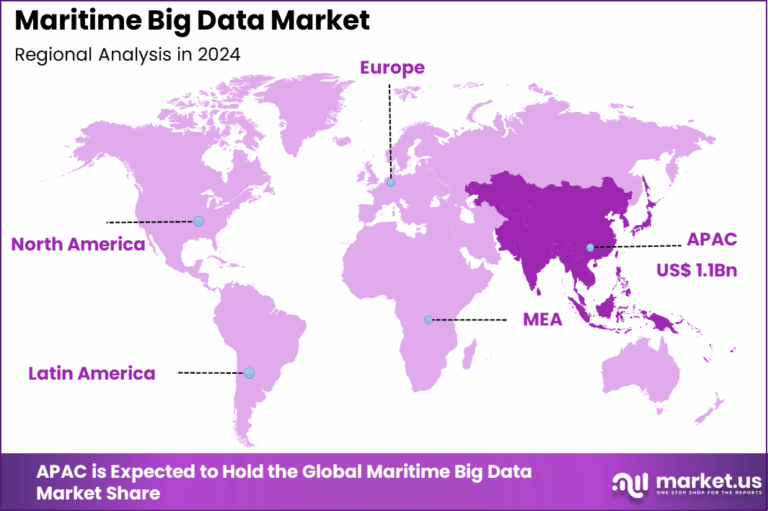
China stands out with a market value of USD 0.46 billion, supported by its large shipping fleet and strategic initiatives to modernize maritime operations. The region benefits from increasing government focus on digital ports, smart logistics, and environmental compliance, all of which accelerate the adoption of big data solutions.
Market Leaders
Key players operating in the Maritime Big Data Market include:
- IBM
- Microsoft
- SAP
- Oracle
- ABB
- Wärtsilä
- Kongsberg Gruppen
- Inmarsat
These companies focus on enhancing analytics capabilities, expanding cloud-based platforms, and integrating AI technologies to strengthen their market position.
Recent Developments
- In 2024, Wärtsilä expanded its digital fleet optimization solutions to support real-time voyage analytics and emissions tracking.
- In 2023, ABB introduced advanced marine advisory systems powered by data analytics to improve fuel efficiency.
- In 2024, Kongsberg Gruppen enhanced its maritime data platforms with AI-enabled decision support tools for autonomous operations.
- In 2023, Inmarsat upgraded its satellite connectivity solutions to enable seamless data transmission for maritime analytics.
- In 2024, SAP strengthened its maritime logistics solutions by integrating advanced analytics and cloud-based data management systems.
How AI is Reshaping the Future of the Maritime Big Data Market?
Artificial intelligence is transforming maritime operations by enabling predictive insights and autonomous decision-making. AI-powered analytics systems process massive volumes of vessel data, including weather conditions, fuel consumption, and navigation routes, to optimize operational performance. Shipping companies increasingly adopt AI to reduce fuel costs and enhance voyage planning accuracy.
For instance, companies such as IBM and Microsoft integrate AI with cloud platforms to deliver real-time analytics for maritime fleets. These solutions help operators identify inefficiencies, predict equipment failures, and improve safety compliance. AI-driven predictive maintenance reduces downtime by identifying potential mechanical issues before they escalate, ensuring uninterrupted operations.
Another key transformation lies in automated decision support systems. AI algorithms analyze historical and real-time data to recommend optimal shipping routes, avoiding congestion and adverse weather conditions. This not only improves delivery timelines but also contributes to significant fuel savings, aligning with sustainability goals.
Furthermore, AI enhances port operations through intelligent cargo tracking and automated logistics planning. Ports equipped with AI-enabled systems streamline vessel scheduling and cargo handling, reducing turnaround times. As maritime stakeholders increasingly prioritize efficiency and environmental compliance, AI adoption is expected to accelerate across the value chain.
Conclusion
The Maritime Big Data Market presents strong growth potential as digital transformation reshapes global shipping operations. Increasing reliance on data-driven decision-making, combined with advancements in AI and IoT technologies, positions the market as a critical enabler of efficiency and sustainability.
Asia-Pacific continues to lead due to its robust maritime infrastructure and rapid adoption of smart technologies. As industry players invest in innovation and expand analytics capabilities, the market is expected to unlock new opportunities for operational optimization, cost reduction, and environmental compliance, making it an attractive space for long-term investment.