










Introduction
IoT Device Statistics: The Internet of Things (IoT) is changing the way we live and work by connecting everyday devices to the internet. Smart gadgets like home lights, thermostats, wearable fitness trackers, and even industrial machines can now talk to each other, share data, and make decisions automatically. IoT devices help us save time, energy, and money while making life more convenient and efficient.
They also power smarter cities, better healthcare, and safer transportation. By linking objects with sensors, software, and networks, IoT turns ordinary devices into intelligent tools. Understanding IoT is key to enjoying its benefits and staying ready for a world that’s more connected than ever.
Editor’s Choice
- The Global IoT Device Management Market is valued at approximately USD 6.4 billion in 2026.
- Based on application, the Connected & Smart Home segment led the market with a 31.35% revenue share in 2025.
- In 2026, Greater China is projected to lead the global IoT market with spending of USD 173.6 billion, followed by North America at USD 103.7 billion and Europe at USD 93.3 billion.
- The IoT industry is expanding at an annual growth rate of 4.88%, supported by 257.3K patents and a global workforce of 7.6 million employees, with 2.4K new hires added last year.
- Around 400 active IoT (Internet of Things) platforms are currently operating in the market.
- IOT Analytics states that with a 32% share of total global IoT connections.
- Worldwide spending on the Internet of Things (IoT) is expected to exceed USD 1 trillion by 2026.
- IoT Services are expected to be the largest spending category, accounting for around 40% of total IoT investment.
- As of 2026, the European Investment Bank is the largest long‑term IoT investor, with a total commitment of about USD 5,000,000,000.
- The utilities sector, including electricity, gas, steam, and air conditioning, is expected to lead with approximately 1,876.3 million devices.
- The global number of IoT devices is projected to increase from 22 billion in 2026 to over 40.6 billion by 2034.
- Consumer electronics accounted for approximately 60% of the total IoT device market share, making it the largest segment.
- Remote asset monitoring (read-only) leads global IoT adoption at 34%, followed by process automation at 33% and remote asset monitoring and control (read/write) at 32%.
- Approximately 75% of IoT attacks are routed through routers, with an average of 5,200 attacks per router per month.
IoT Device Market Size

(Source: market.us)
- The Global IoT Device Management Market is valued at approximately USD 6.4 billion in 2026, up from USD 4.9 billion in 2025.
- By 2033, the market will reach around USD 45 billion, with a CAGR of 32% from 2024 to 2033.
By Category
- According to Mordor Intelligence, based on application, the Connected & Smart Home segment led the market with a 31.35% revenue share in 2025, while Medical IoT is projected to grow at a strong 23.05% CAGR through 2031, reflecting rising digital healthcare adoption.
- By device category, Smart Speakers & Displays accounted for 24.05% of the total IoT device market share in 2025, whereas Wearables recorded the fastest growth, with a 22.35% CAGR over the forecast period.
- By connectivity, cellular solutions represented 39.55% of the IoT devices market in 2025, while LPWAN technologies are expected to expand at a 21.92% CAGR between 2026 and 2031, driven by low-power wide-area deployments.
- By geography, Asia Pacific dominated the global market with a 37.85% revenue share in 2025 and is forecast to maintain its leadership, growing at a 21.05% CAGR through 2031.
By Country
- According to Exploding Topic, in 2026, Greater China is projected to lead the global IoT market with spending of USD 173.6 billion, followed by North America at USD 103.7 billion and Europe at USD 93.3 billion.
- Other major developed markets include Japan (USD 36.4 billion) and South Korea (USD 13.4 billion), while Australasia is expected to reach USD 6.7 billion.
- Among emerging regions, Latin America is forecast to generate USD 25.9 billion, India and South Asia USD 13.3 billion, and South East Asia USD 12.9 billion in IoT spending by 2026.
- Meanwhile, MENA is projected at USD 10 billion, Russia & Central Asia at USD 7.9 billion, and Sub-Saharan Africa at USD 3.9 billion.
Key IoT Market Trends
- StartUs Insight further stated that the IoT industry is expanding at an annual growth rate of 4.88%, supported by 257.3K patents and a global workforce of 7.6 million employees, with 2.4K new hires added last year.
- Edge Computing includes 117,240+ companies, employs 7.5 million people, and has recently added 2,300 new employees, growing at 6.29% per year due to demand for low-latency and real-time analytics.
- The Wearables segment comprises 129,950+ companies and 9.4 million employees, with 2,400 new hires, and records a 1.03% annual growth rate, driven by healthcare and enterprise applications.
- Industrial IoT (IIoT) covers 43,910+ companies with 3.5 million employees, adding 860+ workers in the last year.
- IIoT is growing steadily at 0.70% annually.
IoT Industry Growth Projections
- According to Market.us Scoop, around 400 active IoT (Internet of Things) platforms are currently operating in the market, indicating a highly fragmented, competitive ecosystem.
- Based on industry forecasts, the total number of connected IoT devices is expected to reach at least 25.4 billion by 2030.
- Over 10% of total venture capital funding goes to IoT-related companies.
- The global IoT fleet management market is projected to reach USD 55 billion by 2026, supported by a CAGR of approximately 20% between 2020 and 2026.
- The global IoT healthcare market is expected to reach USD 332.67 billion by 2027, growing at a CAGR of 13.2% from 2020 to 2027.
- The IoT education market is forecast to grow at a CAGR of 74% between 2020 and 2027.
IoT Connectivity Market Share
- IOT Analytics states that with a 32% share of total global IoT connections, Wi-Fi holds the top position among IoT connectivity technologies. At the same time,
- Bluetooth ranks second, accounting for 24% of connected IoT devices worldwide.
- Cellular IoT ranks third, contributing 22% of total global IoT connections, reflecting its strong role in wide-area and mobile IoT deployments.
Global Internet of Things Connectivity Forecast

(Source: iot-analytics.com)
- In 2025, the total number of connected Internet of Things (IoT) devices worldwide reached an estimated 23.9 billion active connections.
- By 2035, global IoT connections are projected to grow to roughly 55.0 billion devices.
- By 2035, cellular 5G/6G IoT is expected to be the fastest‑growing connectivity segment, with a projected CAGR of about 28% to 35%.
IoT Devices Spending Statistics
- According to Business Wire, worldwide spending on the Internet of Things (IoT) is expected to exceed USD 1 trillion by 2026.
- IoT spending is projected to grow at an average annual rate of approximately 10% or more, driven by increasing adoption across industries such as manufacturing, transportation, healthcare, and smart infrastructure.
By Category
- IoT Services are expected to be the largest spending category, accounting for around 40% of total IoT investment in 2026.
- Video Analytics Solutions: Expected to exceed USD 23.5 billion as AI-enabled video processing becomes a major IoT use case across industries.
Top 10 IoT Investors

(Source: startus-insights.com)
- As of 2026, the European Investment Bank is the largest long‑term IoT investor, with a total commitment of about USD 5,000,000,000.
- SoftBank (USD 3.1 billion), Tencent (USD 2.3 billion), GIC (USD 2.1 billion), Sequoia Capital (USD 1.6 billion), Baidu (USD 1.6 billion), BlackRock (USD 1.4 billion), Apollo Global Management (USD 1.4 billion), Tiger Global Management (USD 1.2 billion), and Goldman Sachs (USD 1.2 billion) have collectively invested significant capital into IoT-related companies.
Number of IoT Connected Devices

(Source: statista.com)
- In 2026, the utilities sector, including electricity, gas, steam, and air conditioning, is expected to lead with approximately 1,876.3 million devices, followed by retail and wholesale with 1,395.6 million devices.
- Moreover, water supply and waste management are forecast to account for 560.2 million IoT devices; transportation and storage are projected to reach 452.9 million devices; manufacturing is estimated to total 156.6 million devices; and agriculture, forestry, and fishing are expected to reach 83.5 million devices.
In Various Industries
(Reference: market.biz)
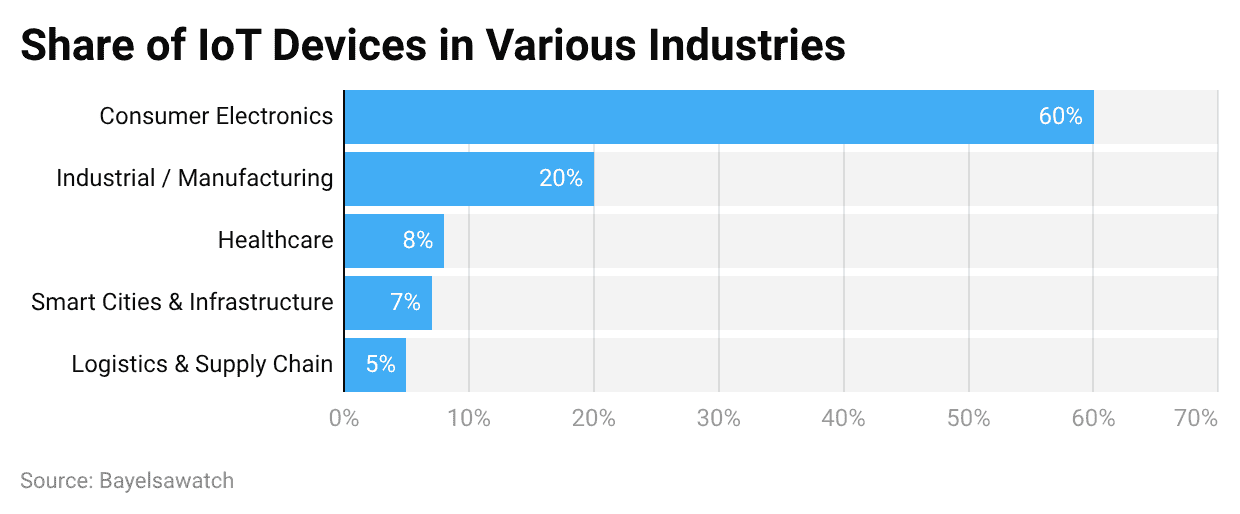
- Consumer electronics accounted for approximately 60% of the total IoT device market share, making it the largest segment, while the industrial and manufacturing sectors account for around 20%.
- Healthcare contributes about 8% of total IoT devices, followed by smart cities and infrastructure at roughly 7%, and the logistics and supply chain sector holds nearly 5% of the overall IoT device market.
Internet of Things Adoption Statistics

(Reference: market.biz)
- According to market.biz, the global number of IoT devices is projected to increase from 22 billion in 2026 to over 40.6 billion by 2034.
- By 2034, China is expected to lead globally, with approximately 7.51 billion consumer IoT devices in use.
- The consumer segment accounts for about 60% of all connected devices in 2025.
- Several industry verticals, including utilities, retail, transportation, and government, already operate over 100 million connected devices each, with total industrial IoT devices projected to exceed 8 billion by 2033.
- In the consumer market, internet and media devices such as smartphones are expected to surpass 17 billion devices by 2033, while IT infrastructure, autonomous vehicles, asset tracking, and smart grids are each forecast to exceed 1 billion devices.
By Use Cases

(Source: market.biz)
- Remote asset monitoring (read-only) leads global IoT adoption at 34%, followed by process automation at 33% and remote asset monitoring and control (read/write) at 32%.
- In addition, vehicle fleet management, location tracking, and asset and plant performance optimisation each report an adoption rate of 31%, while quality control and management stand at 30% globally.
- Good-condition monitoring during transit, predictive maintenance, and on-site track-and-trace solutions each account for 29% of global IoT adoption.
Internet Of Things Big Acquisition Statistics
- The IoT Exits report stated that in 2025, about 320 mergers and acquisitions (M&A) deals were announced in the Internet of Things sector, which was up 34% from 2024.
- Total disclosed deal value in the IoT industry reached approximately USD 43.9 billion.
- Only 21% of deals publicly revealed financial terms, as many companies chose to keep details private.
- Private equity’s involvement in IoT M&A increased to about 29% of all deals in 2025.
- According to Reuters, a major connectivity infrastructure deal was announced in August 2025 when Amphenol agreed to buy CommScope’s Connectivity & Cable Solutions unit for roughly USD 10.5 billion.
- Alphabet’s Google agreed to acquire cybersecurity firm Wiz for USD 32 billion in March 2025, according to AP News reports.
- Other technology and infrastructure acquisitions tied to IoT-relevant ecosystems include SoftBank Group’s planned USD 5.375 billion purchase of ABB’s robotics division.
Blockchain IoT Market Size

(Source: precedenceresearch.com)
- The global blockchain IoT market is estimated to be valued at USD 1,904.89 million in 2025 and is projected to expand significantly to USD 95,535.22 million by 2035.
- The market is expected to grow at a strong CAGR of 54.86% during the forecast period, from 2026 to 2035.
IoT Device Security Challenges
- Approximately 75% of IoT attacks are routed through routers, with an average of 5,200 attacks per router per month, according to Market Biz.
- Around 56% of IoT devices remain vulnerable to malware and cyberattacks due to outdated operating systems, while 48% of businesses report a limited ability to detect IoT breaches within their networks.
- About 84% of companies that adopted IoT have experienced security breaches, with 50% identifying cost and 44% citing maintenance complexity as key challenges.
- From a governance perspective, 55% of brands and businesses believe that third-party IoT providers should comply with privacy and security regulations, and 33% of IT executives consider operational disruption attacks the top concern.
- Although nearly 60% of organisations globally use IoT solutions, about 43% of enterprises lack adequate systems to protect their infrastructure.
The Environmental Impact Of IoT Devices
- According to the 2026 report by GITNUX, Internet of Things (IoT) systems could help reduce global carbon emissions by up to 19% by 2030.
- Research published by Zipdo states that smart automation and IoT-based energy management systems can reduce energy use in buildings by up to 30%.
- A report from MICROEJ highlights that IoT in manufacturing and operations also increases electricity demand, and by 2030, new IoT technologies could add 34 terawatt-hours (TWh) of electricity consumption globally.
- The same research indicates that electronics, including IoT devices, currently account for about 3.7% of global greenhouse gas emissions.
- This share could increase to 14% by 2040 if production and usage continue to grow rapidly.
- Data centres that support IoT systems are expected to double their electricity use by 2026, mainly due to higher artificial intelligence workloads.
- According to research published on arXiv, cumulative carbon emissions from IoT devices are projected to exceed 319 million tonnes of CO2-equivalent by 2028.
- Studies show that device production alone is responsible for 85% to 95% of a typical IoT product’s total lifetime carbon footprint.
- The electronic waste management market is projected to reach USD 63 billion globally by 2026.
Conclusion
In conclusion, IoT devices are changing how we live and work. They connect everyday objects to the internet, making life easier, smarter, and more efficient. From smart homes to healthcare and transportation, IoT brings useful data and convenience.
But with more devices, security and privacy become very important. By using IoT carefully, we can enjoy its benefits safely and improve daily life, work, and industries without risk.
FAQ
They collect information using sensors and send it over the internet to apps or other devices. This helps things work automatically and more smartly.
IoT makes life easier, safer, and more efficient. Think smart homes, fitness trackers, energy savings, and traffic management.
You’ll find them in homes, hospitals, factories, cars, farms, and cities to make everyday life smarter.

Sources