










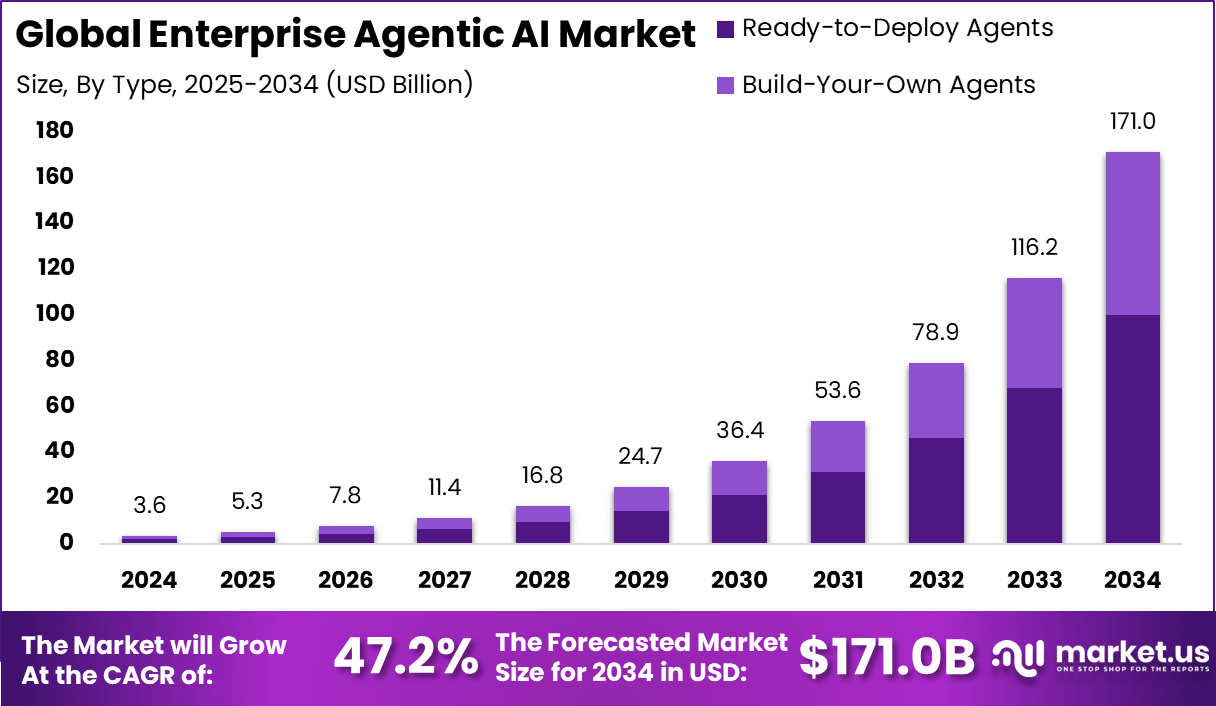
According to Market.us, the global enterprise agentic AI market is set to grow from about USD 3.6 billion in 2024 to nearly USD 171 billion by 2034, at a rapid CAGR of 47.2% over 2025 to 2034. In 2024, North America held a dominant position with more than 39.7% share and around USD 1.4 billion in revenue, reflecting the region’s strong AI infrastructure, cloud maturity, and early enterprise adoption.
This market centers on autonomous software agents that can interpret goals, take actions, and continuously learn, which is reshaping how enterprises handle workflows, customer interactions, and complex decisions. As organizations look for systems that can operate with less supervision but higher reliability, enterprise agentic AI is becoming a strategic layer on top of existing data platforms, business applications, and automation tools.
Gain Access to 2026 Market Intelligence for More Informed Business Strategies – Request a Sample
Market Size and Growth
| Report Features | Description |
| Market Value (2024) | USD 3.6 Bn |
| Forecast Revenue (2034) | USD 171 Bn |
| CAGR(2025-2034) | 47.20% |
| Leading Segment | Ready-to-Deploy Agents: 58.5% |
| Largest Market | North America [39.7% Market Share] |
Growing complexity in operations is one of the top driving factors, pushing enterprises to move from basic rule based automation toward AI agents that can handle dynamic situations and unstructured inputs. At the same time, leaders want to cut process times, reduce errors, and keep up with customer expectations for instant responses, all of which are aligning with the capabilities of agentic AI.
Machine learning is central here, accounting for about 29.9% of the technology segment in 2024, because it enables agents to adapt behavior, refine predictions, and personalize outcomes across use cases. The ecosystem is also supported by major technology vendors and service providers that offer pre built agents, orchestration frameworks, and integration with core enterprise systems.
Engage with Our Expert Team at [email protected] for Data-Driven Solutions
Key Insights summary
- North America led the enterprise agentic AI market with a 39.7% share in 2024, supported by advanced digital infrastructure and strong AI readiness in the United States.
- Customer service and virtual assistants formed the largest application segment at about 26.9%, driven by demand for automated support, compliance workflows, fraud detection, and risk analysis.
- Machine learning accounted for 29.9% of the technology segment, underscoring its central role in enabling self learning agents that improve over time.
- Single agent systems held 46.8% share, reflecting enterprise preference for simpler, targeted use cases in the early stages of adoption.
- Ready to deploy agents captured 58.5%, as companies leaned toward plug and play solutions that can integrate quickly with CRM, ERP, and other core platforms.
- The market is projected to expand at a CAGR of 47.2% through 2034, highlighting strong and sustained demand for autonomous agents in enterprise operations.
- The US market contributed about USD 1.4 billion in 2024, reinforcing its status as a global leader in enterprise AI deployment and infrastructure.
Key Agentic AI Adoption Statistics
- Around 62% of organizations are actively experimenting with AI agents, and 23% have already scaled them in at least one business function.
- By 2028, nearly 33% of enterprise software applications are expected to include built in agentic capabilities, compared to less than 1% in 2024.
- Approximately 43% of organizations are planning to evaluate or adopt agentic AI solutions in 2026.
- About 40% of employers anticipate workforce adjustments where AI agents automate repetitive tasks.
- Nearly 82% of organizations expect to increase overall AI investment in the coming year.
- Ready to deploy agent solutions accounted for 58.5% of market demand in 2024, reflecting preference for pre built models.
- Companies project an average return on investment of 171% from agentic AI deployments, with U.S. firms estimating returns up to 192%.
- Early implementations demonstrate 30% to 70% cost reductions across selected operational workflows.
- AI powered customer service systems are managing approximately 32,000 weekly conversations with an 83% resolution rate.
By Application
Customer service and virtual assistants account for 26.9% of the market, reflecting strong enterprise adoption of AI driven interaction systems. Organizations are deploying autonomous agents to handle customer queries, manage service workflows, and provide real time assistance across digital channels. These systems improve response times and reduce dependency on manual support operations.
The adoption of agentic AI in customer service is also driven by its ability to analyze user behavior and deliver personalized responses. AI agents can continuously learn from interactions, improving service quality over time. As businesses prioritize customer experience and operational efficiency, virtual assistant applications continue to lead adoption.
By Technology
Machine learning represents 29.9% of the technology segment, highlighting its central role in enabling intelligent decision making within agentic AI systems. These models analyze large datasets to identify patterns, predict outcomes, and optimize actions based on historical and real time data. Machine learning allows AI agents to adapt to changing conditions and improve performance without manual intervention.
The integration of machine learning also enhances the scalability of agentic AI platforms. Organizations can deploy AI agents across multiple business functions while maintaining consistent performance. As enterprise data volumes increase, machine learning continues to drive the effectiveness of autonomous systems.
By Agent Type
Single agent systems account for 46.8% of the market, reflecting a preference for focused and task specific implementations. These systems are designed to perform individual functions such as customer interaction, data processing, or workflow automation. Enterprises often adopt single agent solutions as an initial step toward broader AI integration.
The simplicity of single agent systems allows organizations to implement AI solutions quickly and measure performance outcomes effectively. These systems require lower complexity compared to multi agent architectures, making them suitable for targeted use cases. As enterprises gradually expand AI capabilities, single agent systems remain widely adopted.
By Deployment Type
Ready to deploy agents represent 58.5% of the market, indicating strong demand for pre configured AI solutions that can be implemented quickly. Organizations prefer ready to deploy systems to reduce development time and accelerate return on investment. These solutions provide standardized functionalities that address common enterprise requirements.
The adoption of ready to deploy agents is also supported by their ease of integration with existing enterprise systems. Businesses can deploy these solutions without extensive customization, enabling faster operational deployment. As enterprises seek rapid AI adoption, ready to deploy agent platforms continue to dominate the market.
Engage with Our Expert Team at [email protected] for Data-Driven Solutions
By Region: North America
North America holds 39.7% of the market share, reflecting strong early adoption of agentic AI technologies across enterprise sectors. Organizations in the region are actively investing in autonomous systems to improve operational efficiency and decision making capabilities. The presence of advanced technology infrastructure and high digital maturity supports widespread adoption.
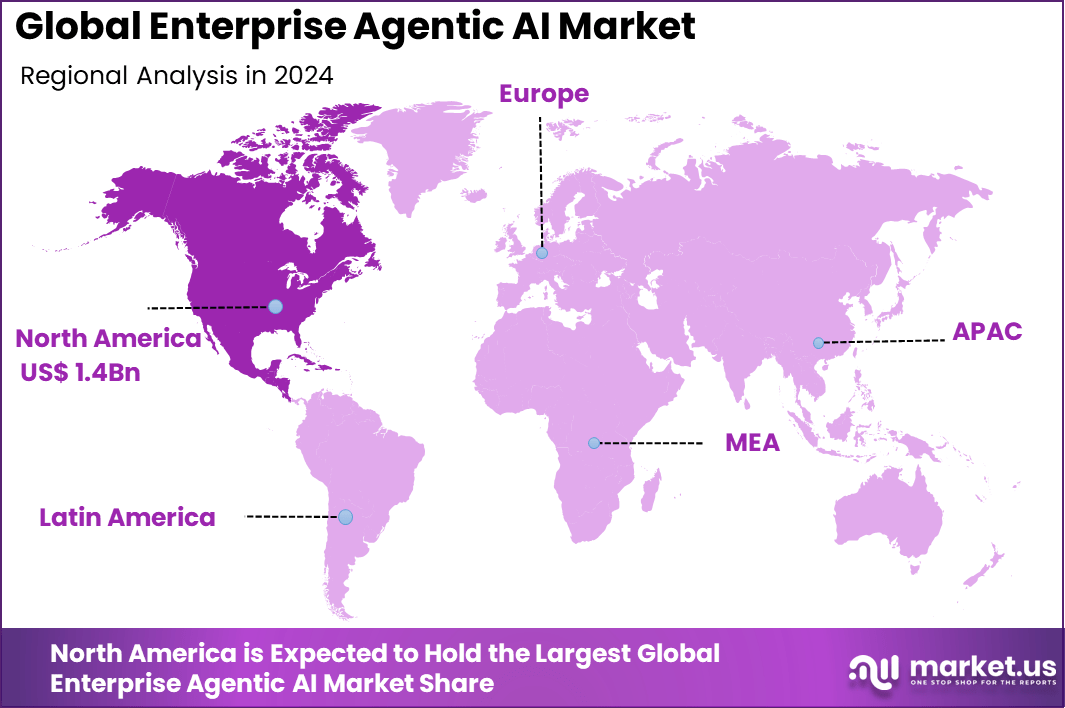
Within North America, the United States contributes USD 1.4 billion, demonstrating leadership in AI readiness and enterprise adoption. Strong investment in artificial intelligence, cloud infrastructure, and enterprise automation has accelerated market growth. With a projected growth rate of 47.2%, the market is expected to experience rapid expansion as organizations increasingly adopt autonomous AI agents across business operations.
Growth Factors
One of the primary growth factors driving the enterprise agentic AI market is the increasing demand for automation of complex business processes. Organizations are moving beyond rule-based automation and adopting AI systems that can handle dynamic tasks such as decision making, workflow orchestration, and multi-step problem solving. Agentic AI enables enterprises to automate entire processes rather than individual tasks.
Another growth factor is the rapid expansion of enterprise data ecosystems. Organizations generate large volumes of structured and unstructured data that require analysis and action. Agentic AI systems can process this data in real time, identify patterns, and execute decisions that improve operational efficiency and business performance.
Emerging Trends
One emerging trend in the enterprise agentic AI market is the development of multi-agent systems where multiple AI agents collaborate to achieve complex objectives. These systems distribute tasks across specialized agents that communicate and coordinate actions, enabling scalable and efficient execution of enterprise workflows.
Another trend is the integration of agentic AI with enterprise software platforms. AI agents are increasingly embedded within business applications such as customer relationship management systems, enterprise resource planning platforms, and IT service management tools, enabling seamless automation of business processes.
Driver Analysis: Need for Intelligent Automation
A key driver of the enterprise agentic AI market is the growing need for intelligent automation across industries. Organizations seek to improve productivity, reduce operational costs, and enhance decision-making capabilities. Agentic AI systems provide advanced automation by combining data analysis, decision logic, and task execution within a single framework.
Another driver is the increasing demand for real-time operational intelligence. Businesses operate in fast-changing environments where rapid decision making is critical. Agentic AI enables continuous monitoring and immediate response to operational events, improving efficiency and competitiveness.
Restraint Analysis: Trust and Governance Concerns
One restraint affecting the enterprise agentic AI market is concerns related to trust, transparency, and governance of autonomous systems. Organizations must ensure that AI agents operate within defined policies and produce reliable outcomes. Lack of transparency in decision-making processes may limit adoption in highly regulated industries.
Another restraint involves the complexity of implementing agentic AI systems. Deploying autonomous AI agents requires integration with existing enterprise systems, data sources, and workflows. This process can require significant technical expertise and organizational alignment.
Opportunity Analysis: Transformation of Enterprise Workflows
A significant opportunity in the enterprise agentic AI market lies in the transformation of enterprise workflows. AI agents can automate end-to-end processes such as customer onboarding, incident management, and financial reconciliation. This capability enables organizations to improve efficiency and reduce operational delays.
Another opportunity involves the expansion of agentic AI into industry-specific applications. Sectors such as healthcare, finance, manufacturing, and logistics can benefit from specialized AI agents designed to handle domain-specific tasks, creating new avenues for market growth.
Challenge Analysis: Managing Autonomous Systems at Scale
One of the key challenges in the enterprise agentic AI market is managing autonomous systems at scale. Organizations may deploy multiple AI agents across different departments and processes, requiring centralized monitoring and governance frameworks. Ensuring coordination and consistency across these agents is critical for maintaining operational stability.
Another challenge involves ensuring data quality and system reliability. Agentic AI systems rely heavily on accurate data inputs to make decisions. Inconsistent or incomplete data can lead to incorrect actions, affecting business outcomes and system performance.
Top key Players
The enterprise agentic AI landscape brings together semiconductor leaders, software vendors, cloud platforms, and consulting firms. NVIDIA Corporation provides GPUs and software stacks that power training and inference for complex AI agents, enabling real time decision making and multimodal interactions. SAP SE and Oracle integrate agentic capabilities into their enterprise resource planning and business platforms so that agents can act directly on transactional data. Accenture and Capgemini help clients design, implement, and govern agentic AI solutions, drawing on large consulting and managed services practices.
OpenAI contributes foundational models and APIs that many enterprises use as the intelligence layer inside their agentic architectures. Celonis and Dataiku focus on process mining, analytics, and AI pipelines, which can feed context and data into enterprise agents. Shield AI, while rooted in defense and autonomy, represents the frontier of physical and mission critical agentic systems, which can inform industrial and logistics use cases. Together, these players and their partners are building ecosystems of tools, frameworks, and reference architectures that make it easier for enterprises to adopt and scale agentic AI.
List of Companies
- NVIDIA Corporation
- SAP SE
- Oracle
- Accenture
- OpenAI
- Capgemini
- Celonis
- Dataiku
- Shield AI
Recent Developments
- In March 2025, Capgemini, in partnership with NVIDIA Corporation, introduced customized agentic solutions aimed at accelerating enterprise AI adoption. These solutions are structured to deliver end to end AI capabilities tailored to the requirements of different industries. By utilizing NVIDIA NIM along with a dedicated agentic gallery, deployment processes are simplified and operational complexity is reduced. This approach supports enterprises in generating actionable insights and advancing agentic driven business transformation.
- In March 2025, Deloitte Touche Tohmatsu Limited launched Zora AI, an agentic AI platform designed to support multiple business functions such as finance, human capital, sales and marketing, supply chain, procurement, and customer service. The platform is built to enable AI agents to perform complex tasks while delivering insights, reporting, analysis, workflow automation, and data sourcing. It also enhances decision making by providing structured and real time intelligence across enterprise operations.
- In March 2025, Oracle and NVIDIA Corporation announced a strategic collaboration to integrate NVIDIA’s accelerated computing and inference software with Oracle’s generative AI services and infrastructure. This integration is intended to accelerate the development and deployment of agentic AI applications across global enterprises. As part of this initiative, more than 100 NVIDIA NIM microservices and over 160 AI tools are being made available through the OCI Console, supporting scalable and efficient implementation of AI driven solutions.
Future of Enterprise Agentic AI Market
Enterprise agentic AI is changing how software behaves inside organizations by turning static systems into active participants in business processes. Instead of just responding to commands, agents can interpret goals, plan steps, and take actions such as updating records, triggering workflows, or contacting customers. This shift moves AI from being a narrow tool to a continuous collaborator, especially in areas like customer support, IT service management, and operations. As orchestration platforms mature, enterprises can coordinate multiple agents to handle complex tasks that span departments and applications.
Machine learning is at the core of this transformation, since it allows agents to adjust behavior based on outcomes, user feedback, and new data. In customer service, for example, agents can learn which answers resolve issues fastest and adapt their playbooks accordingly, raising first contact resolution while reducing human workload. In risk, finance, and compliance, agents can monitor transactions, flag anomalies, and even recommend mitigation actions, with human teams overseeing the final decisions. Over time, enterprises will increasingly combine rule based constraints with learning agents so that systems remain auditable while still improving performance.
Conclusion
The enterprise agentic AI market is moving quickly from concept to practical deployment, driven by the need to handle complex, data rich operations with greater speed and reliability. With North America in the lead and strong momentum in customer service, machine learning based agents, and ready to deploy solutions, the market’s projected 47.2% CAGR to 2034 points to sustained growth rather than a short term spike.
Vendors and enterprises that balance innovation with strong governance, clear use cases, and thoughtful change management are likely to capture the most value from this shift. As standards and best practices mature, agentic AI is set to become a core component of how enterprises design processes, systems, and digital experiences.