








Market Overview
The global drone market is on a strong growth trajectory. The industry is projected to expand from USD 36.4 Billion in 2024 to USD 95.4 Billion by 2034. This growth reflects a compound annual growth rate (CAGR) of 10.1% over the forecast period, signaling robust and sustained demand across sectors.
Drone adoption spans multiple industries, from defense and agriculture to logistics and media. Commercial and military operators recognize drones as cost-effective tools for data collection and operational efficiency. Additionally, growing accessibility of consumer drones continues to expand the overall market base.
Get further insight into the global trends that are affecting the future of the drone industry. Request Sample https://market.us/report/drone-market/request-sample/

Technological progress drives much of this expansion. Manufacturers deliver drones with better battery performance, enhanced imaging sensors, and AI-powered navigation systems. Moreover, the integration of 5G connectivity enables real-time data transmission, making drones more capable for complex field operations.
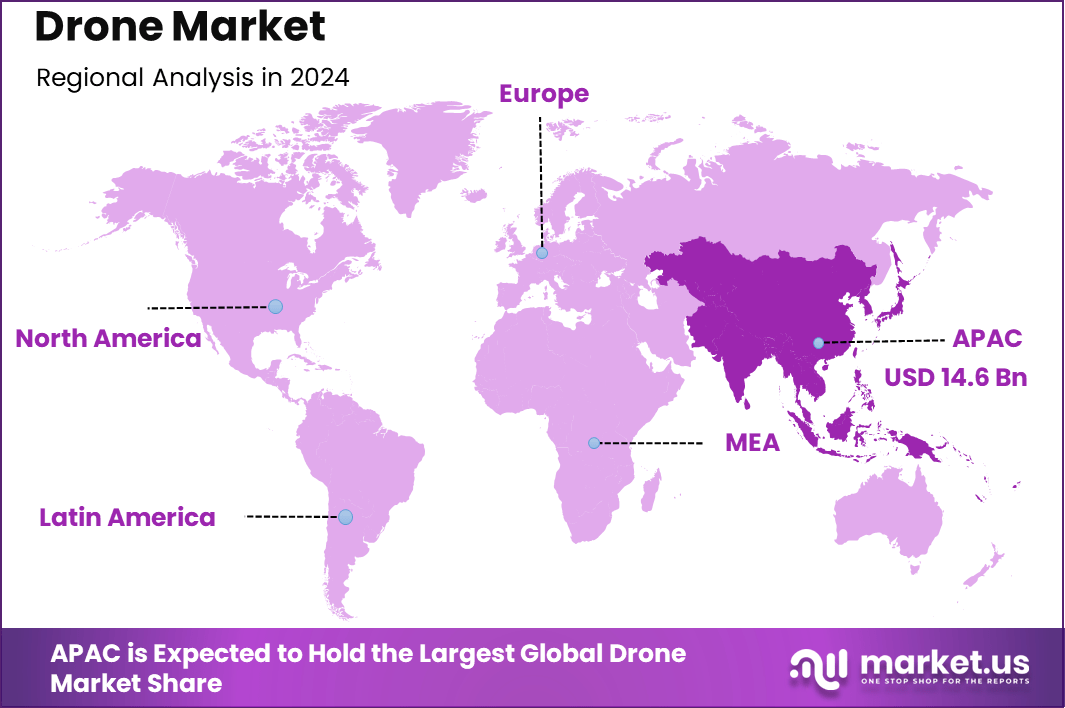
Asia-Pacific leads the global market by a significant margin. The region captured 40.2% of global market share in 2024, generating USD 14.63 Billion in revenue. This dominance reflects strong government investment and rapid industrial adoption across China, India, and Japan.
Regulatory frameworks continue to shape market dynamics. Governments worldwide develop clearer guidelines for drone airspace integration. Consequently, businesses gain more certainty around deployment, which accelerates investment in commercial drone programs and service expansion.
Emerging markets represent a major growth frontier for the drone industry. Industrialization and digital transformation across Southeast Asia, Latin America, and Africa create fresh demand. Furthermore, applications in agricultural monitoring and infrastructure inspection present compelling use cases that fuel adoption in these regions.
Key Takeaways
- The Global Drone Market will reach USD 95.4 Billion by 2034, growing from USD 36.4 Billion in 2024 at a CAGR of 10.1%.
- Asia-Pacific held a dominant 40.2% market share in 2024, generating USD 14.63 Billion in revenue.
- Rotary Wing Drones led the type segment in 2024, capturing 61.1% of total market share.
- Fixed-Wing Drones grew from 31.7% in 2019 to 38.9% in 2024, indicating rising adoption for long-range applications.
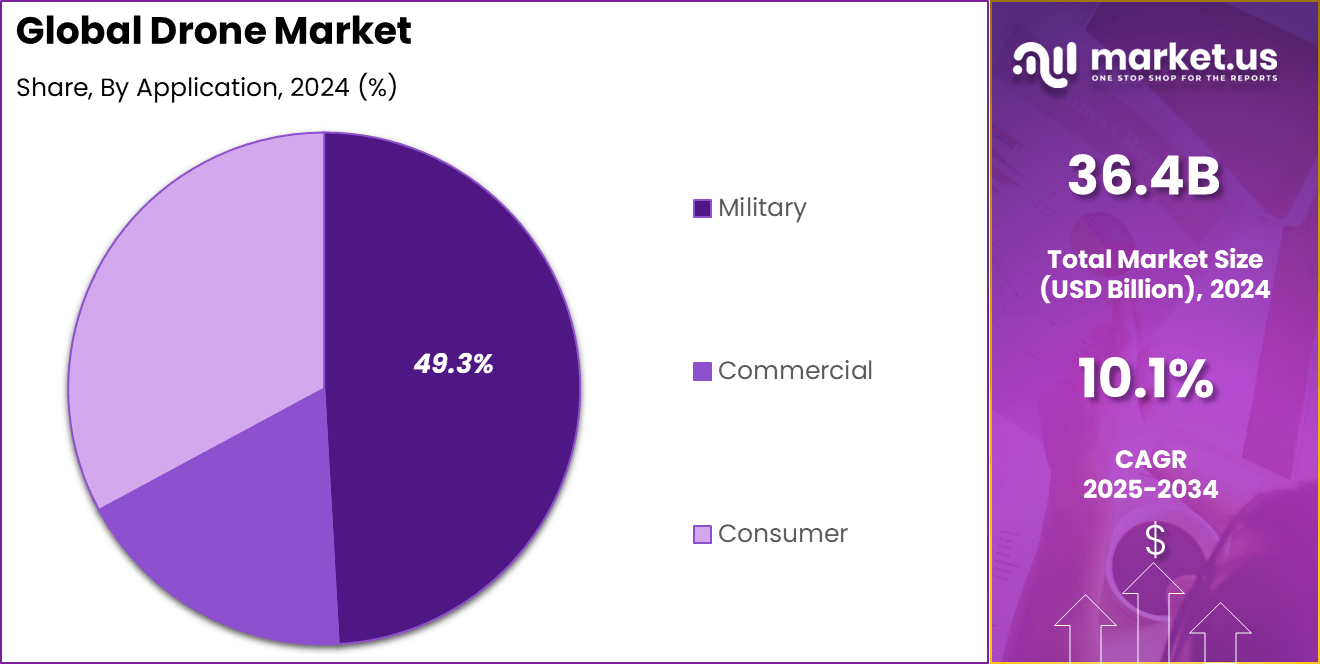
- The Military segment held the largest application share at 48.8% in 2024.
- According to SeedScientific, DJI holds approximately 80% of the US market and 60% of the global drone market.
- The FAA registered 855,860 drones in the United States as of 2024, with 270,183 certified remote pilots.
- The drone industry is projected to create 103,776 jobs by 2025.
- Global drone revenue is forecast to reach USD 63.6 Billion by 2025.
- Non-military drone operations are estimated to exceed 13 million units by 2030.
Market Segmentation Overview
Rotary Wing Drones dominate the type segment with a 61.1% share in 2024. These drones offer vertical takeoff and landing capability, making them ideal for urban and confined environments. However, Fixed-Wing Drones steadily gain ground, growing from 31.7% to 38.9% between 2019 and 2024.
Rotary wing models attract a wide user base because of their ease of operation and flexibility. Hobbyists and professionals rely on quadcopters for photography, inspection, and emergency response. Additionally, ongoing improvements in battery life and payload capacity continue to strengthen their market position.
The Military segment commands 48.8% of total application share in 2024. Defense agencies deploy drones for intelligence, surveillance, reconnaissance, and targeting. Consequently, military budgets across major economies continue to allocate substantial funding toward UAV procurement and development.
The Commercial segment holds 35.5% of application share and is the fastest-growing civilian category. Construction applications lead within this segment at 56.7%, followed by public safety at 15.1%. Agriculture, oil and gas, and mining also contribute to commercial drone growth.
The Consumer segment represents 15.7% of market share but remains important for industry awareness and pilot development. Consumer drone users account for a large portion of the FAA-registered fleet. Moreover, consumer demand influences product innovation that later transfers to professional-grade applications.
Partner With Industry Experts at [email protected] for Actionable, Evidence-Based Strategies
Drivers
Technological advancements power drone market growth. Manufacturers develop improved battery systems, advanced imaging sensors, and AI-driven autonomous flight capabilities. These innovations expand operational range and reduce the need for human oversight. Therefore, drones deliver measurable efficiency gains across agriculture, logistics, and infrastructure sectors.
Expanding commercial applications accelerate market adoption. Businesses in construction, real estate, and media increasingly rely on drones for cost-effective data collection. Additionally, delivery companies actively test drone-based last-mile logistics, creating new revenue channels. The growing variety of use cases validates commercial investment and encourages further product development.
Use Cases
Agricultural drone use transforms crop management practices. Farmers deploy drones for crop health monitoring, irrigation planning, and yield optimization. According to market projections, agriculture could account for 80% of commercial drone usage in the near future. This concentration reflects drones’ ability to cover large areas with speed and precision.
Infrastructure inspection represents another high-value application for drone technology. Drones perform detailed checks on bridges, power lines, pipelines, and buildings. This segment is expected to grow by 50% over the next five years. Consequently, asset owners reduce inspection costs and improve worker safety by removing personnel from hazardous environments.
Major Challenges
Regulatory complexity creates operational barriers for drone operators. Approval processes for commercial flights often extend beyond one month in many jurisdictions. Compliance costs burden smaller operators and delay new application testing. Therefore, businesses must invest significant resources to navigate fragmented airspace regulations across different countries.
Cybersecurity threats pose a serious risk to drone operations. Drones used in military, infrastructure, and critical services remain vulnerable to hacking and electronic interference. Data theft and operational sabotage represent real concerns. Moreover, public concerns around privacy and noise create social resistance, particularly in densely populated urban areas.
Business Opportunities
Emerging market expansion offers a major growth opportunity for drone manufacturers and service providers. Asia-Pacific, Latin America, and Africa show rising demand driven by industrialization and digital adoption. Governments in these regions increasingly support drone use in agriculture and logistics. Consequently, early market entrants can establish strong positioning before competition intensifies.
Drone-as-a-Service (DaaS) models open new revenue streams for technology providers. Companies without in-house drone capabilities subscribe to managed services for inspections, mapping, and deliveries. This model reduces capital expenditure for end users and creates recurring revenue for providers. Additionally, the drone delivery market is expected to reach USD 27.4 Billion by 2030.
Regional Analysis
Asia-Pacific drives global market leadership through strong industrial and government adoption. The region generated USD 14.63 Billion in 2024, representing 40.2% of global revenue. China, Japan, South Korea, and India lead regional adoption. Moreover, China-based DJI controls approximately 60% of the global market, reinforcing the region’s manufacturing dominance.
North America maintains strong market presence through military spending and commercial innovation. The US military operates over 10,000 drones, and the FAA has registered 855,860 units nationwide. Furthermore, over 40 companies actively compete in the US market, with regulatory development enabling broader commercial drone deployment.
Ready to Go Deeper? Our Data Experts Are Just an Email Away at [email protected]
Recent Developments
- January 2025: DJI launched the DJI Flip, a 249-gram foldable drone targeting content creators. It features a 1/1.3-inch 48MP CMOS sensor with 4K HDR video at 60fps and 100fps slow-motion capability.
- January 2025: Pix4D and Freefly Systems announced a strategic partnership. The collaboration integrates photogrammetry software with Freefly’s high-performance drone hardware for improved aerial data collection.
- January 2024: Autel Robotics introduced the Dragonfish VTOL series. Models include Lite, Standard, and Pro variants, designed for mapping, surveying, public safety, and environmental monitoring.
Conclusion
The global drone market presents a compelling growth story driven by technology, defense investment, and commercial expansion. Market size is forecast to nearly triple from USD 36.4 Billion in 2024 to USD 95.4 Billion by 2034. Therefore, stakeholders across industries have strong incentive to engage with this market now.
AI integration, 5G connectivity, and expanding regulatory clarity continue to elevate the strategic value of drone technology. Military, commercial, and consumer segments all demonstrate growing demand. Moreover, the rise of drone delivery and DaaS business models signals that market applications will diversify further over the coming decade.
Businesses that invest in drone capabilities today will gain first-mover advantages in cost efficiency, data quality, and service delivery. Emerging markets offer especially high growth potential for forward-looking operators. Consequently, the drone industry is set to remain one of the most dynamic and strategically important technology sectors through 2034.
Request a Custom Report or Consultation — Write to Us at[email protected]