










Introduction
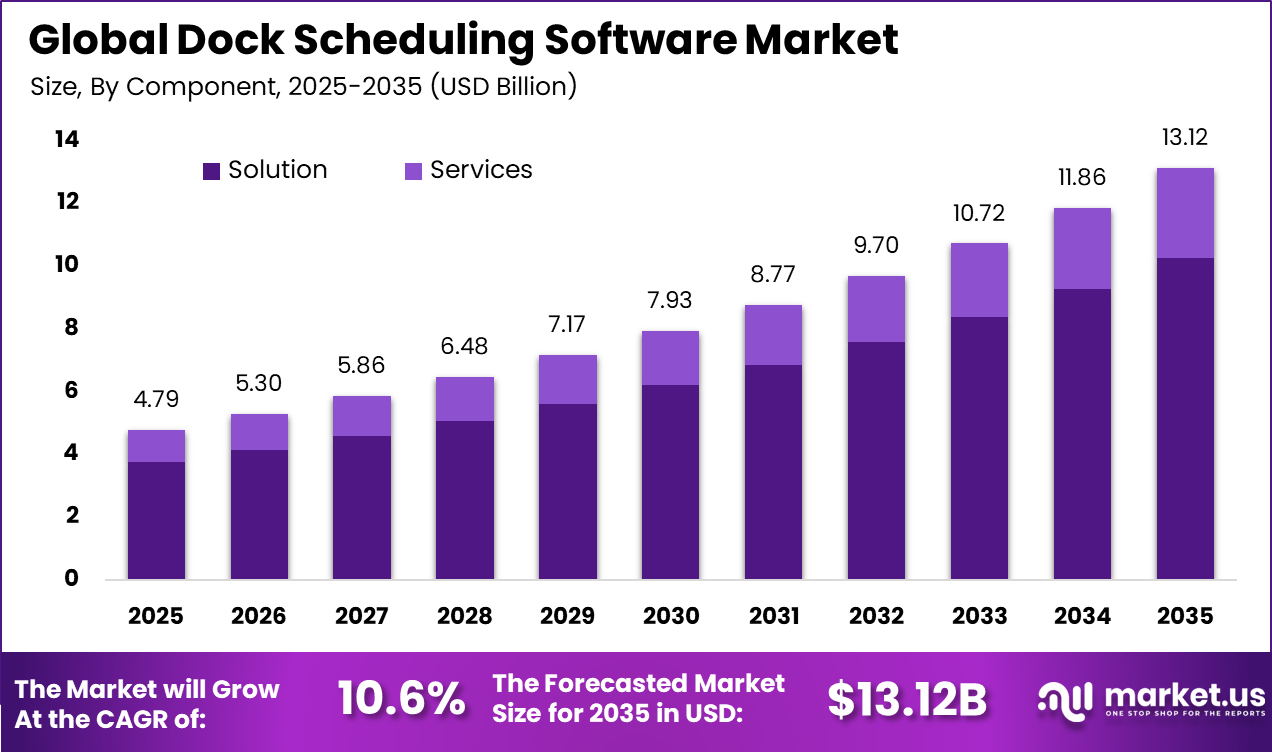
The global Dock Scheduling Software Market is set to grow from USD 4.79 billion in 2025 to around USD 13.12 billion by 2035, expanding at a solid CAGR of 10.6% (2025–2035) as warehouses and distribution centers race to digitize dock operations and reduce congestion, delays, and detention fees.
This surge is driven by rising e‑commerce volumes, tighter delivery windows, labor constraints, and sustainability mandates, which are pushing logistics networks to adopt cloud‑based, data‑driven scheduling platforms that orchestrate carrier appointments across busy yards and cross‑dock facilities.
Request For Sample Report Here @ https://market.us/report/dock-scheduling-software-market/request-sample/
Market Overview
According to Market.us, the global Dock Scheduling Software Market is projected to rise from USD 4.79 billion in 2025 to approximately USD 13.12 billion by 2035, registering a robust 10.6% CAGR over the forecast period. The market is transitioning from manual spreadsheets and phone‑based booking to integrated, cloud‑native platforms that allow carriers, 3PLs, and shippers to reserve dock slots online, synchronize with TMS and WMS systems, and manage inbound/outbound flows in real time.
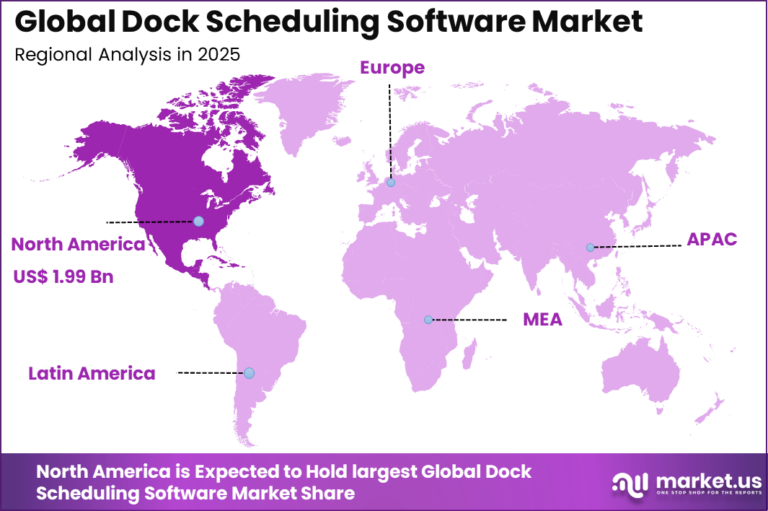
North America holds a dominant position, capturing 41.67% of global revenue—equivalent to about USD 1.99 billion in 2025—supported by advanced logistics infrastructure, high technology adoption, and strong momentum in e‑commerce and grocery distribution. Within North America, the United States and Canada are leveraging digital dock platforms to cut detention, reduce yard congestion, and improve asset utilization, reinforcing the region’s leadership in dock and yard digitization.
Key Takeaways
- Global dock scheduling software market size in 2025: USD 4.79 billion.
- Forecast global market size in 2035: USD 13.12 billion.
- Forecast CAGR (2025–2035): 10.6%.
- North America market share in 2025: 41.67%.
- North America revenue in 2025: USD 1.99 billion.
- Cloud‑based deployment share in 2025: 64.35%.
- Warehouse‑focused dock scheduling (broader reference): around 43% share of related dock/yard applications in 2025, reflecting warehouse‑centric adoption.
- Example outcome: Infor’s October 2025 cloud dock scheduler helped North American food distributors reduce idling emissions by 15%, aligning efficiency with ESG goals.
- Example outcome: Descartes’ November 2025 cross‑border appointment syncing with Canadian 3PLs cut detention fees by 20% in U.S.–Canada flows.
Connect with expert @ [email protected]
| Report Features | Description |
| Market Value (2025) | USD 4.7 Bn |
| Forecast Revenue (2035) | USD 13.1 Bn |
| CAGR (2025-2035) | 10.60% |
| Base Year for Estimation | 2025 |
| Historic Period | 2020-2024 |
| Forecast Period | 2025-2035 |
| Report Coverage | Revenue forecast, AI impact on Market trends, Share Insights, Company ranking, competitive landscape, Recent Developments, Market Dynamics and Emerging Trends |
| Segments Covered | By Component (Solution, Services), By Deployment (Cloud-based, On-premises), By Enterprise Size (Large Enterprises, Small & Mid-Sized Enterprises (SMEs), By Application (Warehouse Management, Transportation Management, Yard Management, Cross-docking Operations, Others), By End-use (Logistics and Transportation, Retail and e-commerce, Manufacturing, Food and Beverage, Healthcare and Pharmaceuticals, Wholesale and Distribution, Others) |
| Regional Analysis | North America – US, Canada; Europe – Germany, France, The UK, Spain, Italy, Russia, Netherlands, Rest of Europe; Asia Pacific – China, Japan, South Korea, India, New Zealand, Singapore, Thailand, Vietnam, Rest of Latin America; Latin America – Brazil, Mexico, Rest of Latin America; Middle East & Africa – South Africa, Saudi Arabia, UAE, Rest of MEA |
| Competitive Landscape | 4SIGHT Connect, Blue Yonder, C3 Solutions, Descartes Systems, Epicor Software, Infor, Manhattan Associates, Oracle, SAP, Zebra Technologies, Open Systems (ProcessPro), ALC Logistics, Roper Technologies (IntelliTrans), DataDriven Recycling, NCR, Exotrac, Transporeon Group, Others |
| Customization Scope | Customization for segments and region/country levels will be provided. Moreover, additional customization can be done based on the requirements. |
Segmentation Deep Dive
By Type / Deployment
Deployment is a critical lens in the Dock Scheduling Software Market, with cloud‑based solutions clearly in the lead.
- Cloud‑based deployment – 64.35% share (2025): Cloud models account for roughly 64.35% of the market, reflecting strong enterprise preference for scalable, centrally managed scheduling platforms that can coordinate multiple sites from unified dashboards. Organizations value cloud solutions for easier multi‑facility rollouts, integration with TMS/WMS, and reduced infrastructure and upgrade costs.
- On‑premises deployment – remaining share: On‑premises systems remain relevant in highly regulated or security‑sensitive environments, but growth is slower due to higher upfront investment, longer deployment timelines, and limited flexibility for remote collaboration compared with cloud.
Cloud‑based dock scheduling is also benefiting from broader trends toward digital supply chain platforms, where dock scheduling is embedded alongside yard management, transportation visibility, and warehouse control, creating a powerful network effect for cloud architectures.
By Application
Within the dock scheduling ecosystem, applications typically span warehouse management, yard management, transportation management, cross‑docking operations, and related workflows.
- Warehouse‑centric scheduling: Broader dock and yard management research shows that warehouse management‑linked applications hold about 43% share in 2025, underscoring that dock scheduling is still primarily anchored in warehouse operations. This dominance stems from the direct impact of dock efficiency on warehouse throughput, labor utilization, and put‑away/pick sequencing.
- Transportation‑linked scheduling: Integrations with TMS allow carriers and shippers to book and adjust appointments directly from transportation workflows, improving on‑time performance and reducing detention and rehandling.
- Yard and cross‑dock operations: As cross‑docking and high‑velocity DCs expand, dock scheduling software is increasingly used to choreograph tight transfer windows, ensuring inbound and outbound doors are synchronized to minimize dwell.
Applications tied to high‑volume distribution centers, grocery and foodservice networks, parcel hubs, and omnichannel retail are growing fastest, because these nodes face intense pressure to turn trailers quickly and meet narrow delivery windows.
By End‑User
Dock scheduling software serves a mix of retailers, e‑commerce companies, manufacturers, 3PLs, carriers, and cold‑chain and CPG operators.
- Retailers and e‑commerce players: These organizations prioritize dock scheduling to manage surging inbound volumes, tighten delivery appointments, and reduce congestion at regional distribution centers, especially during peak seasons.
- Manufacturers: Manufacturing plants rely on structured dock schedules to ensure just‑in‑time deliveries of raw materials and components, preventing line stoppages and smoothing outbound shipments to customers and dealers.
- 3PLs and logistics providers: 3PLs deploy dock and yard platforms as a value‑added service, giving clients real‑time appointment visibility and analytics while improving facility efficiency and lowering detention penalties.
- CPG, food, and cold‑chain: These sectors use dock scheduling to coordinate temperature‑sensitive loads, reduce door wait times, and align with sustainability targets such as reduced idling emissions, as illustrated by food distributors leveraging Infor’s cloud dock scheduler.
End‑user segments directly exposed to high delivery frequency, strict SLAs, and ESG scrutiny are expected to show the strongest long‑term adoption and expansion.
Regional Analysis
North America is the clear leader in the Dock Scheduling Software Market, holding a 41.67% global share and generating approximately USD 1.99 billion in revenue in 2025. The region’s dominance stems from a combination of advanced logistics infrastructure, dense warehouse and distribution center networks, and a high degree of digitalization in supply chain management.
The United States and Canada have been early adopters of dock scheduling software as they confront tight trucking capacity, rising transportation costs, and e‑commerce‑driven volatility. In North American food distribution, for instance, Infor’s cloud dock scheduler has been embraced to achieve a 15% reduction in idling emissions, directly linking dock efficiency with sustainability outcomes. In November 2025, Descartes Systems expanded its dock scheduling platform through partnerships with three major Canadian 3PLs, offering cross‑border appointment syncing that cut detention fees by 20% on U.S.–Canada lanes, further reinforcing the region’s leadership in seamless, digitally managed flows.
Outside North America, Europe and Asia Pacific are emerging as important growth arenas. Europe’s adoption is shaped by complex cross‑border trade, stringent regulatory requirements, and high labor costs that incentivize automation, while Asia Pacific benefits from rapid e‑commerce expansion, infrastructure investment, and growing adoption of cloud‑based logistics tools. As these regions invest more heavily in digital dock and yard management, the global market will become increasingly balanced, but North America is expected to remain a key innovation and revenue hub over the forecast horizon.
Market Leaders
The Dock Scheduling Software Market is populated by a mix of specialist dock/yard vendors, broader logistics software providers, and enterprise technology platforms. Notable players and ecosystem contributors include:
- Descartes Systems Group – Provides dock scheduling as part of a broader logistics and compliance suite, with strong cross‑border capabilities.
- Infor – Offers cloud‑based dock scheduling embedded in warehouse and supply chain platforms, with a focus on ESG reporting and food distribution use cases.
- C3 Solutions – Specializes in dock scheduling and yard management, with solutions such as C3 Reservations and C3 Yard emphasizing predictive analytics and real‑time adjustments.
- Velostics – Focuses on AI‑driven dock scheduling and freight orchestration, improving real‑time decision‑making and dynamic dock allocation.
- Glide (platform) – Enables organizations to build custom dock scheduling applications with embedded AI and integrations to spreadsheets or databases.
In addition, the broader dock and yard management ecosystem is supported by vendors offering integrated dock/yard modules within transportation and warehouse management platforms, as well as emerging SaaS providers targeting specific verticals or regional markets.
Recent Developments
Recent moves from leading vendors highlight the market’s shift toward cloud‑based, AI‑enabled, and sustainability‑aligned dock scheduling solutions.
- Infor – Cloud Dock Scheduler with ESG Reporting (October 2025): In October 2025, Infor released a cloud dock scheduler with embedded ESG reporting capabilities, enabling logistics organizations—particularly North American food distributors—to track and reduce truck idling. Early adopters reported a 15% reduction in idling emissions, demonstrating how scheduling efficiency can support environmental goals.
- Descartes Systems – Cross‑Border Expansion with Canadian 3PLs (November 2025): In November 2025, Descartes expanded its dock scheduling platform via partnerships with three leading Canadian 3PLs, introducing cross‑border appointment syncing that reduced detention fees by 20% and enhanced coordination across U.S.–Canada supply chains.
- Velostics – AI‑Driven Dock Optimization (2025): Velostics continued to promote its AI‑driven dock platform, which uses real‑time data and AI to automate dock assignment and scheduling, reducing congestion during peaks and improving throughput.
- C3 Solutions – AI Integration for Contactless Delivery (2024): C3 Solutions emphasized AI integration across its dock scheduling and yard solutions, showcasing predictive scheduling and real‑time adjustments to enable contactless delivery, reducing wait times and improving dock capacity utilization.
- Glide – AI‑Enabled Low‑Code Dock Solutions (Ongoing): Glide has positioned its low‑code platform as a way for firms to rapidly build dock-scheduling applications with AI features such as data extraction and automated workflows, thereby accelerating digital adoption among SMEs.
These developments underscore a clear direction: next‑generation dock-scheduling platforms will combine cloud, AI, analytics, and ESG reporting to deliver measurable operational and sustainability gains.
How AI is Reshaping the Future of Dock Scheduling Software Market
AI is moving dock scheduling from static calendars to adaptive, self‑optimizing systems that continuously align dock capacity with volatile freight flows. AI‑driven platforms ingest data from TMS, WMS, telematics, carrier ELDs, yard sensors, and even weather feeds to dynamically predict arrivals, adjust time slots, and prioritize urgent loads, significantly reducing idle time and congestion in yards.
According to Velostics, AI‑driven dock scheduling leverages real‑time data streams from connected IoT devices and warehouse systems to enable instant adjustments to dock plans, cutting truck idle times and increasing throughput across high‑traffic facilities. Velostics highlights that AI systems can dynamically assign docks based on real‑time needs—such as shipment urgency, load type, and resource availability—substantially reducing peak‑hour congestion and improving overall facility utilization.
Further More
AI also powers predictive scheduling, where algorithms forecast peak periods and potential delays, then automatically smooth appointment patterns throughout the day. C3 Solutions notes that predictive scheduling uses analytics and machine learning to assign docking times automatically and evenly, reducing manual judgment and phone calls while aligning truck arrivals with labor and equipment availability. C3’s C3 Reservations platform integrates predictive analytics and real‑time adjustments to optimize dock utilization and delivery performance, while C3 Yard extends these capabilities into yard management, increasing gate throughput and reducing detention costs.
Low‑code platforms like Glide are embedding AI directly into customizable dock scheduling solutions, enabling organizations to build tailored scheduling apps that analyze, extract, and generate operational insights without heavy coding. Glide AI can help automate workflows such as approval routing, exception notifications, and capacity alerts, making sophisticated scheduling intelligence accessible to midsize shippers and 3PLs.
As AI becomes more deeply integrated, dock scheduling software is expected to evolve into the nerve center of yard and inbound logistics, coordinating not only dock doors but also gates, parking areas, labor assignments, and equipment, while supporting scenarios such as contactless delivery and autonomous yard tractors. Over the next decade, AI‑enabled dock platforms will be central to building self‑healing, sustainable logistics hubs that automatically rebalance schedules when disruptions occur, minimizing delays and emissions simultaneously.
Conclusion
The Dock Scheduling Software Market is entering a multi‑year expansion cycle, with global revenues forecast to rise from USD 4.79 billion in 2025 to USD 13.12 billion by 2035 at a compelling 10.6% CAGR. As freight networks grow more complex and labor and capacity constraints intensify, dock scheduling software is evolving from a tactical scheduling tool into a strategic control point for warehouse and yard performance, risk management, and sustainability.
For investors, technology providers, and logistics leaders, the market offers attractive opportunities at the intersection of cloud SaaS, AI, and supply chain resilience. Vendors that can deliver highly configurable, AI‑enhanced, cloud‑based dock platforms with strong integration capabilities and clear ROI, through reduced detention, higher throughput, and lower emissions, are best positioned to capture outsized value as adoption matures globally.
Organizations that move early to standardize on next‑generation dock-scheduling solutions will be better equipped to navigate demand swings, meet tighter service levels, and support ESG commitments in an increasingly competitive logistics landscape.