










Introduction
AI Replacing Jobs Statistics: Artificial intelligence is transforming how work is done, as smart machines and algorithms now handle tasks once performed by humans, from factories to offices. This shift brings both opportunities and challenges, as AI improves speed and efficiency while also replacing millions of jobs worldwide. Recent statistics show that industries such as manufacturing, retail, and even finance are experiencing greater automation than ever. In this article, we look at the latest numbers and trends to understand how AI is reshaping jobs today and in the near future.
Editor’s Choice
- AI could affect up to 300 million jobs worldwide by 2025, with about 85 million expected to be replaced.
- Generative AI is projected to replace about 25 million full-time jobs in 2026.
- Administration jobs could fall by 26%, customer service by 20%, and production work by 13%.
- 64% of manufacturing tasks could be automated with current technology.
- 32% of U.S. workers say AI will lead to fewer job opportunities for them in the long run.
- About 11.7% of the U.S. workforce could already be replaced by AI today, meaning more than 1 in 10 workers might lose their jobs as AI performs work tasks.
- The IMF (specifically Managing Director Kristalina Georgieva) stated that 40% of jobs globally are exposed, which includes 60% in advanced economies, 40% in emerging markets, and 26% in low-income countries.
- About 55,000 jobs in the United States were directly lost in 2025 due to AI automation.
- Besides, 60% of jobs in Advanced Economies are at risk of AI automation.
- Among young adults aged 18-24, 52% worry AI will harm their future careers.
- Around 55% of workers think AI will take away more jobs than it creates, and 52 % are worried about how AI will affect their work lives.
Key Findings
- According to the World Economic Forum, AI systems are now technically capable of performing or assisting with about 18,000 work tasks, covering nearly 1,000 job roles in the U.S., with a total current labor value of USD 4.5 trillion that AI could handle.
- AI “exposure,” or how many jobs can be affected, is increasing 9% per year, faster than 2% before.
- The Times of India also reported that around 25% of all work tasks in the U.S. could be automated by AI.
- Research on large language models like GPT‑4 suggests that about 19% of U.S. workers could see at least half of their tasks impacted by these systems.
- Around 34% of tasks could be fully automated by 2030.
Projected Impact Of AI On Jobs
- According to Demand Sage, AI could affect up to 300 million jobs worldwide by 2025, with about 85 million expected to be replaced.
- Around 40% of all jobs are likely to be affected by AI-related changes.
- Oxford predicts 20 million manufacturing jobs may be lost by 2030.
- By 2050, 60-80% of jobs could be automated or transformed.
- AI may create 170 million new jobs, resulting in a net gain of 78 million jobs.
- Women face nearly three times higher automation risk than men.

(Reference: vercel-storage.com)
- Generative AI is projected to replace about 25 million full-time jobs in 2026.
- The impact is expected to increase significantly, with up to 90 million full-time jobs potentially replaced by 2030.
- In Advanced Economies, about 60% of jobs are exposed to some level of AI automation.
- In Low-Income Countries, around 26% of jobs are at risk of AI automation.
- Approximately 25% of workers are concerned that AI could make their jobs obsolete.
- Analysis of 21 OECD countries shows that 27% of jobs are at high risk of automation, including AI and other technologies.
- By 2026, AI-driven robotics could replace around 2 million manufacturing workers worldwide, according to research from MIT and Boston University.
Job Losses By Sector
- According to Botereview, administration jobs could fall by 26%, customer service by 20%, and production work by 13%, making these areas the most affected by AI automation.
- Tertiary jobs like legal and education may see 6% job losses, while the management sector is the least affected at 3%.
| Industry | Job Role | Risk Details |
| Customer Service | Customer Service Representatives | 80% of routine customer service tasks were automated in 2025. |
| Administration | Data Entry and Administrative Support | With up to 95% of tasks potentially automated. |
| Retail | Retail Cashiers and Checkout Workers | 65% of jobs |
| Logistics / Trucking | Transportation and Logistics | An estimated 1.5 million jobs could be lost by 2030. |
| Manufacturing | Manufacturing Workers | More than 50% of jobs may be automated by 2030. |
| Banking & Finance | Financial Services | 70% of roles were exposed to automation in 2025, with 54% considered high-risk. |
| Legal | Legal Support Staff | 80% of paralegal tasks could be automated by 2026, and 65% of research roles will be automated by 2027. |
| Healthcare | Healthcare Support Roles | In 2025, 99% of medical transcription and 40% of medical coding tasks were automated. |
| Media & Marketing | Content Creation and Media | 50% of writers’ and 30% of reporters’ tasks may be automated by 2030. |
| HR | Human Resources Support | 85% of recruitment screening and 90% of benefits administration tasks could be automated between 2025 and 2027. |
Global Manufacturing And Automation Trends
- PatentPC further stated that 64% of manufacturing tasks could be automated with current technology.
- 20 million manufacturing jobs globally could be displaced by 2030 due to automation.
- Around 42% of manufacturing labor time involves repetitive tasks, which are prime for automation.
- 25% of industrial robots globally are used in the automotive sector, and Germany leads Europe with 371 robots per 10,000 workers.
- South Korea has the highest robot density, over 900 per 10,000 workers, while in Japan, more than 50% of factory operations are fully automated.
- 47% of employers struggle to find skilled workers, and 38% see reskilling as a major challenge.
- 45% of manufacturers are using AI and machine learning, and 76% believe hybrid human-robot teams will define the future.
- The global industrial robotics market is projected to reach USD 75 billion by 2030, with adoption growing at 14% CAGR.
- 65% of manufacturers report improved product quality, and 70% of CEOs cite automation as a key cost-reduction strategy.
- By 2030, up to 800 million jobs worldwide could be affected by automation, with manufacturing the most exposed sector.
By Workforce Type
| Workforce | Impacts |
| White-collar (Entry-level) | Axios report stated that 10% to 20% of jobs could be affected within 1–5 years. |
| White-collar & Blue-collar | A report published by the Oliver Wyman Forum found that 67% of white-collar workers, 60% of transport workers, and 59% of retail workers share concerns. |
| University Graduates | In 2025, 40% of graduates chose trade work. |
| Professionals | 52% of respondents agree that trade jobs are less exposed to AI automation. |
| Lower-skilled workers | Employment share may decline by 0.001% per AI adoption unit. |
| OECD (21 countries) | Around 9% of jobs are considered at risk from automation. |
Worker Concerns Over AI Impact On Jobs
- 52% of workers feel worried about AI in the workplace, compared with 36% who feel hopeful.
- Only 29% feel excited, and 33% feel overwhelmed by the idea of AI at work.
- Metaintro also shows that around 39% of workers are concerned they won’t receive enough training on new technology.
- Meanwhile, 43% also expect their job to change significantly due to AI within the next five years.

(Source: buttercms.com.com)
- 55% of workers believe AI will eliminate more jobs than it will create.
- 43% of workers fear AI could make their job seem unnecessary or obsolete, according to CNBN.
- Only 32% of employees think their company has been open about its use of AI.
Workers At Risk Of Job Loss Due To AI
- A 2024 MIT CSAIL working paper regarding the cost-effectiveness of computer vision stated that about 11.7% of the U.S. workforce could already be replaced by AI today, meaning more than 1 in 10 workers might lose their jobs as AI performs work tasks.
- Over the next decade, roughly 47% of U.S. jobs could be at risk of automation.

(Reference: wearetenet.com)
- The IMF (specifically Managing Director Kristalina Georgieva) stated that 40% of jobs globally are exposed, which includes 60% in advanced economies, 40% in emerging markets, and 26% in low-income countries.
- Across the U.S. and Europe, nearly two‑thirds of jobs face some level of automation exposure.
- An authoritative joint study by OpenAI and the University of Pennsylvania found that only 19% of U.S. workers had more than half of their daily tasks influenced by AI.
- According to Punku.ai, 80% of U.S. workers could have at least 10% of their tasks affected by language models like GPTs.
- Only about 23% of workers are in jobs least likely to be replaced by AI.
- AI systems could handle 25% of all current work tasks.

(Reference: wearetenet.com)
- 27% of those with a bachelor’s degree, 19% with some college, and 12% with only a high school education face high exposure.
Are Workers Afraid AI Will Take Their Jobs?
- Pew Research also reported that about 32% of US workers believe AI will lead to fewer job opportunities for them.
- More than 43% fear that using AI at work could eventually make their own role unnecessary.
- Around 55% of people believe AI will remove more jobs than it creates.
- Only 6% of workers think AI will create more job opportunities over time.
- According to AIBase, among young adults aged 18-24, 52% worry AI will harm their future careers.
- A report published by the National University depicts that younger workers are 129% more likely than older workers to fear AI-driven job loss.
- Meanwhile, the dig.watch report also mentioned that 38% of Asian workers said they fear AI is replacing their jobs in 2026.
- Fully remote staff are 42% more likely to believe AI will disrupt their job.
AI Replacing Jobs Statistics By Region
- According to SQ Magazine, about 55,000 jobs in the United States were directly lost in 2025 due to AI automation.
- India expects more than 80% of routine tasks in Global Capability Centres to be automated.
- Japan projects a shortage of 3.39 million workers in AI and robotics roles by 2040 and is already struggling to meet demand.
- South Korea leads globally with about 1,012 robots per 10,000 workers.
- The UK could have around 3.9 million AI‑related jobs by 2035.
- Brazil’s fintech industry processes about 120,000 automated operations daily.
- China is preparing for millions of workers to shift jobs, as AI reshapes labour markets.
Global Job Risks And Worker Concerns About AI
- A recent Computer World article reports that about 60% of jobs in Advanced Economies are at risk of AI automation.
- In Low-Income Countries such as Nigeria and Kenya, around 26% of jobs are exposed to AI.
- Emerging Markets like China, India, and Brazil have about 47% of jobs exposed to AI automation.
- Countries with the highest share of jobs at risk from AI include Switzerland (71%), South Korea (70%), Japan (68%), and Great Britain (67%), while the United States has 59% of jobs at risk.
- A CNBC survey finds that roughly 24% of workers worry that AI could make their jobs obsolete.
- 19% of white workers, 32% of Black workers, 35% of Hispanic workers, and 38% of Asian workers say they are worried about AI’s impact on their jobs.
Jobs And Tasks AI Is Least Likely To Replace
- Jobs that require hands-on work, such as dredge operators, rail engineers, and mold makers, are least likely to be replaced by AI.
- A study by ide.mit.edu finds that tasks involving vision account for only about 1.6 % of total wages in the U.S. economy, and just 0.4 % of wages could be cost‑effectively automated by AI at today’s costs.
- About 23 % of workers are employed in jobs that are among the least exposed to AI.
- The IMF’s global analysis estimates that 40 % of jobs in emerging markets and 26 % in low‑income countries are exposed to AI.
- Exploding Topics stated that around 63 % believe AI will not change employment rates in high‑income countries.
- Additionally, half of all jobs may still be safe from full automation by 2045.
Will AI Replace Most Human Jobs Soon?
(Reference: sqmagazine.co.uk.com)
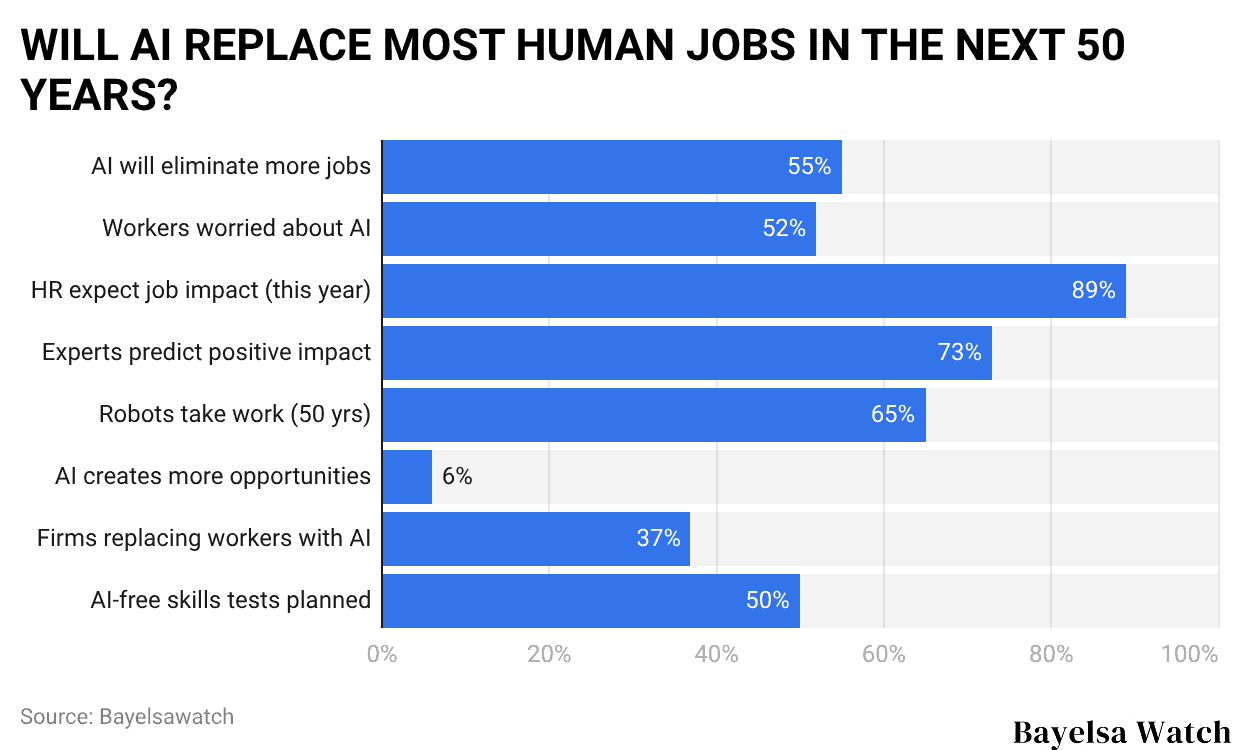
- Around 55% of workers think AI will take away more jobs than it creates, and 52 % are worried about how AI will affect their work lives.
- About 89% of senior HR leaders reported that AI changed job roles in 2025.
- 73% of AI experts believe the overall impact on jobs will be positive over the next 20 years, while 65% expect robots to do much of the human work within the next 50 years.
- Only 6% of workers feel AI will create more jobs in the long run.
- Moreover, 37% of companies plan to replace workers with AI by the end of this year, and 50% of organisations will use tests that focus on non‑AI skills when hiring.
Conclusion
AI is changing the way we work. Machines and smart programs are taking over tasks that humans used to do. This can make work faster and cheaper, but it also puts many jobs at risk. The key is learning new skills and adapting to new roles. By preparing workers for these changes, we can ensure AI helps people rather than replacing them. Understanding these trends today will help shape a better future for both humans and technology.
FAQ
Yes, AI and automation are replacing routine tasks in areas like manufacturing, retail, and data work, but they are also creating new technology-related jobs.
Jobs such as assembly line workers, cashiers, data entry operators, and customer support roles are at the highest risk because they involve repetitive tasks.
No, AI cannot replace all jobs because roles that require creativity, human emotions, and complex thinking are still difficult for machines to perform.