










AI in Travel Market Size
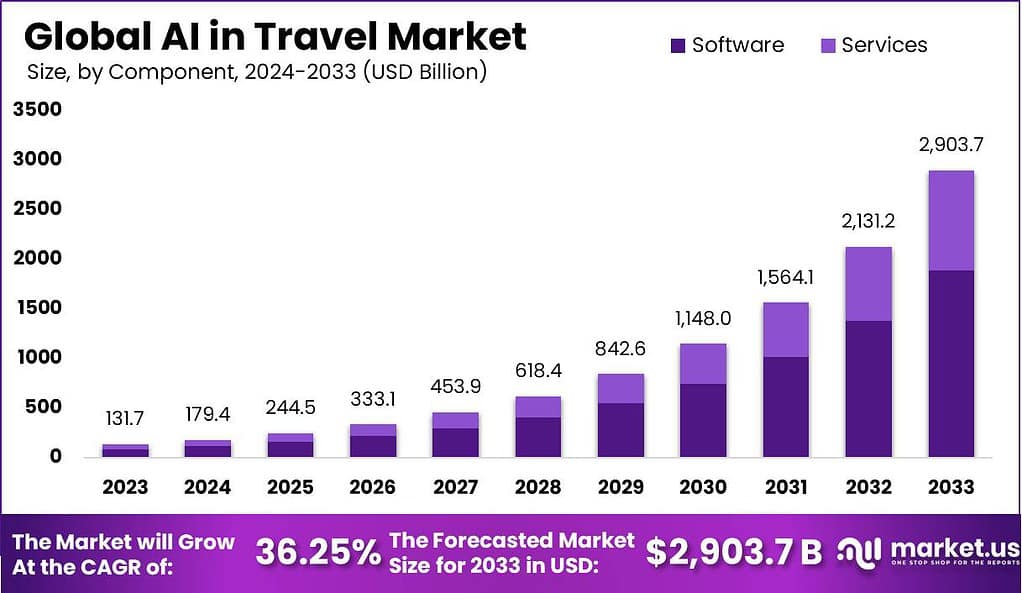
The global AI in travel market is experiencing rapid expansion, supported by increasing digital transformation across the tourism and hospitality ecosystem. The market is projected to reach approximately USD 2,903.7 billion by 2033, rising significantly from USD 131.7 billion in 2023. This sharp increase reflects a strong compound annual growth rate of 36.25% during the forecast period, indicating accelerated adoption of intelligent technologies across travel services.
This growth is largely driven by rising demand for personalized travel experiences, automated customer support, and real-time decision-making tools. AI-powered solutions such as chatbots, recommendation engines, and predictive analytics are being widely integrated to enhance customer engagement and operational efficiency. As travel companies continue to invest in data-driven platforms, AI is expected to play a central role in reshaping booking systems, pricing strategies, and overall service delivery across the industry.
Get a comprehensive report summary that describes the value and forecast along with methodology. Download the PDF brochure
Key Takeaways
- The AI in travel market is projected to reach USD 2,903.7 billion by 2033, growing from USD 131.7 billion in 2023 at a CAGR of 36.25%, reflecting rapid adoption of intelligent travel solutions.
- The software segment led the market in 2023, capturing over 65% share, supported by increasing use of AI-driven platforms for booking, personalization, and operations.
- Cloud-based deployment dominated with more than 61% share, driven by scalability and seamless integration across travel ecosystems.
- The customer service segment held over 25.1% share, reflecting strong adoption of AI-powered chatbots and virtual assistants in traveler interactions.
- North America maintained a leading position, capturing over 34.5% share, with revenues reaching USD 45.4 billion, supported by advanced digital infrastructure and high adoption of AI technologies.
The integration of artificial intelligence in the travel sector has accelerated significantly, particularly during periods of disruption. AI-enabled virtual tours recorded a notable 45% increase in usage during pandemic-related travel restrictions, reflecting how digital experiences supported traveler engagement when physical mobility was limited. It is further estimated that AI technologies could assist the industry in recovering nearly $400 billion in lost revenue, highlighting their strategic importance in post-pandemic recovery. In addition, AI-driven chatbots have demonstrated measurable cost efficiencies, with projected annual savings of around $0.50 billion, reinforcing their role in scalable customer service operations.
Consumer behavior is increasingly aligning with AI-supported travel solutions. Around 75% of travelers express trust in AI for accommodation planning, indicating growing confidence in algorithm-based recommendations. At the same time, approximately 40% of U.S. adults have shown interest in AI-powered virtual travel agents, signaling demand for more personalized and responsive planning tools. However, a balanced service model remains essential, as 37% of customers still prefer human interaction, emphasizing the continued relevance of human support alongside digital systems.
Operationally, AI is expected to drive substantial efficiency gains across the travel ecosystem. Automated travel bookings powered by AI are projected to reach nearly 2.9 billion, reflecting increased reliance on intelligent systems for transaction processing. AI applications are also capable of reducing flight disruption costs by approximately 16%, equivalent to nearly $265 billion in global savings. Airlines that actively invest in AI technologies have the potential to improve operational efficiency by up to 75%, while more than 50% of hotel operators are prioritizing AI investments to enhance service delivery and internal processes.
Get Customized Market Intelligence – Contact Our Team Directly at [email protected]
Report Scope
| Report Features | Description |
| Market Value (2023) | USD 131.7 Bn |
| Forecast Revenue (2033) | USD 2,903.7 Bn |
| CAGR (2024-2033) | 36.25% |
| Base Year for Estimation | 2023 |
| Historic Period | 2019-2022 |
| Forecast Period | 2024-2033 |
| Report Coverage | Revenue Forecast, Market Dynamics, COVID-19 Impact, Competitive Landscape, Recent Developments |
| Segments Covered | By Component (Software, Services), By Deployment (On-premises, Cloud-based), By Application (Customer Service, Booking and Reservations, Travel Planning and Personalization, Marketing and Advertising, Operations Management, Security and Fraud Detection) |
| Regional Analysis | North America – The U.S. & Canada; Europe – Germany, France, The UK, Spain, Italy, Russia, Netherlands & Rest of Europe; APAC- China, Japan, South Korea, India, Australia, New Zealand, Singapore, Thailand, Vietnam & Rest of APAC; Latin America- Brazil, Mexico & Rest of Latin America; Middle East & Africa- South Africa, Saudi Arabia, UAE & Rest of MEA |
| Competitive Landscape | Amadeus, Expedia Group, Booking.com, Sabre, Airbnb, Skyscanner, Kayak, TripActions, Hopper, TravelPerk, Agoda, Google Travel, Cleartrip, MakeMyTrip, CWT, Other Key Players |
| Customization Scope | Customization for segments, region/country-level will be provided. Moreover, additional customization can be done based on the requirements. |
| Purchase Options | We have three licenses to opt for Single User License, Multi-User License (Up to 5 Users), Corporate Use License (Unlimited User and Printable PDF) |
By Component: Software
In 2023, the software segment held a dominant position in the AI in Travel market, capturing more than 65% share. This leadership is driven by the growing use of AI powered applications for booking, pricing, and travel planning. Travel companies are adopting software solutions to automate processes and improve operational efficiency. These tools help deliver faster and more accurate services to customers.
The demand for software is also supported by its ability to enhance personalization and decision making. AI driven platforms analyze user preferences and behavior to provide tailored travel recommendations. This improves customer satisfaction and engagement across digital channels. As travel platforms continue to evolve, software remains a core component of innovation in this market.
By Deployment: Cloud-Based
In 2023, the cloud-based segment led the AI in Travel market, capturing more than 61% share. Cloud deployment allows travel companies to manage large volumes of data efficiently and scale operations as needed. It supports real time data processing, which is essential for dynamic pricing and demand forecasting. This flexibility makes cloud solutions highly attractive for travel businesses.
Cloud platforms also enable seamless integration with multiple systems such as booking engines and customer management tools. Businesses benefit from reduced infrastructure costs and faster deployment cycles. As digital travel services expand globally, cloud-based AI solutions continue to gain strong adoption. This strengthens their position as the preferred deployment model.

By Application: Customer Service
In 2023, the customer service segment held a leading position in the AI in Travel market, capturing more than 25.1% share. Travel companies are increasingly using AI tools such as chatbots and virtual assistants to handle customer queries. These solutions provide instant responses and improve service availability across time zones. This helps enhance the overall customer experience.
The adoption is also driven by the need to reduce operational costs and improve service efficiency. AI powered systems can manage high volumes of interactions without compromising quality. They also support multilingual communication, making them suitable for global travel operations. As customer expectations continue to rise, AI driven customer service solutions remain essential.
Regional Analysis
In 2023, North America held a dominant position in the AI in Travel market, capturing more than 34.5% share with revenues amounting to USD 45.4 billion. The region benefits from advanced technology infrastructure and high adoption of AI solutions across the travel industry. Companies are actively investing in digital tools to enhance customer engagement and streamline operations. This has supported strong market growth.
The presence of major travel platforms and continuous innovation in AI technologies further strengthens the regional market. Businesses in North America are focusing on improving personalization, automation, and real time service delivery. As digital transformation accelerates in the travel sector, the region continues to lead in AI adoption and implementation.

Key Players Analysis
In the AI in Travel market, Amadeus, Expedia Group, and Booking.com are major participants due to their strong digital travel ecosystems and large global customer reach. These companies use AI to improve search relevance, pricing, personalization, and customer support across travel booking platforms. Sabre, Airbnb, and Skyscanner also hold a strong position by applying AI to itinerary planning, demand forecasting, and user experience improvement.
Kayak, TripActions, and Hopper are important players that use AI to simplify travel decisions and automate booking workflows. Their platforms help users compare options, predict fares, manage business travel, and reduce planning time. TravelPerk, Agoda, and Google Travel further strengthen the market by offering AI-enabled recommendations, smarter travel management, and better customer engagement across leisure and corporate travel segments.
Cleartrip, MakeMyTrip, and CWT add depth to the competitive landscape through regional strength, enterprise travel capabilities, and digital booking innovation. These companies are using AI to improve customer targeting, service efficiency, and operational decision-making. Other key players continue to support market growth by introducing new AI features in trip planning, virtual assistance, and dynamic pricing across the travel value chain.
Top Key Players in the Market
- Amadeus
- Expedia Group
- com
- Sabre
- Airbnb
- Skyscanner
- Kayak
- TripActions
- Hopper
- TravelPerk
- Agoda
- Google Travel
- Cleartrip
- MakeMyTrip
- CWT
- Other Key Players