










Introduction
AI In FinTech Statistics: Artificial Intelligence (AI) is changing the way financial services work. It helps companies handle data faster, make better decisions, and offer smarter solutions. In FinTech, AI is used for tasks such as fraud detection, customer support, and personalized financial advice. This makes services quicker, safer, and more user-friendly. From chatbots to automated investments, AI is shaping a new digital future for finance. As it grows, it not only improves efficiency but also creates a more accessible and innovative financial system for everyone.
Editor’s Choice
- The Global AI in Fintech Market size is expected to reach around USD 20.6 billion by 2026.
- PatentPC also reports that the United States leads in AI fintech patents, with around 45% share globally, followed by China at about 38%.
- As of 2025, solutions held 71.45% share in the AI fintech market.
- AI adoption among top fintech startups reached 88%, helping save the global financial industry over USD 500 billion annually by 2030, with USD 120 billion already saved in 2025.
- The global AI-driven fintech market shows that Digital Payments lead the sector, holding 23.9% of the total share.
- Banks lead the adoption of AI in fintech, accounting for 25.0% of total end users.
- China is expected to lead AI in fintech market growth in emerging economies, with a CAGR of 20.4% between 2025 and 2035.
- About 92% of financial firms are investing in AI and machine learning.
- First-Contact resolution in retail banking has exceeded 85% and is supported by AI-powered voice and virtual assistants.
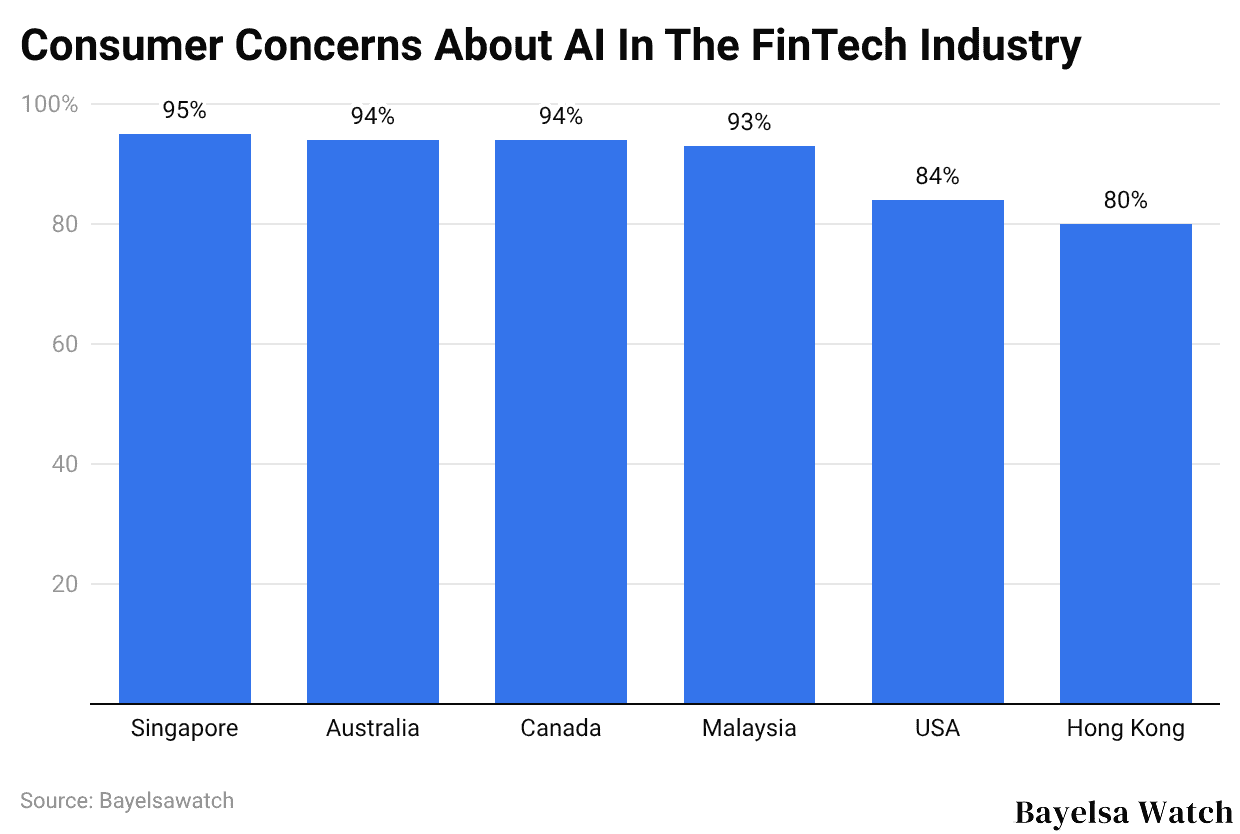
- Consumer concern about AI-powered financial services is very great, at 95% in Singapore, 94% in Australia, and 94% in Canada.
Key Takeaways
- According to PatentPC, over 60% of financial institutions are actively investing in AI and machine learning technologies.
- AI-related patent filings in finance have surged by more than 250% over the past five years.
- The top five global banks collectively hold over 5,000 AI patents.
- China and the U.S. account for more than 70% of all AI patent filings.
- Over 40% of AI patents focus on fraud detection and risk management.
- AI-driven trading systems now manage over 70% of stock market transactions.
- In recent years, 50% of AI patents in finance focus on blockchain, smart contracts, and digital payments.
- About 30% of fintech startups use AI for decision-making, and 75% of AI patents target automation tasks like KYC and risk scoring.
AI In Fintech Market Size

(Source: market.us)
- The Global AI in Fintech Market size is expected to reach around USD 20.6 billion by 2026, increased from USD 17.1 billion in 2025.
- By the end of 2033, the market will reach around USD 76.2 billion, with a CAGR of 20.5% from 2024 to 2033.
Segmental Analysis
- According to Mordor Intelligence 2025, solutions held 71.45% share in the AI fintech market.
- Moreover, the service segment grows at a CAGR of 27.95% from 2026 to 2031.
| Segment | Market Share, 2025 | Growth Trend (CAGR from 2026 to 2031) |
| Application | Fraud & Risk Management (30.55%) | Chatbots & Virtual Assistants (34.8%) |
| Organization Size | Large Enterprises (87.25%) | SMEs & Neo-banks (28.6%) |
| End-User | Retail Banking (33.75%) | Payments & Remittances (32.2%) |
| Geography | North America (37.60%) | Asia-Pacific (33.1%) |
Key Drivers Of Fintech Innovation
- According to Wezom, AI adoption among top fintech startups reached 88%, helping save the global financial industry over USD 500 billion annually by 2030, with USD 120 billion already saved in 2025.
- AI-driven solutions are enhancing fintech efficiency, with around 55% of robo-advisor users trusting algorithms over human advisors.
- AI-based fraud detection has reduced financial losses by 40% for major platforms.
- Loan approval times have significantly decreased, dropping from 48 hours to just 8 minutes using AI-powered underwriting.
- Biometric authentication is used in 70% of fintech logins, and cybersecurity became the top spending category in 2025.
Rise Of Agentic AI In Finance
- Agentic AI systems now act like virtual managers in mobile apps, handling tasks such as loan processing and customer queries with minimal human input.
- A report published by JM Financial found that First-Contact resolution in retail banking has exceeded 85% and is supported by AI-powered voice and virtual assistants.
- JPMorgan Chase improved research speed by 95% and saved nearly USD 1.5 billion using AI.
- Developers using AI tools are completing coding tasks up to 40% faster in the fintech industry.
- Over 90% of fintech companies worldwide now use AI in core operations, and in 2025, around 43% of banks had implemented AI for risk management and compliance functions.
AI In The FinTech Market Statistics By Fintech Domains

(Reference: futuremarketinsights.com)
- The global AI-driven fintech market shows that Digital Payments lead the sector, holding 23.9% of the total share.
- Meanwhile, the Fintech domain is followed by Digital Banking (15.4%), Insurtech (14.6%), and other domains, including Embedded Finance (13.2%), Digital Lending (11.3%), Investments & Wealth (10.7%), and Crypto/Blockchain (6.4%).
By End User

(Reference: futuremarketinsights.com)
- Banks are leading AI adoption in fintech, representing 25.0% of total end users.
- Other major adopters include investment firms at 11.7%, insurance providers at 11.5%, and fintech companies at 10.8%.
- Additionally, mobile payment companies account for 10.3%, RegTech vendors for 9.7%, government regulatory agencies for 8.6%, crypto exchanges for 7.7%, and other end users for 4.7%.
AI In The Fintech Market Growth By Country
- According to Future Market Insights, China is expected to lead AI in fintech market growth in emerging economies, with a CAGR of 20.4% between 2025 and 2035.
Other countries’ growth rates in the same duration are estimated to be:
| Country | CAGR |
| India | 20.1% |
| United States | 15.7% |
| Germany | 15.6% |
| Brazil | 12.4% |
United States Financial Services Digital Advertising Trends
- CoinLaw reported that mobile advertising accounted for 68% of total digital ad budgets in 2025, while search ads secured 42% and social media for 35%.
- Meanwhile, video advertising is expanding steadily, growing 18%, and is estimated to reach USD 9.8 billion.
- Programmatic buying dominated the market, representing 78% of all digital ad transactions.
Specific Applications Of AI In Fintech Businesses

(Source: softjourn.com)
- In customer service, AI supports customer communication channels (64%), real‑time service changes to meet client needs (39%), and personalized risk-exposure analysis (16%).
- For process reengineering and automation, AI is used for automated compliance (22%), automated reporting (44%), and automation of administrative tasks and processes (46%).
- AI‑enabled chatbots and virtual assistants streamline work for staff (35%).
- In risk management, AI is used for risk assessment (32%), fraud detection (46%), and preventive pattern analysis to identify potential exploits (31%).
- To generate new revenue and acquire customers, AI is used for data analytics (41%), informed decision‑making (41%), access to add‑on services or products (39%), AI‑enabled marketing (35%), and digital account opening solutions (31%).
Leading Players And Competitors In AI Fintech
| Company | Market Funding |
| IBM | Market projected to reach USD 36.61 billion by 2026. |
| AWS, Microsoft, Google | Market expected to reach USD 68.5 billion by 2035, growing at 15.9% CAGR. |
| Visa | Prevents around USD 25 billion in fraud annually, scanning 127 billion transactions. |
| Microsoft Azure, Google Cloud AI, AWS | U.S. AI fintech market moving toward USD 100 billion. |
| Zest AI | In 2025, raised around USD 553.9 million across 15 rounds. |
| Plaid | Accounted for USD 575 million at a USD 6 billion valuation. |
Fintech Industry Outlook: Perceptions on Key Developments in the Next 5 Years
| Area | Most Relevant Share | Relevant Share | Less Important Share |
| AI in Finance | 74% | 23% | 3% |
| Regional Interoperability | 53% | 37% | 10% |
| Embedded Finance | 52% | 39% | 9% |
| Open Banking / Open Finance | 49% | 44% | 7% |
| Big Data & Cloud Solutions | 46% | 40% | 14% |
| Blockchain & DeFi | 32% | 48% | 20% |
| Sustainable & Green Finance / Climate Finance | 31% | 39% | 30% |
| Central Bank Digital Currency | 23% | 42% | 35% |
AI Adoption In Financial Services
- According to Market.us, about 92% of financial firms are investing in AI and machine learning.
- Additionally, 86% of bankers believed AI improves decision-making, while 83% say it enhances overall business processes.
- In terms of use cases, 78% of banks use AI-powered chatbots, 67% apply AI for fraud detection, and 63% use it for anti-money laundering activities.
- 28% of fintech startups rely on AI as core technology, compared to 12% of other startups.
- More than USD 10 billion was invested in AI-focused fintech companies.
- MANTL, an AI-based insurance platform, raised USD 100 million
- Pontera secured USD 70 million, boosting the adoption of AI-driven wealth management and financial advisory services.
Role Of AI And Automation In Transforming Financial Services
- A report published by coinlaw.io stated that 90% of financial institutions use AI for fraud detection and investigation, while 64% specifically deploy AI agents for fraud-related tasks.
- Around 75% of banks use AI agents in customer service, improving efficiency, and AI chatbots increase productivity by 70% while reducing costs by 50%.
- Additionally, 61% of banks apply AI in loan processing, and 88% of companies use AI in at least one banking function.
- AI helps reduce operational costs by up to 20% and automates manual back-office processes at scale.
- Robo-advisors, such as Vanguard Digital Advisor, manage over USD 311 billion in assets, while the AI finance market is expected to exceed USD 22.6 billion.
Consumer Concerns About AI In The FinTech Industry
(Reference: coinlaw.io)
- Consumer concern about AI-powered financial services is very great, at 95% in Singapore, 94% in Australia, and 94% in Canada.
- Malaysia also shows strong concern, with 93% of consumers expressing worries about AI use in finance.
- In the United States, 84% of consumers report concerns.
- Hong Kong shows the lowest level of concern, yet 80% of consumers still express concerns.
The Growing Role Of AI In Stock Trading And Fintech
- The Grow report also stated that AI-driven trading systems now handle over 70% of stock market transactions.
- AI patents for algorithmic trading have surged by 400% over the last 10 years, according to PatentPC.
- In fintech, AI-related patents have grown 35% year-over-year since 2018.
- More than 80% of financial firms now use AI for compliance and regulatory monitoring.
- AI-driven credit risk models have recently improved loan approvals by 20%.
Benefits And ROI Of AI In Fintech
- According to Gitnux, AI improves operational efficiency in fintech by 35% on average and helps banks reduce customer acquisition costs by 20% to 30%.
- AI-powered fraud detection reduces losses by 50%, while personalized AI services increase customer retention by 15% to 25%.
- Investments in AI deliver an average ROI of 3.5 times within two years, and AI credit risk models lower default rates by 25%.
- AI chatbots manage 80% of customer queries, cutting service costs by 30%, and predictive AI maintenance saves 12% on IT infrastructure expenses.
- AI trading bots generate 22% annualized returns versus 12% benchmarks, and AI-driven compliance reduces audit times by 40%.
Recent Developments In AI For Fintech
- A report by MEXC further stated that AI‑powered cybersecurity in the banking, financial services, and insurance sector is projected to grow from around USD 35.40 billion to about USD 167.77 billion by 2035, at a CAGR of 18.9 %.
- Fintech partnerships with major cloud and tech providers are embedding AI security and fraud‑prevention tools into platforms, with related markets expanding at a 19% to 24 % CAGR.
- The global roboadvisory market is expected to rise from about USD 14.08 billion in 2026 to roughly USD 102.03 billion by 2034 as AI‑enhanced investment platforms scale.
- Besides, around 42 % of card issuers and 26 % of acquirers save over USD 5 million in two years using AI for payment fraud prevention, with anomaly detection used by 60 % of firms.
- More than three in five financial organizations now use advanced machine learning for real‑time fraud detection and automation.
Conclusion
In conclusion, AI is transforming fintech by making processes faster, smarter, and more user-friendly. It enables better customer service, reduces risks, and improves efficiency. As adoption grows, it will unlock new opportunities while requiring careful data protection. With responsible use, AI can help build a secure, simple, and future-ready financial ecosystem for all users.
FAQ
AI automates tasks, analyses data, improves decisions, and enhances customer service in finance.
AI increases efficiency, reduces costs, improves accuracy, and offers personalized financial services.
AI may cause data privacy issues, bias, errors, and a lack of transparency in decisions.
AI detects unusual patterns, monitors transactions in real time, and effectively prevents financial fraud.
AI can automate routine tasks, but cannot replace humans as they are still needed for complex decision-making roles.

Sources