








Introduction
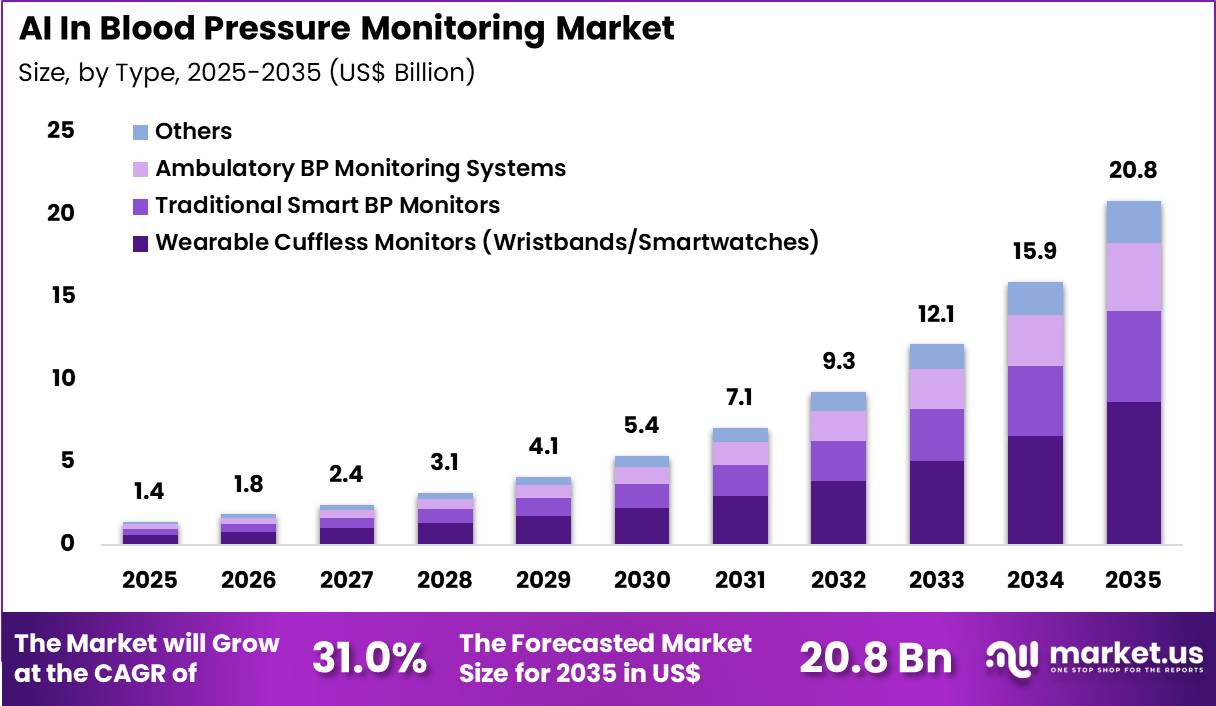
The Global AI in Blood Pressure Monitoring Market is experiencing rapid expansion, driven by the convergence of digital health and advanced analytics. The market is projected to grow from approximately USD 1.4 Billion in 2025 to nearly USD 20.8 Billion by 2035, registering a strong CAGR of around 31.0%. This growth is supported by rising hypertension prevalence, affecting over 1.3 billion people globally, and increasing adoption of wearable and non-invasive monitoring technologies. The integration of AI algorithms into healthcare devices is enhancing diagnostic accuracy and enabling real-time monitoring, positioning the market as a critical component of next-generation healthcare systems.
Get lastest insights and updates at @ https://market.us/report/ai-in-blood-pressure-monitoring-market/free-sample/
Key Takeaways
- In 2025, the AI in blood pressure monitoring market generated revenue of USD 1.4 billion and is projected to reach USD 20.8 billion by 2035, expanding at a CAGR of 31.0%.
- By type, the market includes AI-powered digital monitors, wearable cuffless monitors, non-contact monitoring systems, AI-enhanced PPG apps, and others, with wearable cuffless devices leading at 41.6% share.
- By technology, segments comprise deep learning, machine learning, NLP, and others, with machine learning models dominating at 56.1% market share.
- By application, the market covers hypertension management, cardiovascular prediction, remote monitoring, fitness and wellness, and others, with hypertension management leading at 37.6%.
- By end use, segments include hospitals, home care, clinics, and others, with hospitals and acute care facilities leading at 45.2% share.
- Regionally, North America holds the dominant position, accounting for 48.6% of the total market share.
How is Growth Impacting the Economy?
The expansion of AI-driven blood pressure monitoring is contributing significantly to the digital healthcare economy. Increased investment in AI-enabled medical devices is accelerating innovation, leading to the development of cost-efficient and scalable healthcare solutions. The growth of this market is also fostering job creation across software development, data analytics, and medical device manufacturing sectors.
Healthcare systems are benefiting from reduced hospitalization costs due to early detection and remote monitoring capabilities. Continuous monitoring technologies are minimizing emergency care expenditures by enabling preventive interventions. Furthermore, the rise of wearable health devices is driving consumer spending in the digital health ecosystem.
Public health outcomes are also improving, as early diagnosis reduces the burden of cardiovascular diseases, which are among the leading causes of mortality. Governments and private stakeholders are increasingly investing in AI-based healthcare infrastructure, thereby strengthening economic resilience. Additionally, the integration of AI in remote patient monitoring is expanding access to healthcare in underserved regions, contributing to inclusive economic growth.
Impact on Global Businesses
- Rising Costs & Supply Chain Shifts: The adoption of AI technologies has increased initial investment costs for businesses, particularly in R&D, regulatory compliance, and data infrastructure. However, supply chains are evolving toward localized manufacturing and digital integration, improving efficiency and reducing long-term costs.
- Sector-Specific Impacts: Healthcare providers are adopting AI tools to enhance patient care, while technology firms are expanding into medical device ecosystems. Insurance companies are leveraging AI-driven insights for risk assessment, and wearable device manufacturers are witnessing increased demand due to consumer health awareness.
- Strategies for Businesses: Businesses are focusing on integrating AI with IoT-enabled devices to provide real-time monitoring solutions. Strategic partnerships with healthcare providers and technology firms are being adopted to accelerate product development. Investment in data security and regulatory compliance is becoming essential. Additionally, companies are emphasizing user-friendly interfaces and affordability to enhance adoption in emerging markets.
Report Scope
| Report Features | Description |
| Market Value (2025) | US$ 1.4 Billion |
| Forecast Revenue (2035) | US$ 20.8 Billion |
| CAGR (2026-2035) | 31.00% |
| Base Year for Estimation | 2025 |
| Historic Period | 2020-2024 |
| Forecast Period | 2026-2035 |
| Report Coverage | Revenue Forecast, Market Dynamics, COVID-19 Impact, Competitive Landscape, Recent Developments |
| Segments Covered | By Type (AI-Powered Digital Monitors (Oscillometric), Wearable Cuffless Monitors (Wristbands/Smartwatches), Non-Contact/Continuous Monitoring Systems, AI-Enhanced Photoplethysmography (PPG) Apps and Others), By Technology (Deep Learning (DL) & Neural Networks, Machine Learning (ML) Models, Natural Language Processing (NLP) and Others), By Application (Hypertension Management, Cardiovascular Disease Prediction, Remote Patient Monitoring, Fitness and Wellness and Others), By End Use (Hospitals & Acute Care, Home Care Settings/Patient (Consumers), Clinics & Ambulatory Care and Others) |
| Regional Analysis | North America – The US, Canada; Europe – Germany, France, U.K., Italy, Spain, Russia & CIS, Rest of Europe; Asia Pacific – China, India, Japan, South Korea, ASEAN, Australia & New Zealand, Rest of Asia Pacific; Middle East & Africa – GCC, South Africa, Rest of Middle East & Africa; Latin America – Brazil, Mexico, Rest of Latin America |
| Competitive Landscape | Withings, Aktiia SA, Biospectal SA, Valencell, INC., Biofourmis, Edwards Lifesciences Corporation (now BD), Hello Heart, Shen AI, Huawei Technologies Co., Ltd., Hilo. |
| Customization Scope | Customization for segments, region/country-level will be provided. Moreover, additional customization can be done based on the requirements. |
| Purchase Options | We have three licenses to opt for: Single User License, Multi-User License (Up to 5 Users), Corporate Use License (Unlimited User and Printable PDF) |
Analyst Viewpoint
Currently, the market is in a high-growth phase, driven by technological advancements and increasing healthcare digitization. The adoption of AI-powered monitoring devices is expanding rapidly across developed regions, supported by strong healthcare infrastructure.
Looking forward, the market is expected to witness sustained growth due to continuous innovation in wearable technologies and AI algorithms. The transition toward preventive healthcare and remote patient monitoring will further accelerate demand. Emerging economies are anticipated to play a crucial role in future expansion, supported by increasing healthcare investments and digital adoption. Overall, the outlook remains highly positive with long-term value creation potential.
Regional Analysis
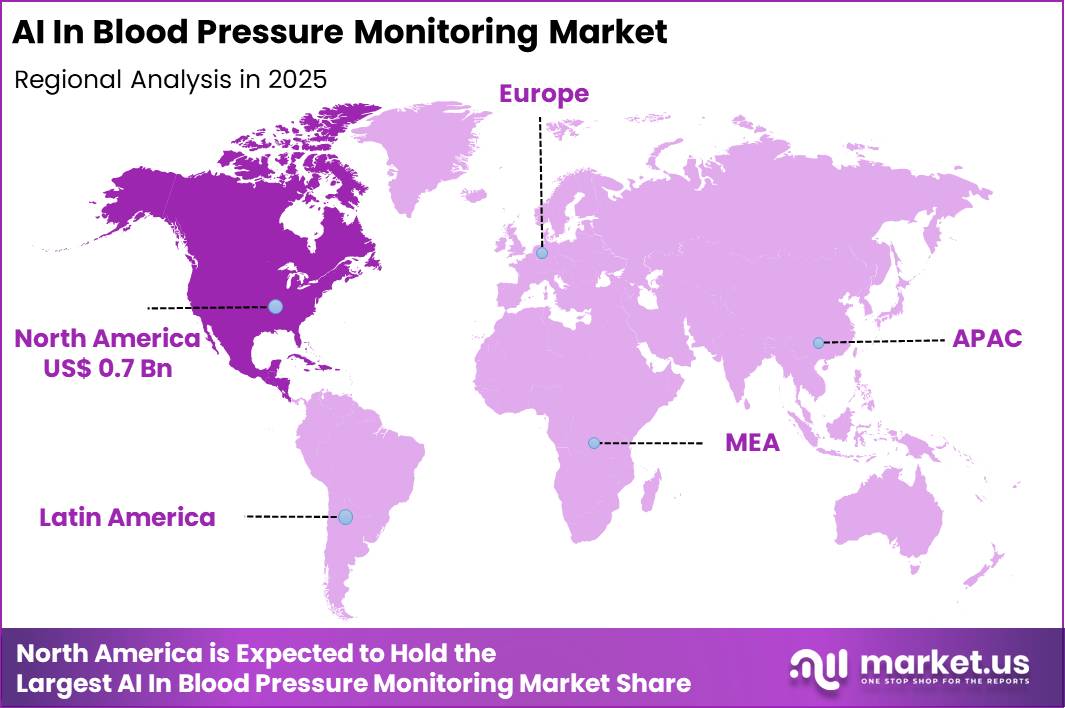
North America dominates the AI in blood pressure monitoring market, accounting for over 48.6% share in 2025, driven by advanced healthcare infrastructure and high adoption of digital health technologies.Europe follows with strong regulatory frameworks and increasing investments in AI-based healthcare solutions.
The Asia-Pacific region is expected to witness the fastest growth due to rising healthcare awareness, large patient population, and increasing adoption of wearable devices. Countries such as India and China are experiencing a surge in hypertension cases, further driving demand. Latin America and the Middle East & Africa are gradually adopting AI-based monitoring solutions, supported by improving healthcare infrastructure.
Business Opportunities
Significant opportunities are emerging in the development of cuffless and non-invasive monitoring technologies, which offer improved patient comfort and convenience. The integration of AI with wearable devices presents a scalable opportunity for continuous health tracking.
Expansion into emerging markets offers untapped potential due to low penetration of advanced monitoring systems. Additionally, partnerships between technology firms and healthcare providers are enabling the development of integrated digital health platforms. Investment in cloud-based analytics and predictive healthcare solutions is expected to create new revenue streams. The increasing focus on preventive healthcare further enhances market attractiveness for new entrants and established players.
Key Segmentation Analysis
The AI in blood pressure monitoring market can be segmented based on product type, technology, end-user, and application. By product type, the market includes wearable devices, portable monitors, and stationary systems. By technology, it is categorized into machine learning, deep learning, and predictive analytics.
In terms of end-users, the market comprises hospitals, clinics, home care settings, and ambulatory surgical centers. Applications include hypertension management, cardiovascular monitoring, and remote patient monitoring. This segmentation reflects the diverse use cases and growing adoption across multiple healthcare settings, enabling targeted growth strategies.
- Type Analysis: Wearable cuffless monitors accounted for 41.6% of market growth and dominate due to rising adoption of AI-enabled wearable devices. Continuous, non-invasive monitoring using optical sensors enhances user convenience, while increasing global hypertension prevalence supports sustained demand for real-time cardiovascular tracking solutions.
- Technology Analysis: Machine learning models represented 56.1% of growth, driven by their ability to analyze complex physiological data such as pulse wave and heart rate variability. These models enhance prediction accuracy and support clinical decision-making, positioning them as a core technology in AI-based blood pressure monitoring systems.
- Application Analysis: Hypertension management accounted for 37.6% of growth, supported by increasing global disease prevalence. AI-driven monitoring enables continuous tracking and personalized treatment strategies, improving patient outcomes. Healthcare systems are increasingly adopting digital tools to enhance long-term chronic disease management and reduce mortality risks.
- End-Use Analysis: Hospitals and acute care facilities contributed 45.2% of growth, driven by advanced infrastructure and high patient volumes. AI-powered monitoring systems support real-time clinical decisions and integrate with electronic health records, strengthening their role as primary adopters of digital cardiovascular monitoring technologies.
Key Player Analysis
Key players in the market are focusing on technological innovation, product differentiation, and strategic collaborations to strengthen their market position. Significant investments are being made in research and development to enhance AI algorithms and improve device accuracy.
Companies are also expanding their product portfolios by integrating advanced features such as real-time analytics and cloud connectivity. Mergers, acquisitions, and partnerships are being utilized to expand geographic presence and technological capabilities. Additionally, a strong focus is being placed on regulatory approvals and compliance to ensure market entry and scalability.
Top Key Players
- Withings
- Aktiia SA (Hilo)
- Biospectal SA
- Valencell, INC.
- Biofourmis
- Edwards Lifesciences Corporation (now BD)
- Hello Heart
- Shen AI
- Huawei Technologies Co., Ltd.
- Hilo
Recent Developments
- In 2025, Aktiia (rebranded as Hilo in some markets) received FDA 510(k) clearance for its over-the-counter, cuffless G0 Blood Pressure Monitoring System (Hilo Band), allowing continuous BP monitoring from a wrist wearable without a traditional cuff and without prescription.
- The device uses optical sensors (PPG) and proprietary AI algorithms with pulse-wave analysis, sending data to a companion app and cloud platform; it is already CE-marked in Europe and is expected to be commercially available to U.S. consumers in 2026, positioning cuffless AI wearables for mainstream, large-scale deployment.
- In April 2025, BD launched the HemoSphere Alta platform, an AI-based hemodynamic monitoring system aimed at critical-care environments, which helps clinicians manage blood pressure fluctuations and optimize circulation
Conclusion
The global AI-driven blood pressure monitoring market is positioned for substantial long-term growth, supported by rapid technological advancements and increasing healthcare digitization. Strong demand for non-invasive, real-time monitoring solutions is reshaping patient care and driving widespread adoption across healthcare systems. Economic benefits are evident through cost reduction, improved clinical outcomes, and enhanced accessibility to care.
While initial investment and regulatory challenges persist, ongoing innovation and strategic collaborations are expected to mitigate these barriers. With expanding opportunities in emerging markets and preventive healthcare, the market is anticipated to remain a critical pillar in the evolution of next-generation, data-driven healthcare ecosystems.