










Market Overview
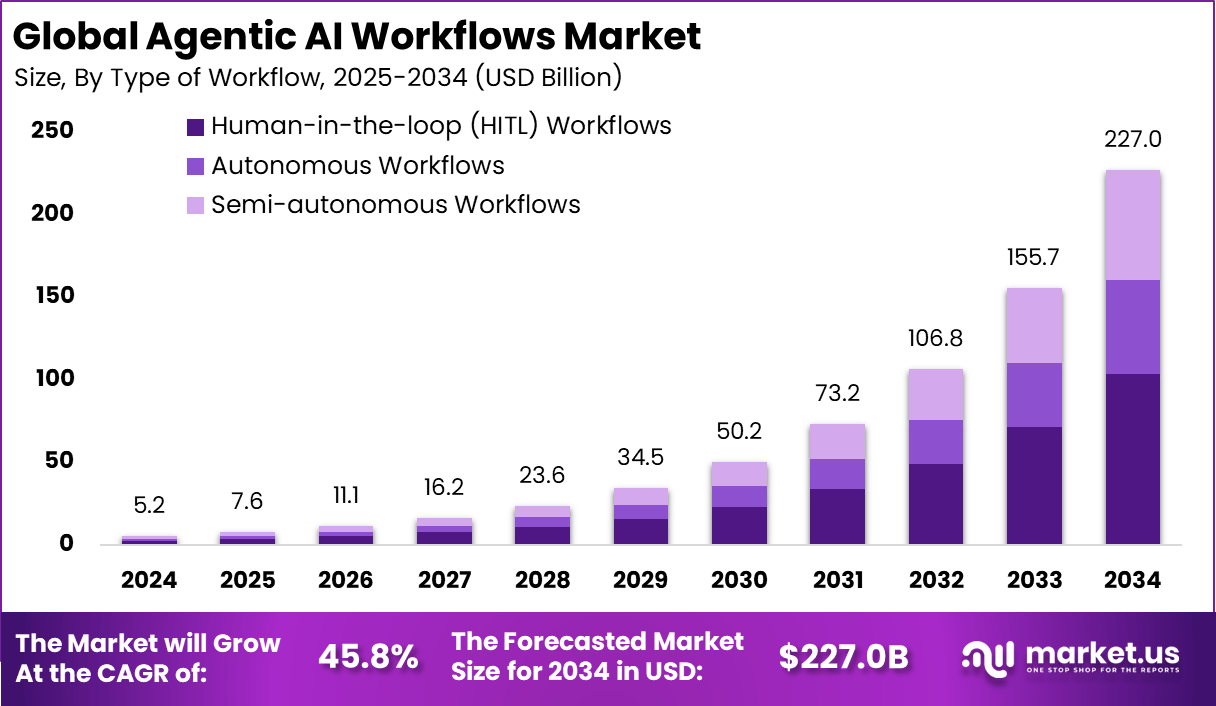
According to Market.us, the Global Agentic AI Workflows Market was valued at USD 5.2 billion in 2024 and is projected to reach USD 227 billion by 2034, registering a compound annual growth rate (CAGR) of 45.8% from 2025 to 2034. This extraordinary growth reflects how deeply autonomous AI systems are being woven into the way businesses plan, decide, and execute at scale. Unlike basic automation that follows fixed instructions, agentic AI systems can reason, adapt, and coordinate multi-step tasks across different platforms, making them genuinely useful for complex enterprise environments.
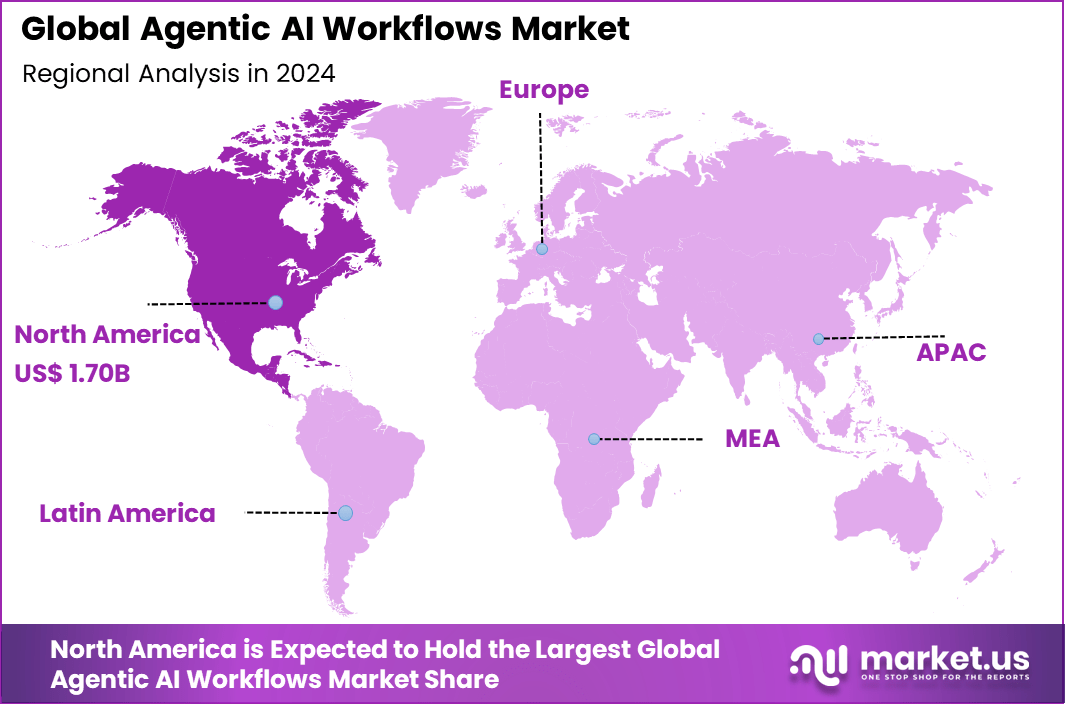
In 2024, North America held a dominant market position, capturing more than a 32.8% share and generating USD 1.7 billion in revenue, driven by heavy investment in AI infrastructure and a concentration of technology leaders. The most powerful driver behind this market is the growing need for intelligent, outcome-driven automation that moves well beyond simple task execution.
Explore 2026 Strategic Data to Drive Better and Faster Decisions – Request a Sample
Businesses today want systems that can independently handle complex, multi-step workflows with minimal oversight, and agentic AI delivers exactly that. Nearly 60% of surveyed organizations cite efficiency gains and faster decision cycles as key motivations for investing in agentic AI platforms. At the same time, advances in Large Language Models (LLMs), Natural Language Processing (NLP), and reinforcement learning are providing the technical backbone needed to build agents that actually perform reliably in real enterprise settings.
Top Market Takeaways
- Human-in-the-Loop (HITL) workflows lead the market, holding a 45.7% share, as enterprises prioritize meaningful human oversight when AI handles sensitive or consequential decisions.
- Natural Language Processing (NLP) accounts for 35.6% of the technology mix, reflecting strong enterprise appetite for conversational automation and document-heavy workflows.
- On-premises deployment dominates with a 60.2% share, reflecting continued preference for data control and regulatory compliance in sectors like healthcare, banking, and law.
- Large enterprises represent 74.6% of total market revenue, as they are best positioned to integrate agentic AI into complex, multi-system business processes at scale.
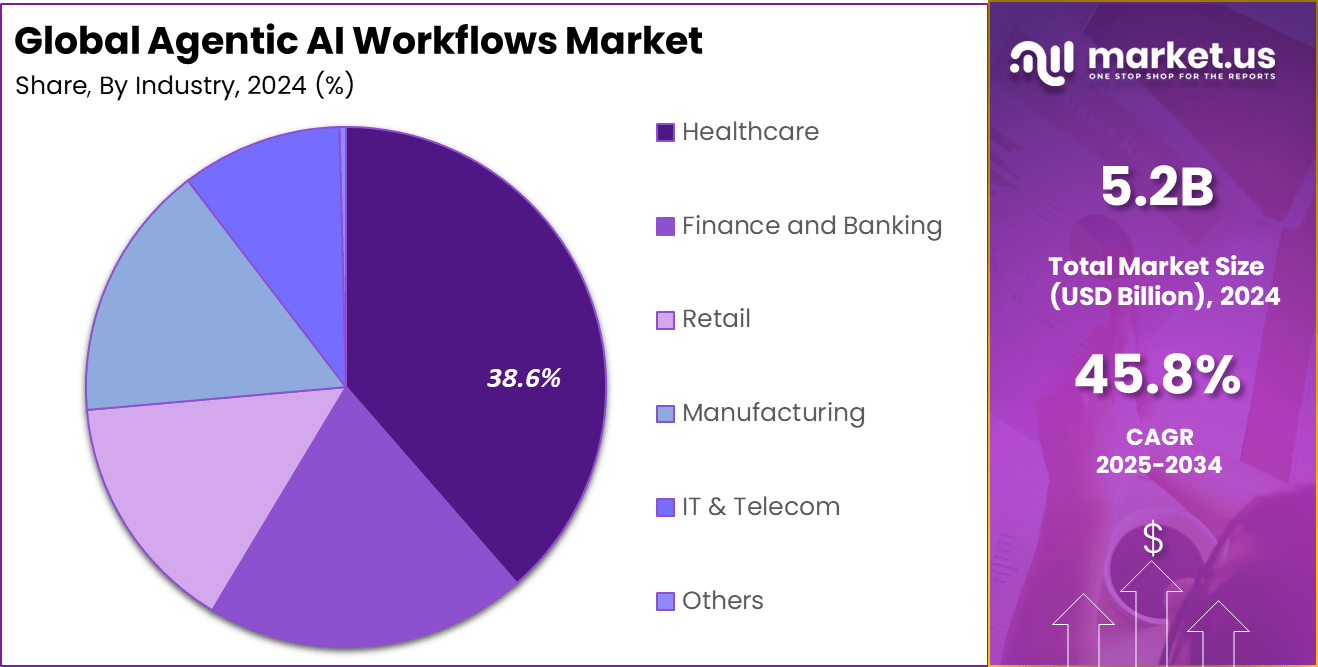
- Healthcare leads all industries at a 38.6% share, driven by high-value applications in diagnostics, patient engagement, and administrative workflow automation.
- North America holds 32.8% of the global market, underpinned by robust AI investment, leading technology companies, and high enterprise adoption rates.
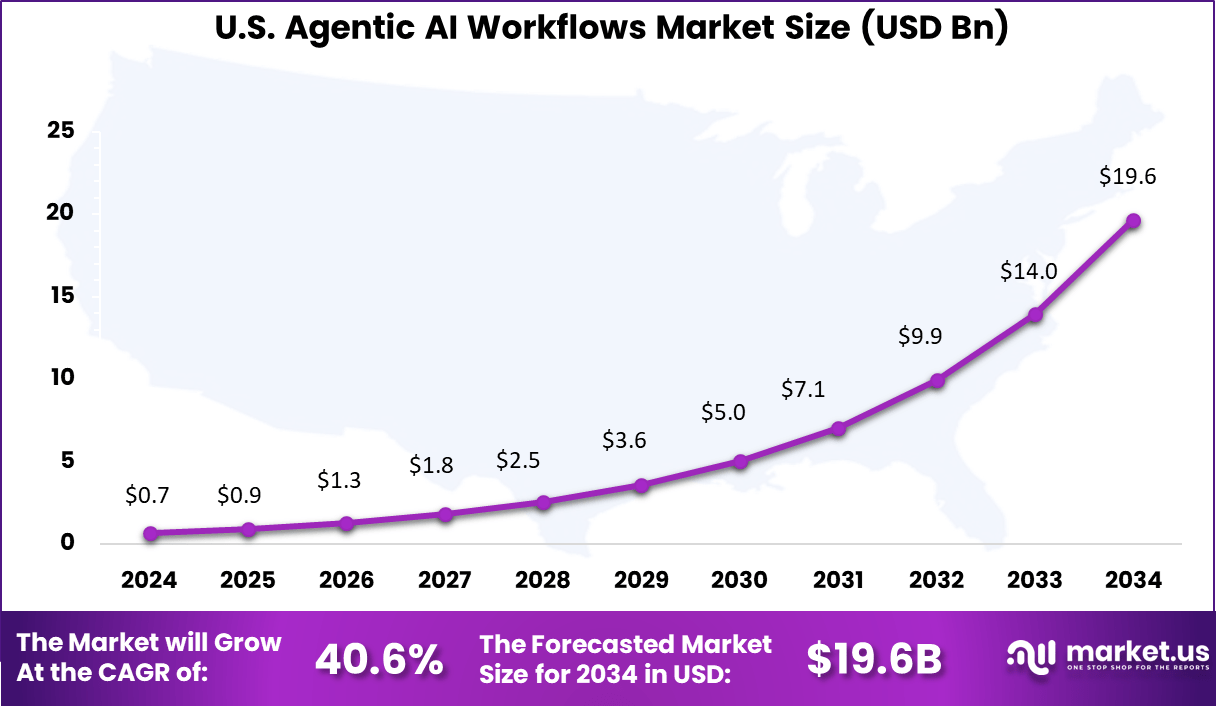
- The U.S. market was valued at USD 0.65 billion in 2024 and is growing at a 40.6% CAGR, supported by innovation funding, enterprise deployment programs, and a mature startup ecosystem.
Engage with Our Expert Team at [email protected] for Data-Driven Solutions
Report Scope
| Report Features | Description |
| Market Value (2024) | USD 5.2 Bn |
| Forecast Revenue (2034) | USD 227.0 Bn |
| CAGR(2025-2034) | 45.80% |
| Base Year for Estimation | 2024 |
| Historic Period | 2020-2023 |
| Forecast Period | 2025-2034 |
| Report Coverage | Revenue forecast, AI impact on Market trends, Share Insights, Company ranking, competitive landscape, Recent Developments, Market Dynamics and Emerging Trends |
| Segments Covered | By Type of Workflow (Human-in-the-loop (HITL) Workflows, Autonomous Workflows, Semi-autonomous Workflows), By Technology (Natural Language Processing (NLP), Computer Vision, Robotic Process Automation (RPA), Others), By Deployment Type (Cloud-based, On-premises), By Enterprise (Small and Medium-sized Enterprises (SMEs), Large Enterprises), By Industry (Healthcare, Finance and Banking, Retail, Manufacturing, IT & Telecom, Others) |
| Regional Analysis | North America – US, Canada; Europe – Germany, France, The UK, Spain, Italy, Russia, Netherlands, Rest of Europe; Asia Pacific – China, Japan, South Korea, India, New Zealand, Singapore, Thailand, Vietnam, Rest of Latin America; Latin America – Brazil, Mexico, Rest of Latin America; Middle East & Africa – South Africa, Saudi Arabia, UAE, Rest of MEA |
| Competitive Landscape | International Business Machines Corporation, Amazon Web Services, Inc., Beam AI, Akira AI, Capgemini, Quantiphi, Fiddler AI, HCL Technologies Limited, Pegasystems Inc., Acceldata, Flowable AG, Trigent Software, Inc., Other Major Players |
| Customization Scope | Customization for segments, region/country-level will be provided. Moreover, additional customization can be done based on the requirements. |
| Purchase Options | We have three license to opt for: Single User License, Multi-User License (Up to 5 Users), Corporate Use License (Unlimited User and Printable PDF) |
By Workflow Type
Human in the loop workflows account for 45.7% of the market, reflecting enterprise preference for maintaining human oversight in AI driven processes. These workflows allow AI agents to perform automated tasks while involving human intervention in critical decision points. This approach is widely used in scenarios where accuracy, accountability, and compliance are essential.
The adoption of HITL workflows is particularly strong in industries handling sensitive data and regulatory requirements. Human validation ensures that AI outputs align with organizational standards and ethical guidelines. As enterprises balance automation with control, HITL workflows continue to serve as the dominant model.
By Technology
Natural language processing represents 35.6% of the technology segment, highlighting its role in enabling conversational and document centric automation. NLP allows AI agents to interpret, process, and generate human language, which is essential for handling tasks such as document analysis, customer communication, and workflow automation.
The increasing use of NLP driven systems supports automation across knowledge intensive processes. Organizations rely on these technologies to manage large volumes of textual data and improve interaction between users and AI systems. As enterprises expand digital communication and documentation processes, NLP remains a key technology driver.
By Deployment
On premises deployment accounts for 60.2% of the market, indicating a strong preference for maintaining AI workflow systems within internal infrastructure. Organizations managing sensitive data prioritize internal deployment to ensure compliance with regulatory standards and maintain full control over data processing.
On premises environments also support integration with existing enterprise systems and legacy infrastructure. This approach allows organizations to customize workflow automation according to specific operational requirements. As data governance and privacy concerns remain critical, on premises deployment continues to dominate adoption.
By Organization Size
Large enterprises represent 74.6% of market adoption due to their ability to implement agentic workflows across complex and large scale operations. These organizations manage multiple systems, departments, and processes that benefit from automation and intelligent coordination. Agentic AI workflows enable enterprises to streamline operations and improve efficiency.
Large organizations also maintain the resources and technical expertise required to deploy advanced AI systems. Structured workflow automation allows them to optimize performance and reduce operational costs. As enterprise digital transformation continues, large companies remain the primary adopters of agentic AI workflows.
By Industry
Healthcare accounts for 38.6% of the market, driven by high value applications in diagnostics, patient management, and administrative workflows. AI driven workflows help automate tasks such as medical record processing, patient interaction, and clinical decision support. These systems improve operational efficiency and enhance service delivery within healthcare environments.
The adoption of agentic workflows in healthcare is also supported by the need for accuracy and regulatory compliance. Human oversight combined with AI automation ensures reliable outcomes in critical processes. As healthcare systems increasingly adopt digital technologies, agentic AI workflows continue to gain importance.
Engage with Our Expert Team at [email protected] for Data-Driven Solutions
By Region
North America holds 32.8% of the market share due to strong investment in artificial intelligence and enterprise automation technologies. Organizations in the region actively adopt agentic workflows to improve operational efficiency and decision making capabilities. The presence of advanced technology infrastructure supports widespread implementation.
Within North America, the United States contributes USD 0.65 billion and is growing at a rate of 40.6%. The country’s strong innovation ecosystem, enterprise adoption programs, and investment in AI technologies have accelerated market growth. Continued focus on automation and intelligent workflows is expected to sustain expansion in the region.
Growth Factors
One of the primary growth factors driving the agentic AI workflows market is the rising demand for end-to-end process automation. Enterprises are seeking to automate entire workflows rather than isolated tasks, particularly in areas such as customer service, IT operations, finance, and supply chain management. Agentic AI workflows enable seamless execution of multi-step processes, reducing manual intervention and improving efficiency.
Another growth factor is the increasing availability of enterprise data and digital infrastructure. Organizations generate large volumes of operational data that can be used to guide workflow decisions. Agentic AI systems leverage this data to analyze conditions, determine optimal actions, and execute workflows in real time.
Emerging Trends
One emerging trend in the agentic AI workflows market is the adoption of multi-agent orchestration frameworks. These systems involve multiple AI agents working collaboratively, each responsible for specific tasks within a workflow. This distributed approach improves scalability and allows organizations to manage complex processes more effectively.
Another trend is the integration of agentic workflows with enterprise software platforms. AI-driven workflows are increasingly embedded within applications such as IT service management, customer engagement platforms, and financial systems, enabling seamless automation across business operations.
Driver Analysis
Need for Adaptive and Intelligent Operations
A key driver of the agentic AI workflows market is the growing need for adaptive operations that can respond to dynamic business conditions. Traditional workflow systems rely on predefined rules, which may not be effective in rapidly changing environments. Agentic AI workflows use real-time data and decision-making capabilities to adjust processes automatically, improving operational agility.
Another driver is the increasing focus on operational efficiency and cost reduction. Organizations aim to streamline processes, eliminate manual tasks, and improve productivity. Agentic workflows enable automation at scale, reducing operational overhead and enhancing process consistency.
Restraint Analysis
Governance and Control Complexity
One restraint affecting the agentic AI workflows market is the complexity of governance and control. Autonomous workflows involve AI agents making decisions and executing actions, which requires strong oversight to ensure compliance with organizational policies. Establishing governance frameworks for these systems can be challenging.
Another restraint involves integration challenges with legacy systems. Many organizations operate traditional workflow platforms and IT infrastructure that may not support advanced AI capabilities. Integrating agentic workflows into these environments may require significant system upgrades and process redesign.
Opportunity Analysis
Transformation of Enterprise Automation
A significant opportunity in the agentic AI workflows market lies in transforming enterprise automation strategies. Organizations can use agentic workflows to automate complex processes such as procurement, incident management, and customer onboarding. This transformation enables faster execution, improved accuracy, and better resource utilization.
Another opportunity involves the expansion of agentic workflows into industry-specific applications. Sectors such as healthcare, finance, and manufacturing can benefit from tailored workflow solutions that address domain-specific requirements, creating new growth opportunities.
Challenge Analysis
Reliability and Decision Accuracy
One of the key challenges in the agentic AI workflows market is ensuring reliability and accuracy in decision making. Autonomous workflows rely on AI models to interpret data and execute actions. Inaccurate predictions or incomplete data can lead to incorrect decisions, affecting business outcomes.
Another challenge involves managing workflow complexity at scale. As organizations deploy multiple agentic workflows across departments, maintaining coordination and performance becomes increasingly difficult. Effective monitoring, optimization, and control mechanisms are required to ensure consistent operation.
Competitive Analysis
The Agentic AI Workflows Market is driven by global technology and cloud providers that enable autonomous workflow orchestration and intelligent decision making across enterprise environments. IBM, Amazon Web Services, and Pegasystems provide platforms that combine artificial intelligence with process automation and workflow management. These solutions allow organizations to deploy intelligent agents that can execute tasks, analyze data, and adapt workflows in real time. Increasing enterprise demand for automation and efficiency has strengthened their market position.
Consulting and AI solution providers contribute significantly by enabling implementation and customization of agentic workflows. Capgemini, HCL Technologies, and Quantiphi deliver AI driven transformation services that integrate agentic workflows into business operations. Their solutions focus on improving operational agility, decision intelligence, and process optimization. These providers support enterprises in deploying scalable AI models and automation frameworks across industries.
Emerging AI and workflow automation vendors further expand the competitive landscape. Flowable, Fiddler AI, Acceldata, and Trigent Software focus on intelligent workflow orchestration, AI model monitoring, and data driven automation platforms. Additional players such as Beam AI and Akira AI contribute to innovation in autonomous agents and workflow intelligence systems. The market remains dynamic, with differentiation driven by real time decision making, AI model integration, and scalability across enterprise ecosystems.
Top Key Players in the Market
- International Business Machines Corporation
- Amazon Web Services, Inc.
- Beam AI
- Akira AI
- Capgemini
- Quantiphi
- Fiddler AI
- HCL Technologies Limited
- Pegasystems Inc.
- Acceldata
- Flowable AG
- Trigent Software, Inc.
- Other Major Players
Recent Developments
- January, 2026 – IBM watsonx Orchestrate launched hybrid-cloud agentic workflows for mainframe modernization. Agents auto-remediate AIOps incidents across z/OS and Kubernetes. Enterprises cut MTTR by 55% in banking deployments. Multi-agent swarms handle 10,000+ daily tickets. Red Hat integration scales to petabyte data lakes. IBM serves 5,000+ workflow customers.
- February, 2026 – AWS Bedrock Agents added multi-step reasoning for supply chain orchestration. Agents negotiate vendor contracts and reroute shipments autonomously. Retailers report 40% faster fulfillment cycles. Step Functions coordinates 100+ agent types. Guardrails ensure compliance across regions. AWS processes 2 billion workflow events daily.
- March, 2026 – Capgemini Intelligent Workflow Platform deployed agentic AI for ESG reporting. Agents aggregate data from 50+ ERP systems with audit trails. Fortune 500 firms met SEC requirements 3x faster. Low-code agent builder supports SAP and Oracle. Capgemini automates 1 million compliance checks quarterly.