










Introduction
Agentic AI Statistics: Artificial intelligence is growing fast and is no longer limited to following human instructions. It can now think and act on its own. This type, called Agentic AI, can make decisions, set goals, and take actions. It learns from its surroundings, plans steps, and improves with experience. At the same time, it raises questions about control, safety, and ethics. Understanding Agentic AI is important because it will shape a future where machines don’t just assist humans, but act with a level of independence.
Editor’s Choice
- The global agentic AI market is projected to reach USD 10.8 billion in 2026.
- The component segment of Agentic AI held 61.65% share in 2025, led by solutions, while services are projected to grow at 43.80% CAGR.
- About 93% of business leaders believe that organizations that successfully scale AI agents over the next 12 months will gain a competitive advantage.
- As of 2025, North America led the global AI agentic platforms market, accounting for 22.5%.
- Around 51% of companies have already deployed AI agents, showing strong current adoption across industries.
- Agentic tools significantly reduce trip-planning time, completing tasks in 9.2 minutes versus 38.5 minutes manually, saving 76% of time.
- In 2026, organizations reported a 34% increase in productivity among low-skilled workers using AI tools.
- Consumption-based pricing is the most preferred model at 55%, as organizations pay only for actual usage, making it flexible and scalable.
- Around 68% of customer interactions are expected to be handled by agentic AI by 2028.
- Only 21% of companies are projected to have mature AI governance frameworks by 2028.
Key Takeaways
- According to Market.us, 96% of enterprises are expanding their use of AI agents, while 83% of executives view agentic AI investment as essential to staying competitive.
- Organizations have cut operational costs by 30% through faster response times enabled by AI agents.
- Agentic AI reduces human task time by up to 86% in multi-step workflows, significantly boosting operational efficiency.
- Around 45% of Fortune 500 companies are actively piloting agentic systems in 2025.
- These systems can complete up to 12 times more complex tasks than traditional large language models, thanks to autonomous decision-making and dynamic feedback loops.
Agentic AI Market Size

(Source: market.us)
- The global agentic AI market is projected to reach USD 10.8 billion in 2026.
- By 2034, the market is forecasted to expand significantly to USD 196.6 billion.
- The market is expected to grow at a CAGR of 43.8% between 2025 and 2034.
Agentic AI Market Segmentation Insights
- According to Mordor Intelligence, the component segment of Agentic AI held 61.65% share in 2025, led by solutions, while services are projected to grow at 43.80% CAGR.
| Category | Market Share, 2025 | Growth Trend CAGR (From 2026 to 2031) |
| Deployment | Cloud (59.72%) | Hybrid (44.60%) |
| Organization Size | Large enterprises (65.05%) | SMEs (43.55%) |
| Industry | BFSI (19.12%) | Automotive (45.10%) |
| Architecture | Multi-agent systems (53.30%) | Growing at 43.50% |
| Application | Process automation (23.21%) | Virtual assistants (44.20%) |
Key Growth Drivers & Impact Analysis
- Rapid adoption of autonomous AI agents in enterprise workflows is the biggest driver, contributing +9.6% to market growth.
- Growing demand for AI-based decision-making and task automation adds +8.4%.
- Integration with cloud and enterprise software contributes +7.1%.
- Expanding generative AI use cases adds +6.3%.
- Increased AI investment across complex industries contributes +5.2%.
Global Agentic AI Market Outlook Beyond 2026
- By 2029, AI agents are expected to resolve 80% of common customer service issues without human help, according to Gartner.
- By 2028, 33% of enterprise software will integrate agentic AI, enabling 15% of daily work decisions to be made autonomously.
- Guardian agents are projected to capture 10-15% of the market by 2030.
- About 93% of business leaders believe that organizations that successfully scale AI agents over the next 12 months will gain a competitive advantage.
- According to Deloitte, nearly 93% of IT leaders plan to introduce autonomous agents within two years, and 50% of enterprises using generative AI will deploy autonomous agents by 2027, up from 25% in 2025.
- Over 80% of organizations see AI agents as essential enterprise apps, and 88% of executives plan to increase AI budgets within 12 months.
- Finally, 89% of CIOs consider agentic AI a strategic priority, with a focus on automation, decision-making, and enterprise orchestration.
Global AI Agentic Platforms Market Share By Region

(Source: factmr.com)
- As of 2025, North America led the global AI agentic platforms market, accounting for 22.5%.
- Moreover,n East Asia held a close second position with a 21.9% share.
- Meanwhile, South Asia and the Pacific region contributed 14%.
- The other categories, including Western Europe and other regions, accounted for the largest combined share at 33.7%.
Country-wise Y-o-Y Growth Insights
| Year | United States | China | India |
| 2025 | Starts strong, with approximately 42% growth, demonstrating early adoption leadership. | Follows near 39%, with strong but developing investments. | begins at around 38%, reflecting a growing early-stage market. |
| 2035 | Expected to rise above 42%, maintaining leadership. | Around 41%, closing the gap. | Will reach almost 39.5%, showing strong long-term potential. |
AI Investment & Adoption Statistics
- According to the Nvidia Blog, 82% of organizations plan to increase AI investment in the coming year.
- 43% of enterprises are considering adopting agentic AI in 2026.
- 40% of enterprise applications will embed task-specific AI agents by end-2026.
- Moreover, 33% of enterprises are either piloting or fully running their first AI use case.
- 62% of organizations are experimenting with AI agents; 23% are scaling them.
- 77% of Asia-Pacific workers say their companies are experimenting with AI agents; 73% say agents will be critical in 3-5 years.
- Salesforce resolves 83% of around 32,000 weekly customer conversations using AI agents.
- 98% of U.S. small businesses use at least one AI-enabled tool.
- Morgan Stanley’s report further stated that almost 2/3 of employers plan to hire AI-skilled talent; 40% expect workforce reductions due to AI automation.
- 45% of organizations will orchestrate AI agents at scale across all functions by 2030.
- Around 39% of decision-makers say the CIO/CTO will lead AI strategy.
- Demand Sage further reported that over 85% of Fortune 500 companies use Microsoft AI, and nearly 70% use Microsoft 365 Copilot, while 90% use Copilot Studio to build custom agents.
- Around 99% of Fortune 500 firms use AI, and 19% have fully deployed agentic AI; leaders include Salesforce, Unilever, and Procter & Gamble.
- About 89% of CIOs consider agentic AI a key priority, and 43% of tech leaders allocate over half of their AI budgets to it.
- 21% of firms invested USD 10 million+ in AI, rising to 35% planning next year; 88% expect higher budgets.
- Nearly 62% expect over 100% ROI, with an average return of 171%.
Industry Specific Adoption Statistics
- A 2025 report by Cyntexa found that around 68% of healthcare organizations have adopted AI strategies.
- By 2028, 75% of software developers are expected to use AI coding agents, up from less than 10% in 2023.
- Around 80% of customer service teams will adopt AI by 2026 to improve productivity.
- About 40% of roles in Global 2000 companies will directly interact with AI agents by 2026
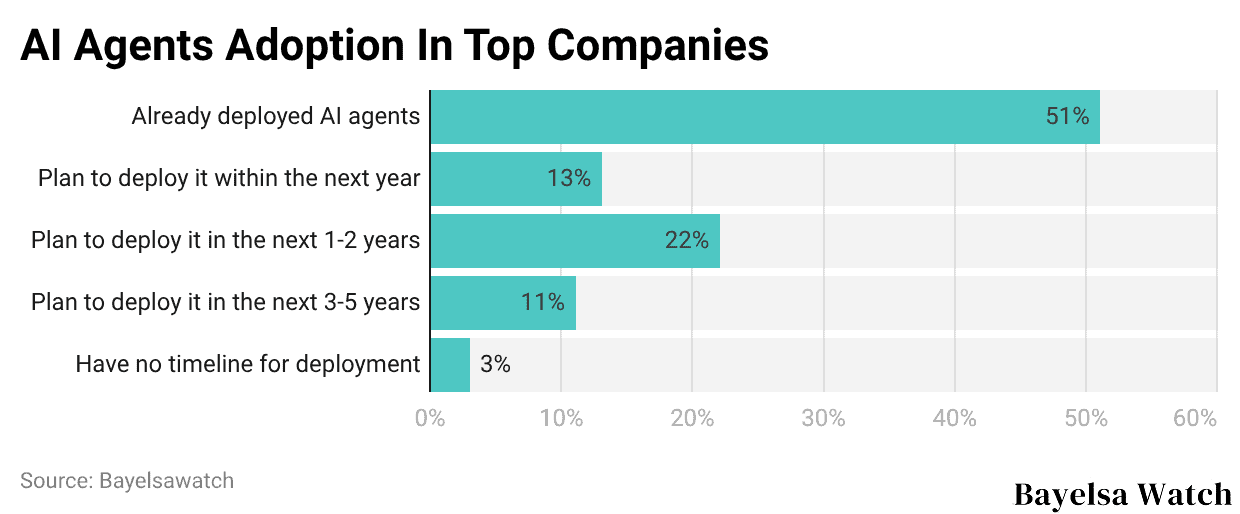
AI Agents Adoption In Top Companies
(Reference: demandsage.com)
- Around 51% of companies have already deployed AI agents, showing strong current adoption across industries.
- 13% plan to deploy within 1 year, while 22% aim to roll out in the next 1-2 years.
- Only 11% expect deployment in 3-5 years, and only 3% have no defined timeline.
Consumer Adoption Of AI Agents In Online Shopping
- According to walkingtree.tech, around 70% of consumers use AI agents for travel bookings, while 65% rely on them for hotels.
- For shopping, 59% use AI for electronics, 56% for beauty products, and 53% for clothing, mainly for comparisons and personalization.
- About 51% use AI for OTC products, 45% for groceries, and 45% for snacks, supporting convenience and repeat purchases.
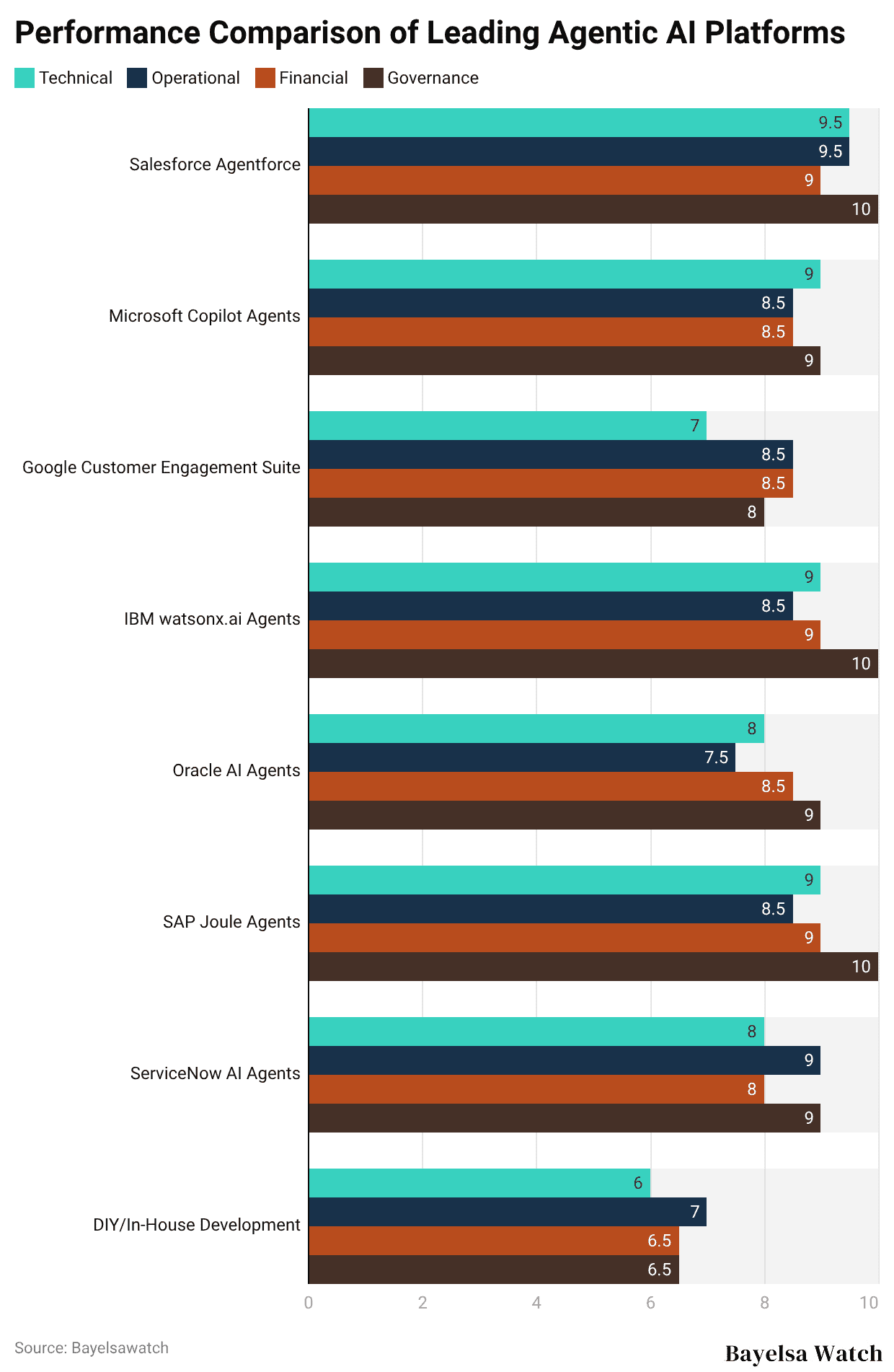
Performance Comparison Of Leading Agentic AI Platforms
(Reference: demandsage.com)
| Agentic AI Platform | Technical Score | Operational Score | Financial Score |
| Salesforce Agentforce | 9.5 | 9.5 | 9 |
| Microsoft Copilot | 9 | 8.5 | 8.5 |
| Google Customer Engagement Suite | 7 | 8.5 | 8.5 |
| IBM watsonx.ai | 9 | 8.5 | 9 |
| Oracle AI Agents | 8 | 7.5 | 8.5 |
| SAP Joule | 9 | 8.5 | 9 |
| ServiceNow AI Agents | 8 | 9 | 8 |
| DIY / In-House Development | 6 | 7 | 6.5 |
Preferred AI Agent Pricing Models Among Organizations

(Source: walkingtree.tec)
- Consumption-based pricing is the most preferred model at 55%, as organizations pay only for actual usage, making it flexible and scalable.
- Platform-based pricing (43%) and license-based pricing (37%) are also widely used, offering more predictable costs through fixed fees or per-user access.
- Tier-based pricing (33%) and outcome-based pricing (17%) are less preferred.
Time Efficiency Gains From Agentic AI Tools
- According to FirstPageSage, agentic tools significantly reduce trip-planning time, completing tasks in 9.2 minutes versus 38.5 minutes manually, saving 76% of time.
- For the SaaS comparison, tasks take 8.7 minutes compared to 27.0 minutes manually, resulting in 68% time savings.
- Budget optimization requires 6.1 minutes versus 21.3 minutes, saving 71%, while learning recommendations save 64% time (5.3 vs 14.6 minutes).
- B2B vendor sourcing takes 10 minutes compared to 22.4 minutes manually, saving 55%.
Task Completion Rate By AI Platforms

(Reference: firstpagesage.com)
- Claude Computer Use leads with an 86% task completion rate without human help, followed by AutoGPT at 81%.
- OpenAI Code Interpreter achieves 73%, while Google Project Mariner and Google Project Astra reach 69% and 65%.
Most-Refused Agentic Tasks By AI Platforms
| Task Type | Refusal Rate | Reasons |
| Legal Counsel | 32% | AI cannot give personalized legal advice due to regulatory limits. |
| Reverse Engineering | 21% | Decompiling software or analyzing proprietary code violates ethical and legal standards. |
| Financial Investment Guidance | 18% | AI avoids giving stock or portfolio advice to comply with financial rules. |
| Speculative Predictions | 15% | Forecasting trends or future events is unreliable and discouraged. |
| Health Risk Assessments | 14% | Personalized medical advice is restricted to follow regulations like HIPAA. |
ROI And Productivity Impact Of Agentic AI Deployments
- Accelirate’s report stated that organizations reported a 34% increase in productivity among low-skilled workers using AI tools.
- About 8% of executives plan to expand AI budgets to scale agentic AI initiatives.
- 50% of enterprises are expected to deploy autonomous AI agents across workflows by 2027.
- 93% of IT leaders have plans to introduce autonomous agents within two years.
- Over 80% of companies believe AI agents will transform enterprise applications.
Technology Architecture And Capabilities Of Agentic AI
- According to Landbase, multi-agent systems lead with a 66.4% market share, coordinating specialized agents such as strategy, research, SDR, and RevOps.
- Ready-to-deploy agents make up 58.5% of deployments, reducing risk and accelerating adoption.
- Moreover, initial deployments recommend Level 1-2 autonomy.
- AI models are trained on billions of data points for nuanced decision-making.
- Systems operate 24/7, and complex multi-agent deployments take 6-18 months.
Transformation of Customer Service and Engagement with AI Agents
- Around 68% of customer interactions are expected to be handled by agentic AI by 2028.
- 93% predict that AI will enable more personalized and proactive services, while 89% emphasize human-AI collaboration rather than replacement.
- Retention emails achieved 3 times the engagement of acquisition emails, and 63% of revenue comes from AI-nurtured repeat customers.
Security And Compliance Challenges

(Source: website-files.com)
- Around 51% of organizations are already seeing malicious attacks linked to AI in 2024.
- By 2027, AI‑related laws are expected to cover roughly 50% of the world’s economies, creating a fragmented regulatory landscape.
- Only about 21% of companies are projected to have mature AI governance frameworks by 2028.
- Roughly 40% of CIOs are expected to demand guardian agents.
- An estimated 25% of enterprise security breaches could be traced back to AI agent abuse or misconfiguration.
Top Agentic AI Trends Shaping The Future Of Work

(Source: multiqos.com)
- AI is boosting creativity by helping professionals design products and campaigns faster, reducing time-to-market and improving innovation outcomes.
- Agentic AI automates both routine and complex tasks, from data entry to financial modeling, improving efficiency across industries like healthcare and manufacturing.
- AI-powered virtual assistants are evolving, with over 50% of businesses adopting them in 2025 to manage workflows and automate tasks.
- AI enhances decision-making by analyzing large datasets, enabling faster, more accurate insights across sectors such as finance and healthcare.
- AI-driven customer engagement improves personalization, supports dynamic pricing, and enhances customer satisfaction and revenue growth.
- AI supports dynamic workforce management by optimizing scheduling, forecasting demand, and improving productivity while reducing employee burnout.
Conclusion
Agentic AI is changing technology from simple tools into systems that can act on their own and make decisions. It can help industries work faster, solve problems, and support people in many tasks. However, it also raises concerns about safety, control, and ethics. We must build these systems carefully and use them responsibly. In the future, Agentic AI can be very powerful, but its success depends on keeping it safe, clear, and aligned with human needs and values.
FAQ
Regular AI works by following given instructions, while Agentic AI can think, make decisions, and take actions on its own without needing step-by-step guidance.
It helps save time, speeds up work, solves difficult problems, and reduces the need for human effort.
If Agentic AI is not managed properly, it can make mistakes, be difficult to control, and pose safety and ethical risks.

Sources