



Introduction
Drone Statistics: Drones are smart flying machines that are changing the world. Once used primarily by the military or as toys, drones are now widely employed in photography, agriculture, delivery services, rescue missions, and environmental studies. They can reach places that are difficult or dangerous for humans to access and collect real-time information quickly.
Drones save time, reduce risk, and improve efficiency. As this technology continues to grow, drones are becoming an important part of modern life while also raising concerns about safety and privacy.
Editor’s Choice
- According to Statista, global revenue is expected to reach USD 4.47 billion in 2026.
- China is expected to generate the highest revenue in 2026, with USD 1.7 billion.
- About 8% of Americans, roughly 26.8 million people, own drones, making them increasingly common.
- The civil drone market is expected to generate approximately USD 18.72 billion in revenue by 2026.
- The global commercial drone market is estimated at USD 83.97 billion in 2025 and is projected to reach USD 116.81 billion in 2026.
- In 2026, the global consumer drone market is estimated to reach around USD 7.35 billion.
- The global military drone market is projected to reach USD 13.31 billion in 2026 and USD 23.78 billion by 2035.
- In 2026, the global racing drones market is expected to reach around USD 690.89 million.
- Fingers are the most commonly injured body part, accounting for 56% of drone-related injuries.
- Only 11% of Americans support the use of drones flying near homes.
- The 18-24 age group owns approximately 162,613 drones, representing 19% of total drone owners.
- Rotary-wing drones dominate the market, making up 63% of all drones.
- More than 60% of drone encounters happen within 200 feet of airports.
- There were 4,250 reported drone-related injuries from 2020 to 2025.
- In 2025, 67% of construction companies reported using drones to survey their sites.
Key Takeaways
- As of October 2025, 855,860 drones are registered with the FAA in the United States.
- According to Hire Drone Pilot, the global drone market is projected to reach USD 127 billion by 2032, nearly tripling in size from 2025.
- DJI dominates the U.S. consumer drone market, holding 80% market share.
- 96% of U.S. drone owners are men, while only 4% are women.
- Approximately 8% of Americans, around 26.8 million people, own a drone.
- 63% of drone registrations are for recreational purposes, and 37% are for commercial use.
- FAA grants 92% of waivers for night flight operations.
- 67% of construction companies use drones for site surveys and monitoring.
- Drones have saved an estimated 340 lives through medical deliveries in rural areas.
- Drones reduce carbon emissions by 87% compared to helicopters.
- Reforestation drones can plant 100,000 trees per day, 67 times faster than manual planting.
- 82% of luxury real estate listings above USD 1 million include drone photography.
- Film and media drone services generate USD 840 million in annual revenue.
- Drone delivery averages 12 minutes, compared to 45 minutes for traditional delivery.
- Walmart provides drone delivery to 4.5 million households.
- Infrastructure inspections using drones reduce costs by 55%.
- Emergency response is 37% faster with drone assessments.
- Drones track 2,400 endangered species globally.
- Wildfire detection is 14 minutes faster using drones.
- U.S. agricultural drones monitor 3.2 million acres of farmland annually.
- Precision drones reduce pesticide use by 30% to 40%.
- 68% of consumers are willing to receive packages weighing less than 5 lb via drone delivery.
- By 2027, 23 cities worldwide are expected to launch urban air taxi drone services.
Interesting Facts About Drones
- A drone is an aircraft that flies without a human pilot.
- Some of the smallest drones in the world weigh less than 1 gram.
- The term “drone” comes from the sound and movement of male bees.
- Drones are also referred to as Unmanned Aerial Vehicles (UAVs), Unmanned Aircraft Systems (UAS), or Remotely Piloted Aircraft Systems (RPAS).
- Drone use is expanding beyond military applications to recreational, scientific, industrial, agricultural, and commercial applications.
- Common uses include photography, mapping, security, infrastructure inspection, farming, disaster response, and transport.
- Drones can be controlled remotely by a pilot or autonomously using onboard computers.
- Sensors, software, and systems enable drones to operate effectively in commercial settings.
- They can fly in straight lines, on orbits, or on custom trajectories.
Drones Market Size
- According to Statista, global revenue is expected to reach USD 4.47 billion in 2026.
- The market is projected to grow at an average annual rate of 3.96% between 2026 and 2030.
- China is expected to generate the highest revenue in 2026, with USD 1.7 billion.
- This implies that per-person drone revenue in China will be USD 0.57 in 2026.
- By 2030, the total number of drones sold worldwide is expected to reach 10.51 million units.
- The drone market volume is projected to increase by 3.2% in 202 relative to 2026.
- On average, each person worldwide is expected to own 0.001 drones in 2026.
- The Hire Drone Pilot report further stated that the global drone market is projected to nearly double in value, from USD 63.6 billion in 2025 to USD 127 billion in 2032.
- Major sectors contributing to growth include agriculture, construction, delivery services, and infrastructure inspection.
- Asia is experiencing the fastest market growth, with a 19.4% CAGR.
Civil Drone
- According to Market.us Scoop, the civil drone market is expected to generate approximately USD 18.72 billion in revenue by 2026, up from USD 16.25 billion in 2025.
- By the end of 2027, the market will generate total revenue of USD 21.62 billion.
Commercial Drone
(Source: precedenceresearch.com)
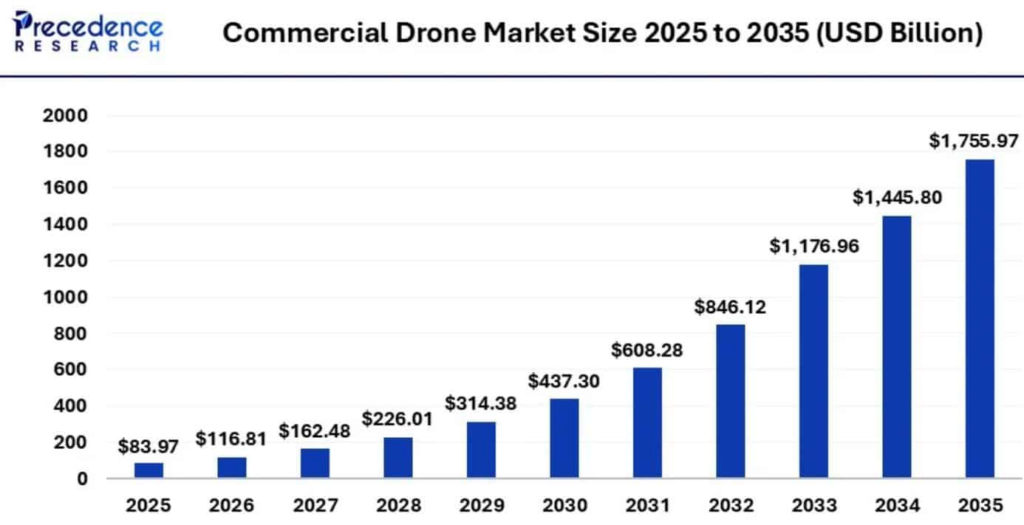
- The global commercial drone market is estimated at USD 83.97 billion in 2025 and is projected to reach USD 116.81 billion in 2026.
- The market is projected to reach approximately USD 1,755.97 billion by 2035, growing at a CAGR of 35.53% from 2026 to 2035.
- In 2025, North America accounted for the largest share of the professional drone market, at over 39% of global sales.
- Rotary blade drones dominated the market, accounting for 81% of the total market share.
- The filming and photography segment was the leading drone application, accounting for 32% of the market.
- Among end users, the media and amusement industry accounted for the largest share, contributing 29% of the market.
Consumer Drone
(Source: globalgrowthinsights.com)
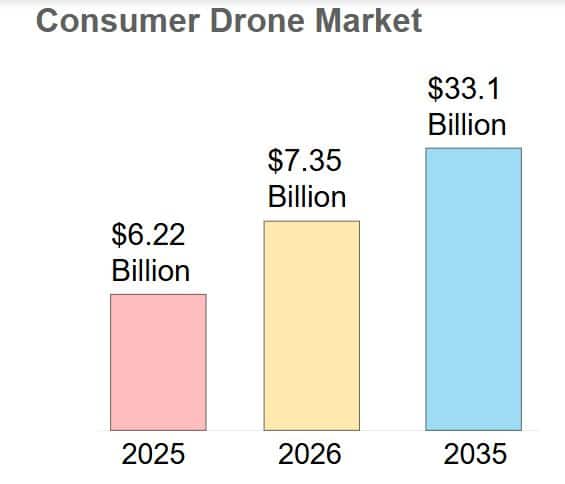
- In 2026, the global consumer drone market is estimated to reach around USD 7.35 billion.
- By 2035, the market is expected to reach approximately USD 33.1 billion, with a 18.2% CAGR from 2026 to 2035.
- By 2026, camera drones will account for nearly 60% of total consumer drone demand.
- Recreational users are expected to make up more than 45% of the market, reflecting the popularity of drones for personal use.
- The Asia‑Pacific region is projected to hold approximately 48% of the global market share.
U.S. Consumer Spending On Drones
- Premium Models (Over USD 2,000): More than 33% of drone purchases are premium models, which are professional-grade drones equipped with advanced features.
- Consumer & Mid-Range Models (Under USD 2,000): The remaining 67% of purchases are consumer and mid-range drones, designed for general and mid-level use.
Military Drones
- Business Research Insights further stated that the global military drone market is projected to reach USD 13.31 billion in 2026 and USD 23.78 billion by 2035, growing at a compound annual growth rate of 6.6%.
- About 60% of military drone purchases are directed toward fixed-wing drones.
- Legal, ethical, and regulatory issues delay the deployment of approximately 40% of military drones.
- North America leads the global military drone market, accounting for roughly 50% of all defence drone contracts, while Europe follows with 25%, and the Asia-Pacific region is seeing rapid adoption growth.
- About 35% of new drones feature VTOL, AI autonomy, and swarming.
- Rotary-wing drones accounted for about 30% of all deployed units due to their operational flexibility.
- In 2025, the U.S. Army selected Shield AI’s V-BAT, and VTOL drone procurement increased by 15%.
Racing Drones
(Source: precedenceresearch.com)
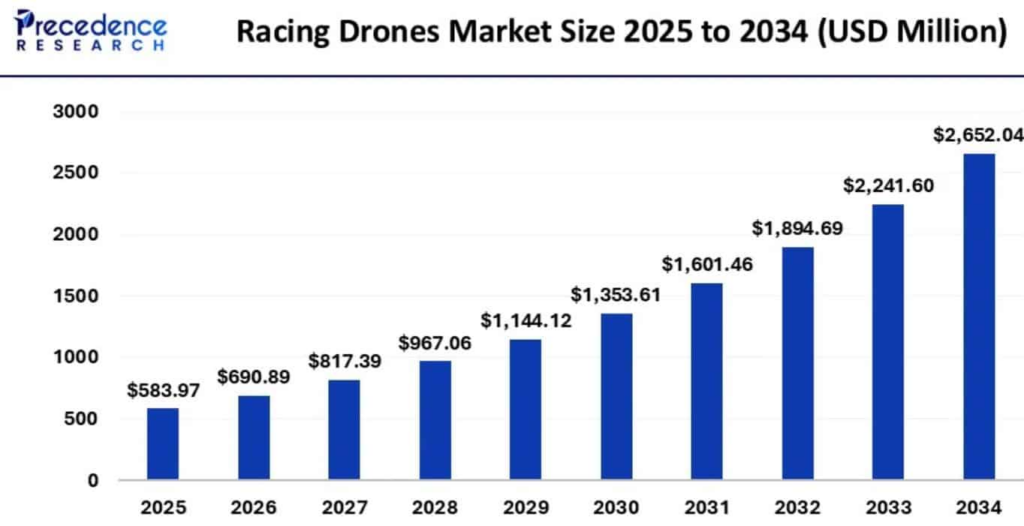
- In 2026, the global racing drones market is expected to reach around USD 690.89 million.
- By the end of 2034, the market size will be around USD 2,652.04 million, with a CAGR of 18.31% from 2025 to 2034.
- In the United States, the drone market will reach approximately USD 191.72 million by 2026.
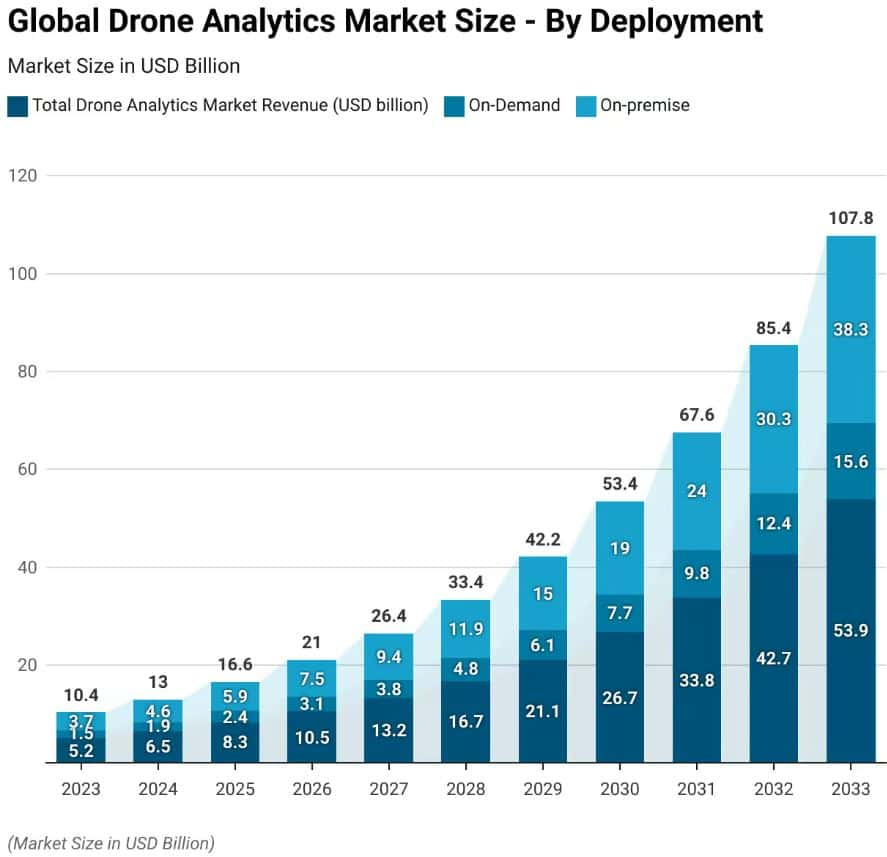
Global Drone Analytics Market By Deployment
(Source: market.us)
- In 2026, the global drone analytics market is projected to reach USD 21 billion.
- In contrast, the On-Demand deployment will account for USD 7.5 billion, representing approximately 36% of the market.
- On-premises deployment will account for USD 3.1 billion, with 15% of the total.
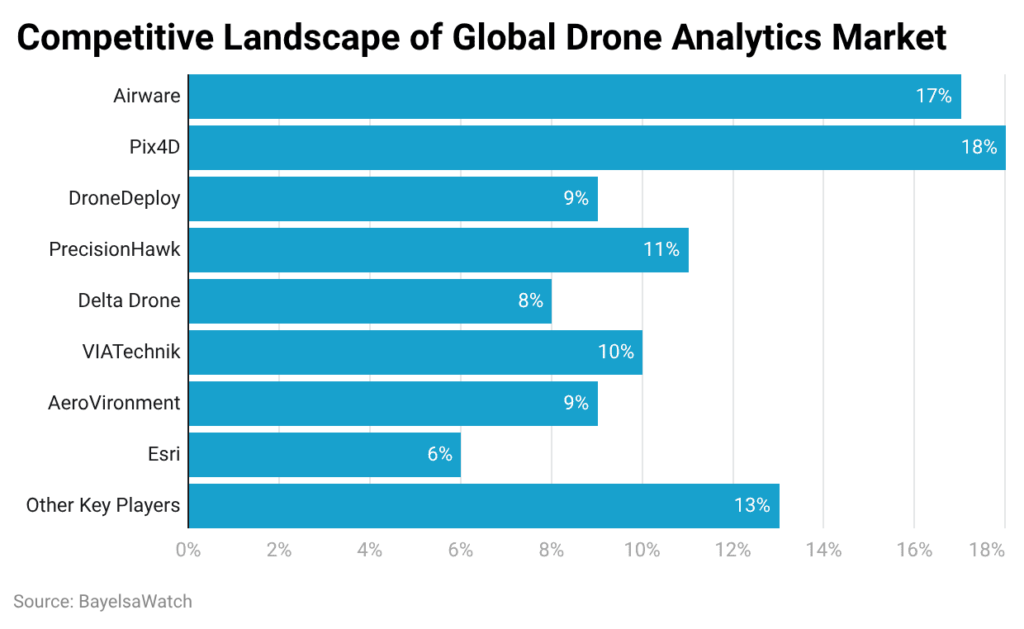
By Company Share
(Reference: market.us)
- Pix4D leads the global drone analytics market with an 18% share, followed closely by Airware at 17%, while PrecisionHawk (11%) and VIATechnik (10%) hold notable positions.
- AeroVironment and DroneDeploy each have 9%, Delta Drone 8%, Esri 6%, and other players collectively make up 13%, reflecting a fragmented market beyond the main competitors.
Drone Registrations and In The United States

(Source: hiredronepilot.uk)
- In 2025, a total of 855,860 drones were registered with the FAA.
- Of these, 536,183 drones (63%) were registered for recreational use.
- The remaining 316,075 drones (37%) were registered for commercial purposes.
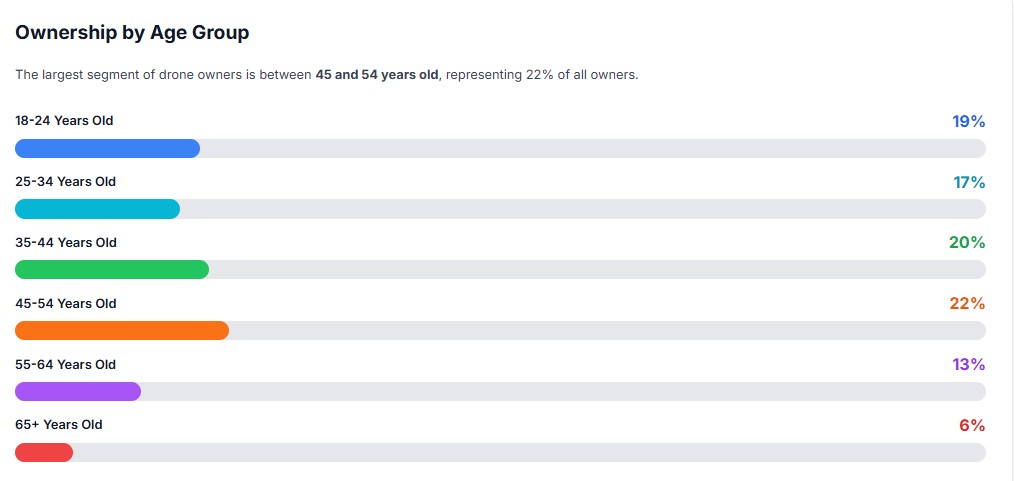
By Ownership Demographics
- As of 2025, around 96% of drone owners in the United States were men, while only 4% were women, according to Hire Drone Pilot.
(Source: hiredronepilot.uk)
- The 18-24 age group owns approximately 162,613 drones, representing 19% of total drone owners.
- Drone owners aged 25-34 account for 17% of all registered drones, totalling 145,496.
- The 35-44 age group holds 20% of drone registrations, approximately 171,172 drones.
- Individuals aged 45-54 are the largest group of drone owners, accounting for 22% and approximately 188,289 drones.
- Owners aged 55-64 account for 13% of the total, around 111,262 drones.
- The 65+ age group accounts for 6%, with approximately 51,352 drones registered.
- In 2025, 855,860 U.S. drones were registered, mostly owned by adults aged 45-54.
Drone Safety Statistics By Crashes, Incidents, And Injuries
- According to the Hire Drone Pilot report, there were 4,250 reported drone-related injuries from 2020 to 2025.
- Around 84% injuries occurred to males, while 16% of injuries involved females.
- 21% of the injured were under 18, and 79% were 18 or older.
- More than 70% of the reported incidents involved multirotor drones.
- Over 60% of drone incidents occurred within 200 feet of an airport.
Most Common Injury Types Caused By Drones
- As of 2025, lacerations (cuts or wounds) are the most common type of injury, accounting for 72% of all cases.
- Contusions and abrasions (bruises or scrapes) make up 10% of injuries.
- Other types of injuries represent the remaining 18%.
- Fingers are the most vulnerable body parts, accounting for 56% of injuries.
- Head injuries are the second most common, making up 24% of cases.
- Lower extremities (legs, ankles, and feet) account for 14% of injuries.
- Trunk injuries (chest and torso) represent 6% of all cases.
Characterisation of Drones By Type
- Rotary-wing drones dominate the market, making up 63% of all drones, according to Market.us Scoop.
- Fixed-wing drones account for 16% of the market, representing a smaller but still significant share.
- Other types of drones include versatile configurations (14%), VTOL drones (5%), and aerostats or other specialised drones (1% each).
By Performed Tasks
| Drone Tasks | Share |
| Asset Management | 17% |
| Disaster Relief | 13% |
| Law Enforcement | 12% |
| Military | 11% |
| Aerial Delivery | 9% |
| Aerial Survey | 8% |
| Science/Development | 6% |
| Hobby/Leisure/Entertainment | 4% |
| Aerial Transport | 3% |
| High Tech | 3% |
| Aerial Photography | 2% |
U.S. People’s Reactions To Drones
| Emotion | Share | Category |
| Curious | 58% | Positive/Neutral |
| Interested | 45% | Positive |
| Nervous | 26% | Negative |
| Indifferent | 18% | Neutral |
| Excited | 15% | Positive |
| Angry | 12% | Negative |
| Scared | 11% | Negative |
Public Support For Drone Use By Location Type
| Location Type | Support Share |
| Public Parks | 44% |
| Beaches | 35% |
| Events (Concerts, Rallies) | 24% |
| Crime Scenes or Traffic Accidents | 20% |
| Near People’s Homes | 11% |
Drone Encounters Statistics
- More than 60% of drone encounters happen within 200 feet of airports.
- These incidents are a critical safety concern for aviation.
- Single-engine propeller aircraft account for 125 incidents, representing 44.8% of total cases.
- Multi-engine jets are involved in 116 incidents, accounting for 41.6% of total cases.
- Helicopters are involved in 38 incidents, making up 13.6% of the total.
- There were 279 recorded incidents in total, which equals 100% of reported cases.
Commercial Drone Applications And Industry Impact
- In 2025, 67% of construction companies reported using drones to survey their sites.
- Drones were used to monitor approximately 3.2 million acres of farmland in the United States.
- Moreover, 82% of luxury property listings are valued at more than USD 1 million.
- The film and media industry generated around USD 840 million in revenue from professional drone services.
- When drones are used for initial assessment in emergencies, response times improve by 37%.
- Using drones for inspecting infrastructure can reduce costs by 55% compared to traditional inspection methods.
- Drones help insurance companies process claims 43% faster, improving efficiency and customer satisfaction.
Impact of AI On Drones
- Enhanced Autonomy and Decision-Making: AI enables drones to operate autonomously, performing tasks such as aerial surveys, package delivery, and infrastructure inspections without constant human oversight.
- Increased Operational Efficiency: AI helps drones plan more efficient flight paths and reduces the need for manual control, improving efficiency across agriculture, logistics, and other industries and reducing time and costs.
- Advanced Surveillance and Monitoring: AI-powered drones can autonomously monitor large areas, analysing real-time data to detect threats or unusual activity, supporting security and military operations.
- Improved Data Collection and Analysis: AI-enabled drones collect and process large volumes of data accurately, supporting environmental monitoring, infrastructure maintenance, and crop management.
- Regulatory and Ethical Challenges: The use of AI in drones raises privacy, data security, and ethical concerns, which require careful regulation and oversight.
Conclusion
In conclusion, drones are useful tools that support multiple applications, including agriculture, photography, healthcare, and delivery. They save time, reach difficult places, and make work easier. However, they must be used carefully to avoid safety and privacy problems. With proper rules, drones can be very helpful in the future.
FAQ
Most drones fly for 15-30 minutes, whereas professional models can remain in the air for hours.
Drones store data on memory cards or internal storage or upload it to the cloud.
Misuse is the main problem, including privacy invasion, safety risks, and careless or illegal operators.
Most drones cannot fly in rain; water can damage electronics and destabilise flight.
Payloads vary, but some industrial drones can lift over 100 kg.