










Subscription Economy Market Size
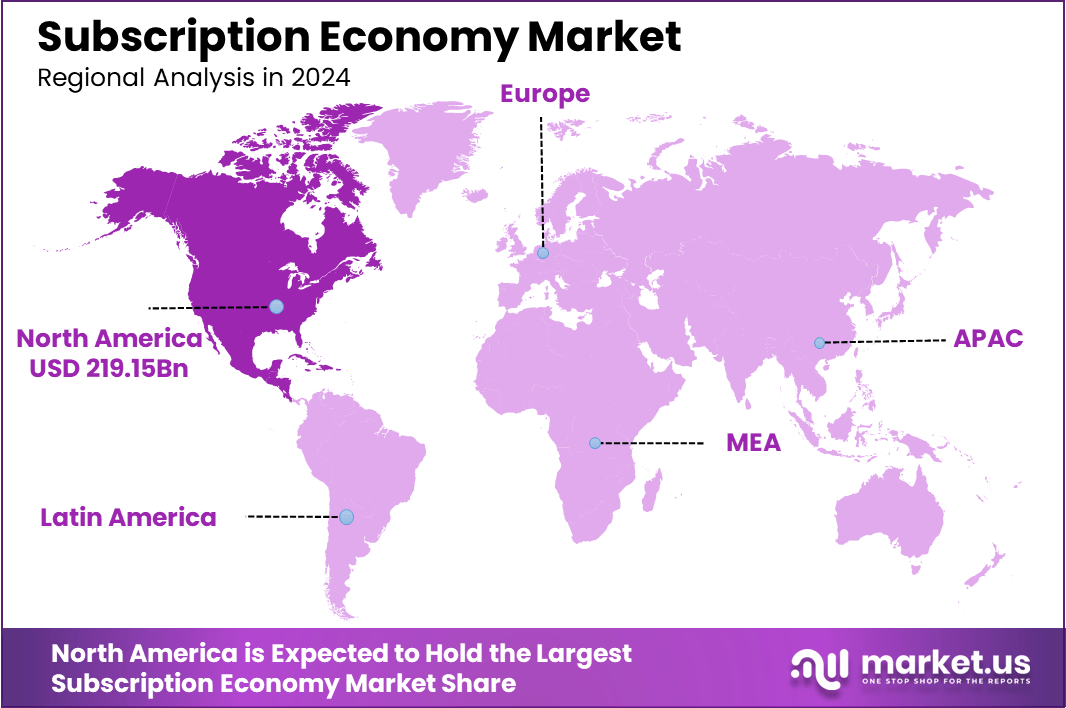
The Subscription Economy market was valued at USD 487.0 billion in 2024 and is projected to reach approximately USD 2,129.92 billion by 2034, expanding at a 15.9% CAGR during the forecast period from 2025 to 2034. This growth is being supported by the increasing adoption of recurring revenue models across digital services, media, software, retail, and consumer goods. In 2024, North America held the leading market position with more than 45% share, generating around USD 219.15 billion in revenue.
The market’s growth was also supported by the rapid digitalization of services and changing customer spending habits. Subscription-based offerings became more common across entertainment, education, wellness, software, and retail categories. Businesses were able to use these models to personalize offerings, introduce tiered pricing, and improve lifetime customer value. As a result, the subscription economy evolved into a major commercial framework across both consumer and enterprise markets.
Get a comprehensive report summary that describes the value and forecast along with methodology. Download the PDF brochure

Top Market Takeaways
- Content subscriptions led the market in 2024 with a share of more than 45%, supported by rising consumer demand for digital media and online content access.
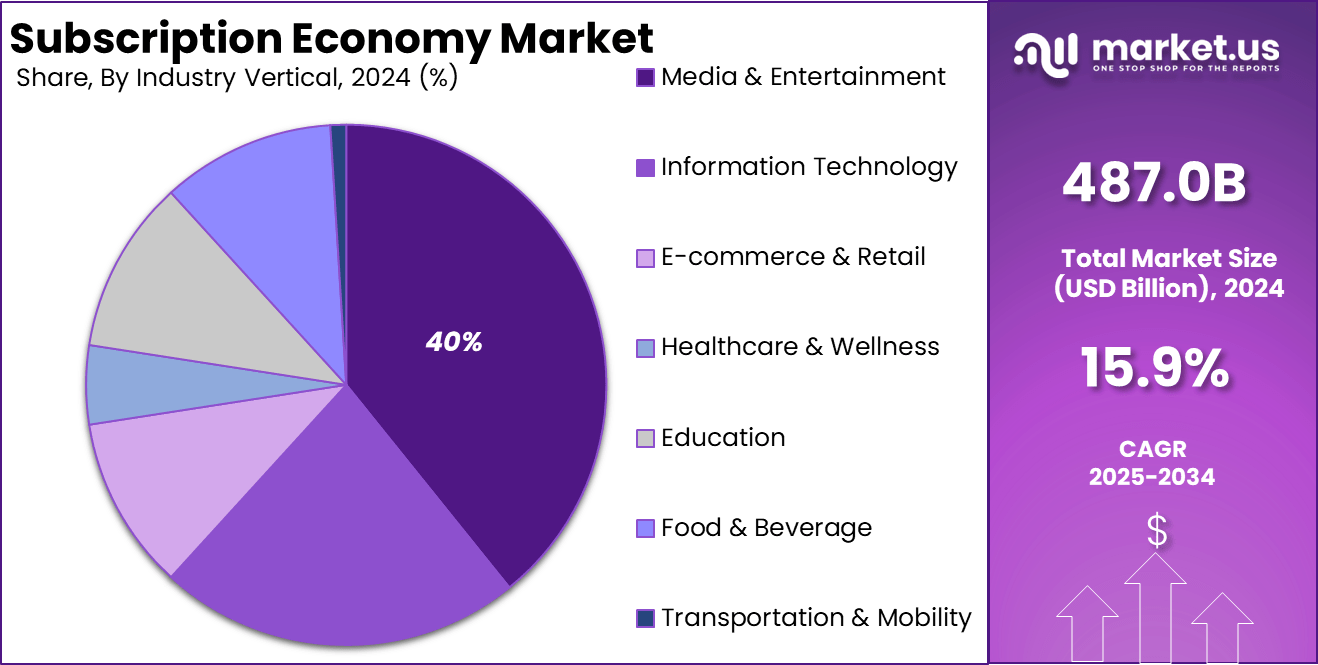
- The media and entertainment segment captured over 40% of the market, driven by the strong adoption of streaming and subscription-based digital services.In 2024, North America held a dominant share of over 45%, generating revenue of USD 219.15 billion.
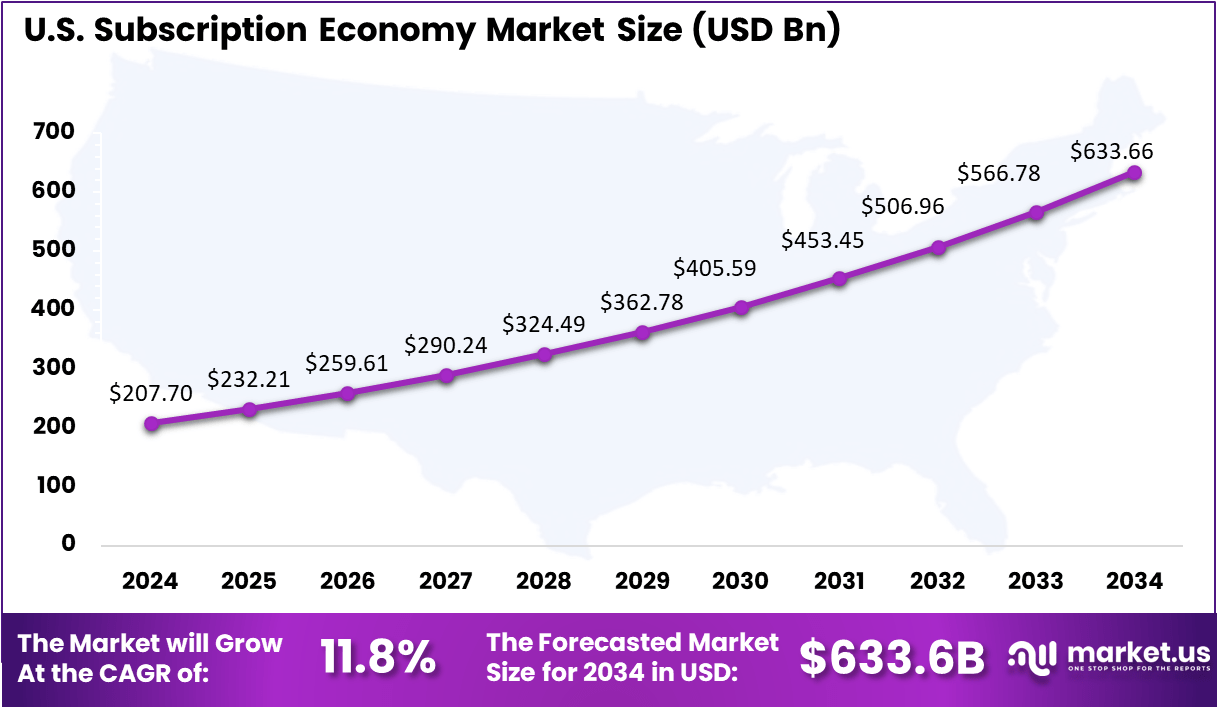
- The U.S. subscription economy market was valued at approximately USD 207.70 billion in 2024 and is expected to reach USD 232.21 billion in 2025.
- By 2034, the U.S. market is projected to expand to USD 633.66 billion, growing at a CAGR of 11.8%.
Market Overview
The subscription economy market refers to a business model where customers pay recurring fees to access products or services rather than owning them outright. This model spans across software, media, e commerce, fitness, and digital services, enabling companies to generate predictable and recurring revenue streams. Over the past decade, the subscription economy has undergone a structural transformation, expanding by more than 435%, reflecting a fundamental shift from ownership to access based consumption models .
Top driving factors for this market are strongly linked to changing consumer preferences and the need for predictable revenue. Businesses are increasingly adopting subscription models to ensure stable cash flow and long term customer relationships. Consumers prefer flexibility, convenience, and personalized access to services instead of one time purchases. It is also observed that subscription based companies grow 4.6x faster than traditional business models, highlighting the strong financial advantage of recurring revenue strategies .
Demand analysis indicates widespread adoption across industries such as software, entertainment, e commerce, and digital services. Software as a service remains a dominant contributor, supported by enterprise demand for scalable and cloud based solutions. Organizations today use an average of over 100 SaaS applications, reflecting deep integration of subscription models in business operations . In addition, digital subscriptions such as streaming, online education, and subscription commerce are witnessing strong user engagement across global markets.
Request a custom report or consultation – write to us at [email protected]
Report Scope
| Report Features | Description |
| Market Value (2024) | USD 487.0 Bn |
| Forecast Revenue (2034) | USD 2,129.92 Bn |
| CAGR (2025-2034) | 15.90% |
| Base Year for Estimation | 2024 |
| Historic Period | 2020-2023 |
| Forecast Period | 2025-2034 |
| Report Coverage | Revenue forecast, AI impact on market trends, Share Insights, Company ranking, competitive landscape, Recent Developments, Market Dynamics and Emerging Trends |
| Segments Covered | By Service Type (Content Subscriptions, Product Subscriptions, Service Subscriptions, Membership Subsciptions), By Industry Vertical (Media & Entertainment, Information Technology, E-commerce & Retail, Healthcare & Wellness, Education, Food & Beverage, Transportation & Mobility, Others) |
| Regional Analysis | North America – US, Canada; Europe – Germany, France, The UK, Spain, Italy, Russia, Netherlands, Rest of Europe; Asia Pacific – China, Japan, South Korea, India, New Zealand, Singapore, Thailand, Vietnam, Rest of APAC; Latin America – Brazil, Mexico, Rest of Latin America; Middle East & Africa – South Africa, Saudi Arabia, UAE, Rest of MEA |
| Competitive Landscape | Netflix, Spotify, Disney+, Xbox Game Pass, Microsoft, Adobe, Salesforce, Zoom, Amazon Prime, Peloton, Teladoc, HelloFresh, Blue Apron, Zipcar, Others |
By Service Type Analysis
In 2024, the content subscriptions segment held a dominant share of over 45% in the Subscription Economy Market. This leadership reflected the continued growth in consumer demand for streaming video, music, digital publishing, gaming, and other on-demand media services. The widespread shift toward digital consumption encouraged users to prefer recurring access models that offer convenience and broad content libraries. This made content subscriptions the most established and commercially successful segment within the market.
The strength of this segment was further supported by evolving user behavior centered on continuous engagement and platform loyalty. Providers increasingly focused on exclusive content, personalized recommendations, and bundled offerings to retain subscribers. The recurring nature of content consumption helped companies maintain predictable revenue flows and stronger audience relationships. As digital media usage expanded globally, content subscriptions continued to hold the leading position in the market.
By Industry Vertical Analysis
In 2024, the media and entertainment segment accounted for more than 40% of the Subscription Economy Market, making it the leading industry vertical. This dominance was driven by the broad adoption of streaming platforms, digital media services, and subscription-based access to entertainment content. Consumers increasingly preferred flexible, on-demand entertainment experiences over traditional ownership or pay-per-use models. This shift significantly strengthened the role of subscription models across the media and entertainment industry.
The segment’s expansion was also supported by continuous investment in original content, platform innovation, and user experience enhancement. Companies in this space used subscription strategies to build recurring income streams and deepen consumer engagement over time. The ability to serve large audiences through scalable digital platforms further improved the commercial value of the model. As a result, media and entertainment remained the most influential industry segment in the subscription economy.
Regional Analysis
In 2024, North America held a dominant market position, capturing over 45% of the global Subscription Economy Market and generating revenue of USD 219.15 billion. The region’s leadership was supported by high digital adoption, strong consumer spending on subscription services, and the early maturity of recurring revenue business models. Businesses across software, media, retail, and digital services widely adopted subscription frameworks to secure stable revenue and improve customer retention. This created a strong regional foundation for sustained market expansion.
North America also benefited from a highly developed digital payment ecosystem and strong acceptance of app-based and platform-based subscription services. Consumers in the region showed high willingness to pay for convenience, exclusivity, and continuous access to products and services. Enterprises also used subscription models to enhance forecasting, customer data insights, and service customization. These factors helped North America maintain its leading share in the global market.
United States Analysis
In 2024, the United States subscription economy market was valued at approximately USD 207.70 billion. The market is estimated to reach USD 232.21 billion in 2025 and further expand to nearly USD 633.66 billion by 2034, registering a CAGR of 11.8% during the forecast period. This performance reflected the country’s advanced digital commerce environment and the strong presence of subscription-led business models across consumer and enterprise categories. The United States remained the core contributor to regional revenue generation.
The country’s market growth was supported by rising adoption of recurring billing models in media, software, consumer goods, and online services. Companies in the United States increasingly used subscriptions to improve customer loyalty, reduce revenue volatility, and strengthen long-term engagement. Consumers also showed growing preference for curated, flexible, and digitally managed subscription experiences. As a result, the United States continued to represent one of the most mature and commercially significant markets in the global subscription economy.
Emerging Trends Analysis
The subscription economy market is increasingly driven by the shift from ownership to access-based consumption models. Consumers and businesses are preferring recurring payment models that provide flexibility, convenience, and continuous value. This trend is evident across industries such as software, media streaming, e-commerce, and even automotive services. Over the past decade, subscription-based businesses have grown by approximately 435%, significantly outpacing traditional business models and reflecting a structural transformation in how products and services are delivered.
Another important trend is the rise of hybrid subscription models combining subscriptions with usage-based or ad-supported pricing. Companies are introducing flexible pricing tiers to reduce churn and attract a wider audience. For instance, ad-supported subscription plans are gaining traction, with nearly 46% of users opting for lower-cost ad-based tiers in digital services. This indicates a shift toward affordability and personalization, where users choose plans based on their usage patterns and budget preferences.
Driver Analysis
The primary driver of the subscription economy market is the demand for predictable and recurring revenue streams for businesses. Subscription models enable companies to generate stable cash flows and improve customer lifetime value. This has encouraged widespread adoption across industries, especially in SaaS, where nearly 99% of businesses use at least one subscription-based software service, highlighting the dominance of recurring revenue models in enterprise operations.
In addition, changing consumer behavior is significantly driving market growth. A large proportion of consumers now rely on multiple subscription services for entertainment, software, and daily needs. Studies indicate that 98% of consumers subscribe to at least one service, and millennials maintain an average of 17 subscriptions, demonstrating strong acceptance of subscription-based consumption patterns.
Restraint Analysis
One of the key restraints in the subscription economy market is increasing consumer fatigue due to multiple subscriptions. As users subscribe to numerous services, managing costs becomes challenging, leading to subscription cancellations or reduced spending. Reports suggest that average monthly subscription spending can exceed $200, often with users unaware of a significant portion of their active subscriptions.
Another restraint is rising customer acquisition costs and churn management challenges. As competition intensifies, companies must invest heavily in marketing and retention strategies. Acquisition costs have increased by over 200% in recent years, putting pressure on profitability and forcing businesses to optimize pricing and engagement strategies.
Opportunity Analysis
Significant opportunities are emerging from the expansion of digital services and global internet penetration. The subscription economy is expected to reach approximately $1.2 trillion by 2030, reflecting strong adoption across industries and regions. This growth is driven by increasing digital transformation, mobile usage, and the expansion of subscription-based offerings in new sectors such as healthcare, automotive, and education.
Additionally, the integration of artificial intelligence and data analytics is creating new opportunities for personalization and revenue optimization. Businesses are leveraging AI to analyze customer behavior, reduce churn, and deliver tailored experiences. Companies with strong data-driven subscription models often achieve 3:1 to 5:1 lifetime value to acquisition cost ratios, indicating high profitability potential when managed effectively.
Challenge Analysis
A major challenge in the subscription economy market is maintaining customer retention over time. While acquiring users is important, long-term success depends on minimizing churn and delivering consistent value. Even though churn rates have improved to around 5.4%, retaining customers in a highly competitive environment remains a key concern for businesses.
Another challenge is balancing pricing strategies with user expectations. Consumers increasingly demand flexibility, transparency, and value for money. Businesses must continuously innovate pricing models and service offerings to remain competitive. Failure to meet evolving expectations can lead to rapid churn and reduced customer loyalty, making pricing optimization a critical factor in sustaining growth.
Key Player Analysis
The Subscription Economy Market is driven by leading digital entertainment and service platforms offering recurring revenue models. Netflix, Spotify, and Disney+ dominate through content-driven subscription models. Amazon Prime and Xbox Game Pass expand value through bundled services. These platforms focus on user retention and personalization. Their models ensure steady recurring revenue. This supports strong growth in digital subscription adoption.
Enterprise software and productivity platforms play a key role in expanding subscription-based business models. Microsoft, Adobe, Salesforce, and Zoom deliver cloud-based subscription services. These companies enable scalable software access through monthly and annual plans. Their solutions improve business efficiency and collaboration. This drives widespread adoption across enterprises and professionals.
Consumer-focused subscription services are expanding across health, fitness, and lifestyle segments. Peloton, Teladoc, HelloFresh, Blue Apron, and Zipcar offer subscription-based access to services. These companies focus on convenience and personalization. Their models enhance customer engagement and loyalty. Other key players continue to expand offerings. This competitive landscape supports steady growth in the subscription economy.
Top Key Players in the Market
- Netflix
- Spotify
- Disney+
- Xbox Game Pass
- Microsoft
- Adobe
- Salesforce
- Zoom
- Amazon Prime
- Peloton
- Teladoc
- HelloFresh
- Blue Apron
- Zipcar
- Others
Recent Developments
- January, 2026 – Netflix password crackdown added 8 million paid memberships globally. Ad-supported tier reached 40% of new signups with 25% lower churn. Platform served 300 million paid users across 190 countries. Live events integration boosted engagement 35%. Share price hit all-time highs on profitability gains.
- February, 2026 – Spotify HiFi tier launched with lossless audio for audiophiles. Podcast monetization generated USD 200 million quarterly revenue. 626 million monthly active users with 246 million premium subscribers. AI DJ feature increased session times 20%. Audiobook bundling drove 15% subscriber growth.