










According to Market.us, The global Visual Effects (VFX) market is projected to reach USD 28,073.92 million by 2033, increasing from USD 12,122 million in 2025, at a CAGR of 10.7% during the forecast period from 2024 to 2033. This growth is driven by rising demand for high-quality digital content across films, streaming platforms, gaming, and advertising industries, supported by advancements in CGI, real-time rendering, and immersive visual technologies.
The visual effects market focuses on the creation of computer generated imagery and digital enhancements used in films, television, gaming, and digital media. VFX enables the production of scenes that cannot be captured through traditional filming, including complex environments, characters, and simulations. As entertainment content becomes more immersive, VFX has become a critical component of storytelling and production quality. It allows creators to deliver visually rich experiences across multiple platforms.
Get a comprehensive report summary that describes the value and forecast along with methodology. Download the PDF brochure

Based on data from WorldMetrics, the average annual salary for VFX artists in the United States stands at USD 71,110, indicating the high level of specialization and technical expertise required in this field. The United States maintains a leading position in the global market, accounting for over 35% of total share, supported by its well-established film ecosystem and continuous investment in advanced production technologies.
VFX has become a core component of modern filmmaking, with more than 80% of blockbuster films incorporating visual effects to enhance storytelling and audience engagement. Despite strong growth, the industry is facing structural challenges related to workforce availability. More than 80% of VFX companies report a shortage of skilled professionals, reflecting a widening talent gap that may impact production timelines and operational efficiency.
The gaming sector continues to play a critical role in market expansion, contributing over 25% of total demand for VFX solutions. In addition, the rapid advancement of immersive technologies such as virtual reality and augmented reality is opening new avenues for growth. The combined VR and AR market reached a valuation of approximately USD 124.5 billion by 2023, creating significant opportunities for VFX integration in interactive environments.
Key Takeaways
- The visual effects market is projected to reach USD 40 billion by 2033, growing at a CAGR of 10.7%.
- In 2023, simulation FX led the market with a share of more than 26%.
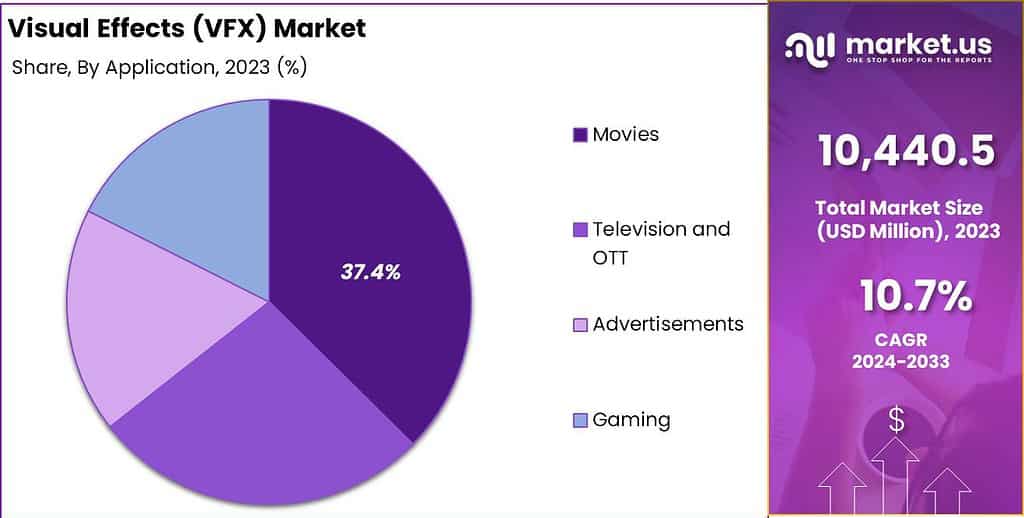
- The movies segment held a dominant share of over 37% in 2023, reflecting strong demand from film production.
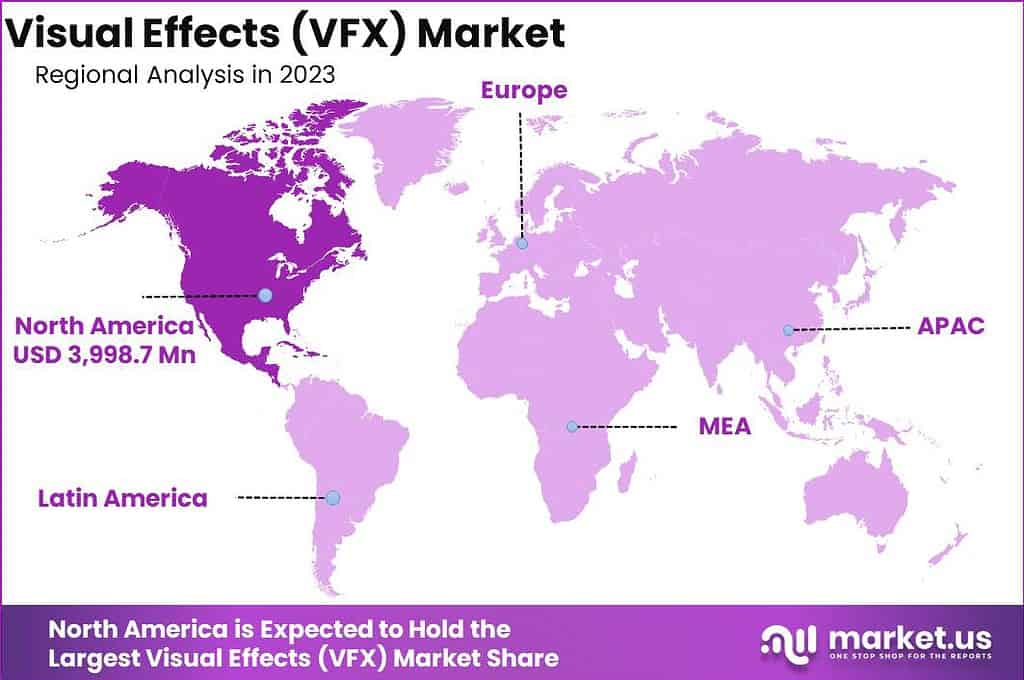
- North America accounted for more than 41% of the global VFX market in 2023.
- AI systems were expected to handle nearly 25% of roto work in the VFX industry by 2024, showing growing automation in repetitive tasks.
- The use of AI and machine learning in the VFX and animation industry was projected to grow at a CAGR of 14.3% by 2025.
- Films using AI-powered VFX have reported ticket sales that were 25% higher than films using traditional VFX methods.
- Around 88.5% of VFX artists believe AI will support their work rather than replace their jobs.
Visual Effects (VFX) Statistics
- In some analyses, over 71% of original series are reported as using “significant” VFX, showing that high‑end scripted content has near‑universal VFX utilization.
- In India, the animation, VFX and post‑production segment was about INR 103 billion in 2024, despite a 9% contraction, with VFX spend in high‑budget films reaching up to 30% of total budgets (15% for mid‑budget).
- Understood. Here are sector bullets with usage emphasis and only non–market-research-firm style stats (industry/association/media sources, plus qualitative where needed).
- Around 80-90% of top‑grossing films now rely on significant VFX work, and VFX often takes 20-40% of big‑budget film production costs (for some tentpole titles).
- Over 70% of original series from major OTT platforms use heavy VFX sequences, and more than 1,000 new OTT titles with notable VFX were commissioned over just a few recent years.
By Technique
In 2023, the Simulation FX segment held a dominant position in the Visual Effects (VFX) market, capturing more than 26% share. This dominance was supported by the increasing use of advanced simulation technologies to create realistic effects such as fire, smoke, water, and explosions in digital content. Simulation FX plays a critical role in enhancing visual storytelling by delivering high-quality, physics-based animations. Its adoption has grown significantly across large-scale productions that require immersive and visually complex scenes.
The segment’s strength is also linked to the rising demand for realism in films, television, and streaming content. Studios are investing in simulation tools to achieve cinematic quality while reducing practical production constraints. Continuous advancements in rendering technologies and computing power have further improved simulation capabilities. This has positioned Simulation FX as a key technique within the VFX production pipeline.
By Application
In 2023, the movies segment held a dominant position in the Visual Effects market, capturing more than 37% share. The film industry remains the largest consumer of VFX services, driven by the need to create visually engaging and high-budget productions. Visual effects are widely used in action, fantasy, and science fiction genres to deliver complex scenes that cannot be achieved through traditional filming. This has significantly increased the demand for VFX in movie production.
The segment’s growth is further supported by the expansion of global film production and rising audience expectations for high-quality visuals. Streaming platforms and international film industries are also contributing to increased demand for cinematic content. Investments in VFX technology and production capabilities continue to rise across studios. As a result, movies remain the leading application segment in the VFX market.
Regional Analysis
In 2023, North America held a dominant position in the Visual Effects market, capturing more than 41% share of the global market. The region’s leadership is supported by a strong presence of major film studios, advanced production infrastructure, and high adoption of digital technologies. The United States, in particular, serves as a global hub for film and entertainment production, driving significant demand for VFX services. This has established North America as a key region in the industry.
The regional dominance is also influenced by continuous investment in technology and talent within the VFX ecosystem. Production companies in the region are early adopters of advanced tools such as real-time rendering and virtual production. Strong collaboration between studios, technology providers, and creative professionals further enhances market growth. These factors collectively contribute to North America’s leading position in the global VFX market.
Key Regions and Countries
North America
- US
- Canada
Europe
- Germany
- France
- The UK
- Spain
- Italy
- Netherlands
- Rest of Europe
Asia Pacific
- China
- Japan
- South Korea
- India
- Australia
- Singapore
- Thailand
- Vietnam
- Rest of APAC
Latin America
- Brazil
- Mexico
- Rest of Latin America
Middle East & Africa
- South Africa
- Saudi Arabia
- UAE
- Rest of MEA
Key Players Analysis
- The Walt Disney Co.: Operates some of the world’s largest in‑house VFX/animation units (e.g., Industrial Light & Magic via Lucasfilm, plus Marvel, Pixar) and is one of the biggest global buyers and producers of high‑end VFX content.
- Adobe Inc.: Provides key VFX and motion‑graphics tools such as After Effects and Premiere Pro, which are widely used for compositing, motion design and finishing across film, TV, advertising, and online video.
- Autodesk Inc.: Supplies core 3D DCC tools like Maya and 3ds Max that sit at the center of many VFX pipelines for modeling, rigging, animation and layout in films, series, and games.
- DNEG: A top‑tier global VFX studio working on major Hollywood and streaming projects, known for large‑scale feature film work and long‑form series, with multi‑year service deals with studios and platforms.
- Animal Logic: A leading animation and VFX studio (e.g., work on “The Lego Movie”–type projects), expanding facilities in hubs like Vancouver and employing hundreds of artists across feature films and high‑end animation.
- Maxon Computer GmbH: Developer of Cinema 4D, a widely used 3D tool in broadcast, motion graphics and design‑driven VFX (often tightly integrated with Adobe After Effects in studio pipelines).
- Blackmagic Design Pty Ltd: Maker of DaVinci Resolve and Fusion, used for color grading, online editing and node‑based compositing; Resolve’s integrated Fusion page is now a full VFX and motion‑graphics environment.
- SideFX: Creator of Houdini, the standard for procedural VFX such as particles, fluids, destruction and crowds; heavily used in big films, TV and high‑end games for complex simulations.
- The Foundry Visionmongers Ltd (Foundry): Known for Nuke, the industry‑standard high‑end compositing tool used across major studios for feature film and premium TV work.
- CINESITE: A major independent VFX and animation studio group delivering film and series work for global clients, regularly listed alongside other top vendors like DNEG, Weta, Framestore and Animal Logic.
Top Key Players in the Market
- The Walt Disney Co.
- Adobe Inc.
- Autodesk Inc.
- DNEG
- Animal Logic
- Maxon Computer GMBH
- Blackmagic Design Pty Ltd
- SideFX
- The Foundry Visionmongers Limited
- CINESITE
Recent Developments
- January, 2026 – Disney’s Industrial Light & Magic integrated Omniverse for virtual production pipelines. Real-time LED walls cut location shoots 40% on Marvel projects. ILM delivered VFX for 15 major releases last year.
- February, 2026 – Adobe Substance 3D enhanced AI upscaling for VFX textures. Artists generate 16K PBR maps from sketches instantly. Production speeds rose 35% across streaming workflows.
- March, 2026 – Autodesk Maya 2026 added Bifrost AI fluid simulations. Water effects render 5x faster on consumer GPUs. Film studios reduced sim farms by 60%.
Report Scope
| Report Features | Description |
| Market Value (2023) | USD 10,440 Mn |
| Forecast Revenue (2033) | USD 28,073.9 Mn |
| CAGR (2024-2033) | 10.70% |
| Base Year for Estimation | 2023 |
| Historic Period | 2019-2022 |
| Forecast Period | 2024-2033 |
| Report Coverage | Revenue Forecast, Market Dynamics, COVID-19 Impact, Competitive Landscape, Recent Developments |
| Segments Covered | By Type (Matte Painting, Simulation FX, Motion Capture, Compositing, CGI), By Application(Movies, Television & OTT, Advertisements, Gaming) |
| Regional Analysis | North America – US, Canada; Europe – Germany, France, The UK, Spain, Italy, Russia, Netherlands, Rest of Europe; Asia Pacific – China, Japan, South Korea, India, New Zealand, Singapore, Thailand, Vietnam, Rest of APAC; Latin America – Brazil, Mexico, Rest of Latin America; Middle East & Africa – South Africa, Saudi Arabia, UAE, Rest of MEA |
| Competitive Landscape | The Walt Disney Company, Adobe Inc., Autodesk Inc., DNEG, Animal Logic, Maxon Computer GMBH, Blackmagic Design Pty Ltd, SideFX, The Foundry Visionmongers Limited, CINESITE |
| Customization Scope | Customization for segments, region/country-level will be provided. Moreover, additional customization can be done based on the requirements. |
| Purchase Options | We have three license to opt for: Single User License, Multi-User License (Up to 5 Users), Corporate Use License (Unlimited User and Printable PDF) |