










Introduction
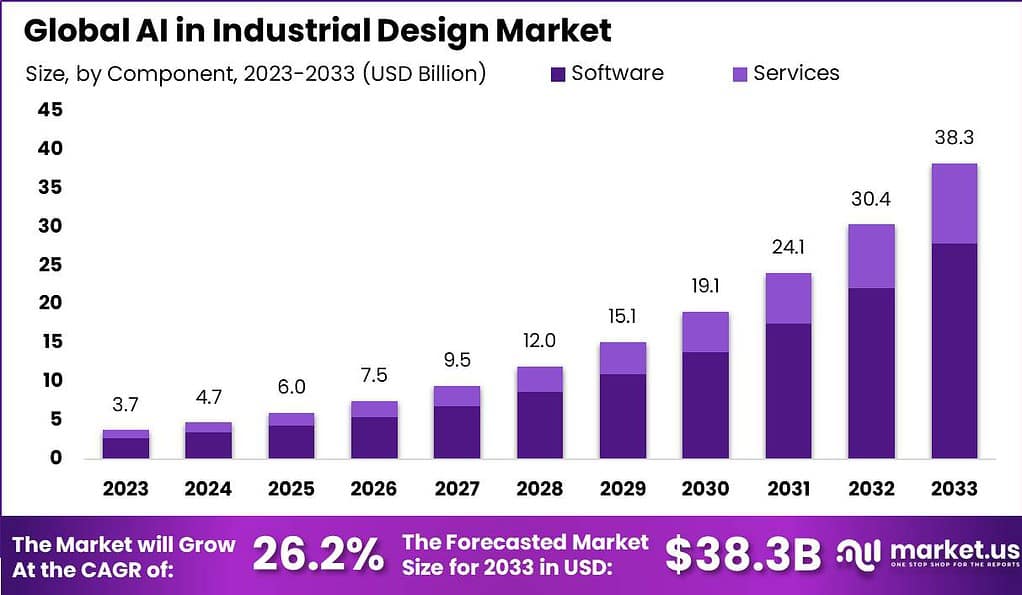
According to Market.us, The global AI in Industrial Design market is projected to reach USD 38.3 billion by 2033, rising from USD 6.0 billion in 2025, at a CAGR of 26.2% during the forecast period from 2024 to 2033. This growth is being supported by the increasing use of AI tools in product development, design automation, rapid prototyping, and workflow optimization across industrial design processes.
Get a comprehensive report summary that describes the value and forecast along with methodology. Download the PDF brochure
Key Takeaways
- The AI in industrial design market is projected to reach USD 38.3 billion by 2033, expanding at a CAGR of 26.2% during the forecast period.
- In 2023, the software segment held a leading share of more than 72.7%, reflecting strong reliance on design automation and simulation tools.
- The cloud-based segment captured over 67.6% of the market, supported by scalable computing and easier collaboration across design teams.
- The automotive segment accounted for more than 33.7%, driven by growing use of AI in product modeling, prototyping, and engineering design.
- Asia-Pacific led the market with a share of over 34.7% in 2023, supported by strong research investment and the presence of major technology and manufacturing hubs.
By Component
The software segment held a dominant position in the AI in Industrial Design market, capturing more than 72.7% of the market share. This leadership was supported by the growing use of AI-powered design tools for simulation, modeling, visualization, and rapid prototyping across industrial workflows. Software platforms remained the core layer of deployment because they enabled faster design iterations, better accuracy, and stronger integration with digital engineering systems.
The strength of this segment was also linked to the rising need for design automation in product development. Companies increasingly adopted software-led AI systems to shorten development cycles and improve design efficiency without heavily increasing manual workloads. This made software the most commercially important component in the market during 2023.
By Deployment
The cloud-based segment held a dominant market position in the AI in Industrial Design market, capturing more than 67.6% share. Its growth was supported by the scalable nature of cloud infrastructure, which allowed businesses to run AI design tools with better flexibility and lower upfront hardware requirements. Cloud deployment also improved team collaboration, especially for design teams working across multiple sites and regions.
The segment gained further strength from the increasing demand for real-time data access and faster model deployment. Cloud environments made it easier to update software, manage large design datasets, and connect AI tools with broader enterprise systems. As a result, cloud-based deployment emerged as the preferred model for many industrial design use cases in 2023.

By Industry Vertical
The automotive segment held a dominant market position, capturing more than 33.7% share of the AI in Industrial Design market. This dominance was driven by the automotive industry’s strong focus on design optimization, lightweight engineering, safety improvement, and faster product development cycles. AI tools were increasingly used to support concept development, component design, simulation, and manufacturing-ready refinement.
The automotive industry also benefited from AI’s ability to reduce design errors and improve testing efficiency before physical production begins. With rising pressure to innovate in electric vehicles, connected systems, and advanced mobility platforms, AI-supported industrial design became more important across vehicle development programs. This kept automotive as the leading industry vertical in the market during 2023.
Report Scope
| Report Features | Description |
| Market Value (2025) | USD 6 Bn |
| Forecast Revenue (2033) | USD 38.3 Bn |
| CAGR (2024-2033) | 26.20% |
| Base Year for Estimation | 2023 |
| Historic Period | 2019-2022 |
| Forecast Period | 2024-2033 |
| Report Coverage | Revenue Forecast, Market Dynamics, COVID-19 Impact, Competitive Landscape, Recent Developments |
| Segments Covered | By Component (Software, Services), By Deployment Mode (Cloud-Based, On-Premise), By Industry Vertical (Automotive, Consumer Electronics, Aerospace & Defense, Healthcare, Other Industry Verticals) |
| Regional Analysis | North America – US, Canada; Europe – Germany, France, The UK, Spain, Italy, Russia, Netherlands, Rest of Europe; Asia Pacific – China, Japan, South Korea, India, New Zealand, Singapore, Thailand, Vietnam, Rest of APAC; Latin America – Brazil, Mexico, Rest of Latin America; Middle East & Africa – South Africa, Saudi Arabia, UAE, Rest of MEA |
| Competitive Landscape | Autodesk Inc., Dassault Systèmes SE, Siemens AG, NVIDIA Corporation, PTC Inc., Ansys Inc., Hexagon AB, Altair Engineering Inc., Bentley Systems Incorporated, MathWorks, Other Key Players |
| Customization Scope | Customization for segments, region/country-level will be provided. Moreover, additional customization can be done based on the requirements. |
| Purchase Options | We have three license to opt for: Single User License, Multi-User License (Up to 5 Users), Corporate Use License (Unlimited User and Printable PDF) |
Regional Analysis
In 2023, Asia-Pacific led the AI in Industrial Design market with a share of over 34.7%. The region’s leadership was supported by the concentration of major technology firms, expanding industrial manufacturing activity, and continued investments in research and development. Strong digital transformation efforts across economies such as China, Japan, South Korea, and India also supported wider AI adoption in design environments.
The region also benefited from a growing base of automotive, electronics, and advanced manufacturing companies that increasingly rely on AI-enabled product design tools. Strong industrial digitization programs and high innovation activity created favorable conditions for market expansion. This combination of technology investment and manufacturing depth helped Asia-Pacific maintain its leading regional position in 2023.

Key Regions and Countries
North America
- The US
- Canada
Europe
- Germany
- France
- The UK
- Spain
- Italy
- Russia & CIS
- Rest of Europe
APAC
- China
- India
- Japan
- South Korea
- ASEAN
- Rest of APAC
Latin America
- Brazil
- Mexico
- Rest of Latin America
Middle East & Africa
- GCC
- South Africa
Emerging Trends
The AI in industrial design market is increasingly shifting toward generative design and simulation-led development processes. AI-powered generative design tools are enabling designers to create multiple optimized design alternatives based on constraints such as weight, durability, and material usage.
It has been observed that AI-assisted design workflows can reduce product development time by nearly 30% to 40%, while also improving design efficiency through automated iteration cycles. This trend is transforming traditional design methods into data-driven and highly optimized processes across manufacturing and product engineering sectors.
Another emerging trend is the integration of AI with digital twin technology and real-time simulation platforms. Designers are now able to test and validate products in virtual environments before physical production, reducing prototyping costs and improving accuracy. Studies indicate that virtual simulation and AI-based validation can lower prototyping expenses by up to 25%.
Driver Analysis
The primary driver of the AI in industrial design market is the increasing need for faster innovation cycles and reduced time-to-market. In highly competitive industries, companies are focusing on accelerating product development without compromising quality.
AI enables automation of repetitive design tasks, allowing engineers to focus on complex problem-solving. It has been reported that automation in design processes can improve productivity by over 35%, which is encouraging organizations to adopt AI-driven solutions. Another important driver is the growing demand for customization and user-centric product development.
AI systems can analyze customer data, usage patterns, and feedback to guide design decisions. This enables the creation of highly personalized products at scale. The rise in demand for customized products across sectors such as automotive, consumer electronics, and healthcare is significantly contributing to the adoption of AI in industrial design processes.
Restraint Analysis
One of the key restraints in the AI in industrial design market is the requirement for high-quality and structured data. AI models depend heavily on accurate datasets to generate reliable outputs. In many industrial environments, data is often fragmented across different systems, which reduces the effectiveness of AI-based design tools. Poor data quality can lead to inaccurate design recommendations, limiting trust in these technologies.
Another restraint is the high cost associated with implementation and integration. Deploying AI solutions requires investment in advanced software platforms, computing infrastructure, and skilled professionals. For small and medium enterprises, these costs can be a significant barrier. Additionally, integrating AI into existing design workflows can be complex, requiring changes in processes and employee training.
Opportunity Analysis
Significant opportunities are emerging from the adoption of smart manufacturing and Industry 4.0 practices. AI-enabled design tools are being used to optimize production processes, reduce material waste, and improve product performance. It has been observed that AI-driven optimization can reduce material usage by up to 20%, supporting sustainability goals and cost efficiency.
Furthermore, the expansion of additive manufacturing and 3D printing technologies is creating new opportunities. AI can generate complex and lightweight designs that are specifically optimized for 3D printing processes. This allows manufacturers to produce innovative products that were previously difficult to design using traditional methods.
Challenge Analysis
A major challenge in the AI in industrial design market is the lack of skilled professionals who can effectively use AI tools. While AI can automate many aspects of design, expertise is still required to interpret results and make informed decisions. The shortage of professionals with both design and AI knowledge is slowing adoption in some industries. Training and upskilling the workforce remains a key requirement for successful implementation.
Another critical challenge is ensuring the reliability and validation of AI-generated designs. Industrial products must meet strict safety and performance standards. AI-generated outputs need to be thoroughly tested and validated before deployment. Studies suggest that validation processes can add up to 15% to 20% additional time in certain projects.
Key Players Analysis
The AI in Industrial Design Market is led by advanced design software providers integrating AI into engineering workflows. Autodesk Inc., Dassault Systèmes SE, and Siemens AG offer intelligent design and simulation platforms. PTC Inc. and Bentley Systems Incorporated enhance digital twin and product lifecycle capabilities. These companies focus on automation and generative design.
High-performance computing and simulation providers play a critical role in AI-driven design optimization. NVIDIA Corporation, Ansys Inc., and Altair Engineering Inc. deliver advanced simulation and AI modeling tools. Hexagon AB strengthens precision engineering through digital reality solutions. These companies enable real-time testing and predictive analysis. Their platforms reduce design errors.
Specialized software and analytics providers contribute to innovation in algorithm development and modeling. MathWorks supports AI-based simulation and data analysis through advanced computing environments. These tools help engineers optimize complex systems. Increasing adoption of AI in design processes is driving demand for such solutions. Other key players continue to invest in research and product development.
Top Key Players in the Market
- Autodesk Inc.
- Dassault Systèmes SE
- Siemens AG
- NVIDIA Corporation
- PTC Inc.
- Ansys Inc.
- Hexagon AB
- Altair Engineering Inc.
- Bentley Systems Incorporated
- MathWorks
- Other Key Players
Recent Developments
- January, 2026 – Autodesk Fusion 360 gained Dreamcatcher generative design with multi-objective AI. Engineers explore 10,000 lattice structures simultaneously for additive manufacturing. Automotive OEMs reduced material use 35% on suspension components.
- February, 2026 – Siemens NX integrated NVIDIA Omniverse for AI-driven digital twins. Virtual factories test assembly lines before construction, cutting commissioning time 50%. Factories simulate 1 million production variants monthly.
- March, 2026 – SOLIDWORKS xDesign added AI sketch-to-CAD conversion. Designers convert hand-drawn concepts to parametric models in seconds. Consumer electronics firms accelerated prototyping 3x.