




Introduction
Quantum Computing Statistics: Many people believed that Quantum computing would forever be a dream for physicists. However, it appears quantum computing may become a fact sooner than anticipated, as evidenced by the billions of dollars being spent globally on quantum technologies with yearly investment approaching 10’s of billions, a true gold rush for quantum technology.
A notable gap exists between the hype surrounding quantum technologies and the actual level of preparation being undertaken – most business leaders believe omnipresent quantum technologies will disrupt their businesses before the end of the decade, but statistically, only about 25% of companies have undertaken any level of preparation for this.
On the research side, physicists have shown that logical qubit lifetimes can extend into seconds; this directly affects the validity of current quantum error correction rules.
Editor’s Choice
- From January to September 2025, Quantum computing firms raised US$3.77 billion, nearly 3 times the amount raised in the full year 2024.
- Quantum computer sales are soaring with an average annual compound growth rate of 25.4%.
- According to our findings, for quantum computing, finance (28%), global energy and materials (16%), and advanced tech industries are the most applicable industries.
- Quantinuum is valued at US$10 billion with total funding of US$600 million.
- In terms of revenue, the Asia Pacific market stood at US$650m, followed by North America at US$580m.
- During the first three quarters of 2025, equity financing by quantum computing firms has totaled approximately US$3.77 billion.
What Is Quantum Computing?
Quantum computing is a new type of computing based on quantum mechanics, the science that describes how matter and energy interact on very small scales like atoms and sub-atomic particles. Classical computers use “bits,” either 0s or 1s to represent information, where quantum computers use “quantum bits,” also called “qubits”. Unlike bits, qubits can exist in multiple states at the same time, known as “superposition”. They can also interact with one another through a property called “entanglement”.
This enables quantum computers to perform calculations much faster than traditional computers can. Quantum computing has great potential in many areas, like cryptography, developing new materials, medicine, especially drug discovery, and modelling complex systems. In addition to this, quantum computing also offers new ways to solve important problems.
Quantum Computing Market Share Statistics
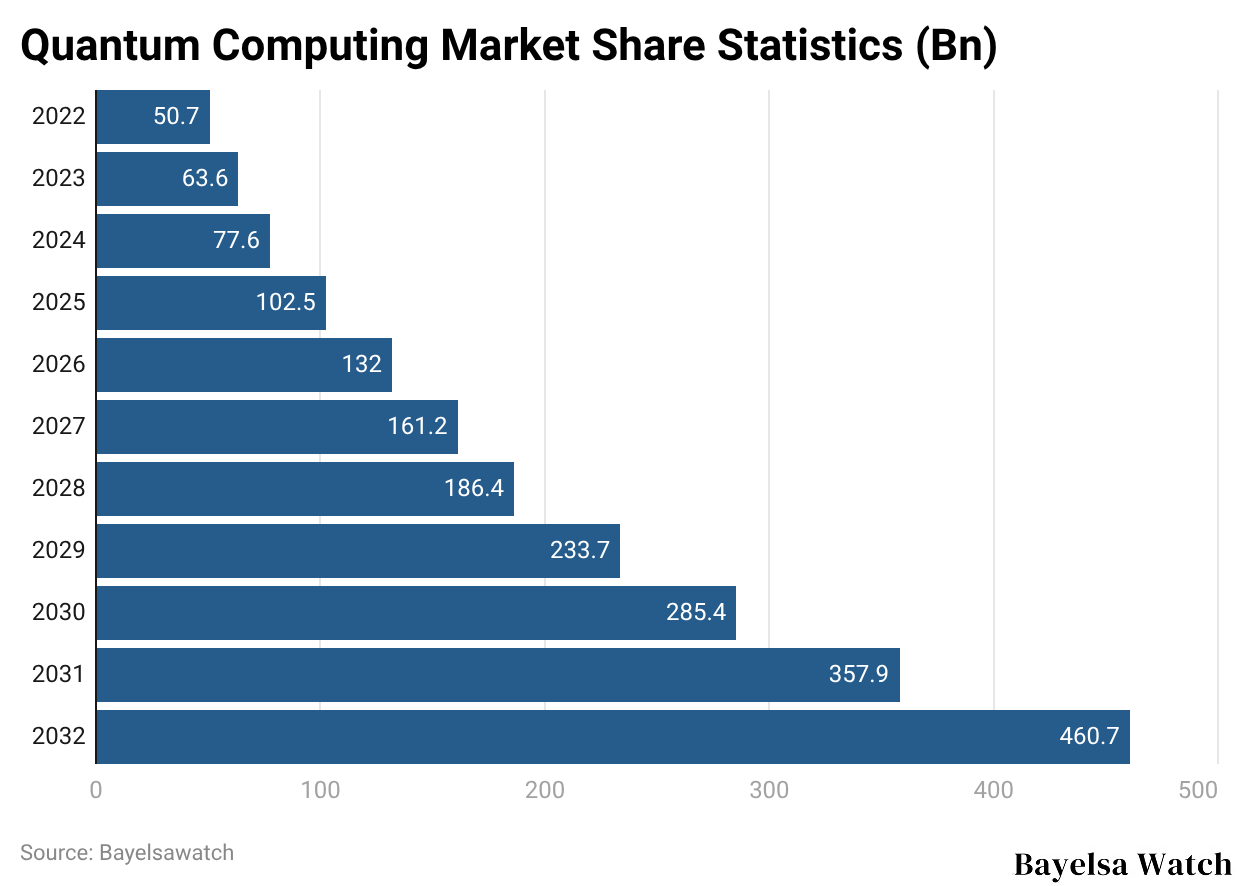
- Quantum computer sales are soaring with an average annual compound growth rate of 25.4%. With revenues expected to increase over the next several years.
- This past year (2022), the quantum computing industry had a total revenue of US$50.7B.
- The projected revenue for 2023 is US$63.6B, which represents solid continued growth.
- The next couple of years have even bigger growth in store. Projected revenue of US$77.6B in 2024 and US$102.5B in 2025 indicates that the growth rate is really starting to pick up steam.
- Looking ahead a little farther, quantum computer revenue is expected to grow to US$132 billion in 2026, and US$.161B in 2027.
- And then growing to $186.4B in 2028, and USUS$233.7B in 2029.
- By 2030, the estimated revenue is expected to exceed US$285.9B, with no signs of slowing. The projected revenue, as of the 1st quarter of 2031, is estimated at US$357.9B, and projected revenue for the 1st quarter of 2032 is expected to reach US$460.7B.
Quantum Computing Adoption Statistics
- From January to September 2025, Quantum computing firms raised US$3.77 billion, nearly 3 times the amount raised in the full year 2024 (US$1.3 billion).

- Startups (40%) and universities (33%) are the leading producers and innovators in quantum computers.

- Quantum processors that had more than 1000 qubits were developed by IBM.
Quantum Computing Use Cases Statistics
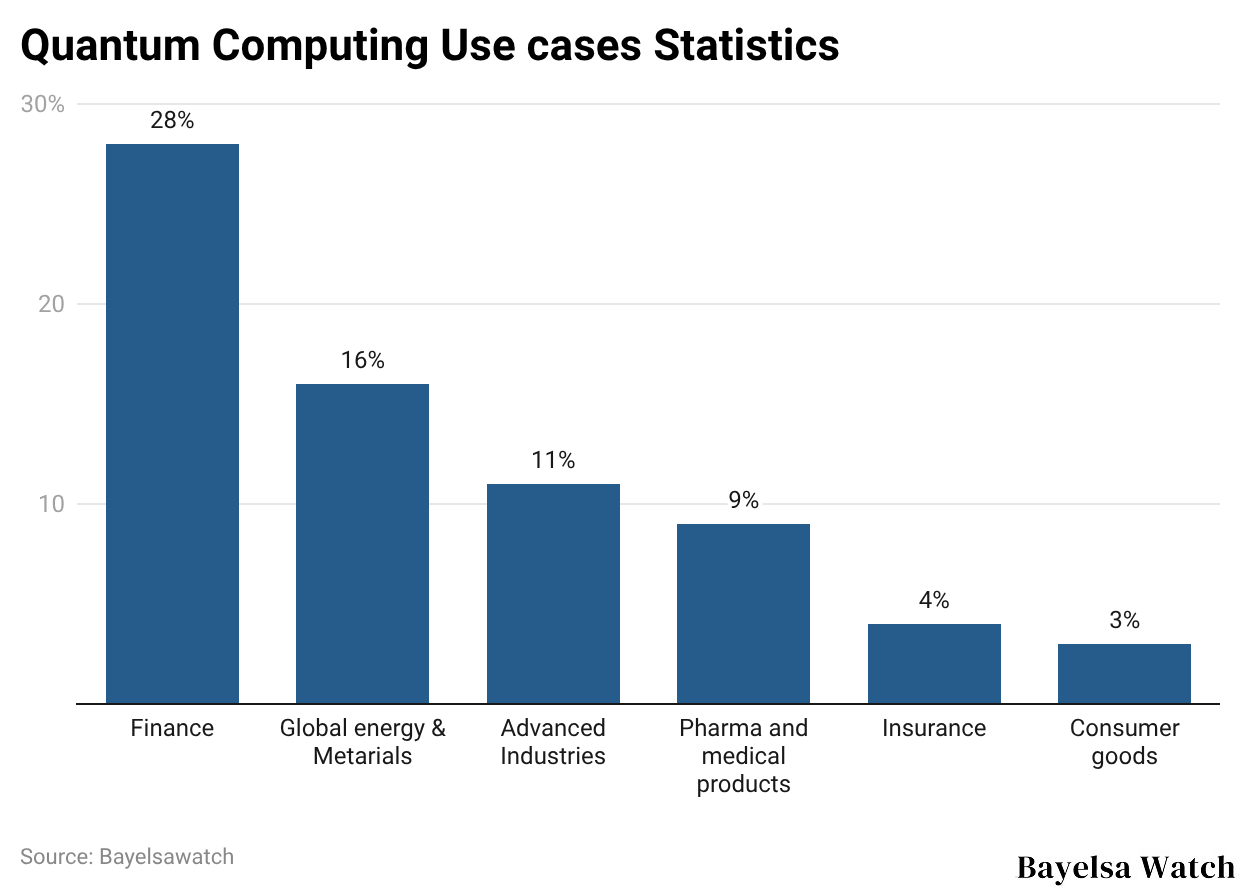
- According to our findings, for quantum computing, finance (28%), global energy and materials (16%), and advanced tech industries are the most applicable industries.
Quantum Computing Startups By Funding
- PsiQuantum has received Series E funding at a valuation of US$7 billion, raising US$1 billion.
- Quantinuum is valued at US$10 billion with total funding of US$600 million.
- D-Wave has had 19 rounds of funding totaling US$216 million.
- Rigetti has had 9 rounds of funding totaling US$198.5 million.
- The University of Oxford has received more public funds than any other organization; it has received a total of US$117.59 million in public funding through 62 grants.
- IonQ has had 3 rounds of funding amounting to US$52 million.
- Silicon Quantum Computing has received US$66 million.
- Cambridge Quantum Computing (CQC) has received US$48 million through 7 rounds of funding.
- 1QBit has raised CA$45 million through 4 rounds of funding.
- IQM has raised €29 million through 3 rounds of funding.

Quantum Computing In Finance Statistics
- In 2025, the global quantum computing sector is estimated to have a worth of USD 1.67 billion; finance accounts for approximately twenty percent of this total (by application).
- The implementation of quantum computing (via quantum algorithms) in 2025 allowed Goldman Sachs to improve risk assessment processes and conduct transactions twenty-five times quicker than previously possible using classical models.
- In 2025, several leading banks, including JPMorgan Chase & Co., integrated quantum cryptography to help protect approximately USD 3 trillion annually in transactional volume.
- Deloitte’s Quantum Lab reported 50% reduction in computation time when leveraging advanced quantum technologies/given the use of quantum systems when optimizing portfolios.
- Quantum finance investments grew 50% in 2025, resulting in roughly USD 2.25 billion of new investment (predominantly occurring in North America and Asia).
- HSBC utilized quantum simulations in 2025 to optimize pricing for derivatives; resulting calculation discrepancies were reduced by roughly twenty-two percent versus classical calculation methods.
- At the end of 2025, quantum technologies may help banks globally to save approximately USD 15 billion/year through the detection/prevention of fraudulent activities.
Quantum Security Revenue Worldwide
- In terms of revenue, the Asia Pacific market stood at US$650m, followed by North America at US$580m.
- The ECB announced a new €300m program in 2025 to implement quantum-resistant defenses within EU financial systems.
- The total market for quantum security is expected to be US$1.7bn in 2025 with a compound annual growth rate (CAGR) of 49%.
- In terms of quantum security spending, 42% of the total will be made by financial institutions and will be secured on high-value transactions.
- There was a 70% increase in the number of post-quantum cryptography implementations in 2025 due to the rise in quantum threats.
- According to a 2025 report from a leading survey, 70% of banks worldwide are currently transitioning to quantum-proof encryption strategies.
- Cybersecurity companies have experienced a 350% increase in demand for post- quantum digital certificates in 2025.

Quantum Computing Investment Statistics
- During the first three quarters of 2025, equity financing by quantum computing firms has totaled approximately US$3.77 billion.
- This amount is almost three times greater than the full-year figure (US$1.3 billion) in 2024. This amount is almost three times greater than the full-year figure (US$1.3 billion) in 2024.
- Just two late-stage technology companies captured half of total venture investment in quantum computing in the last year (PsiQuantum & Quantinuum).
- Additionally, European companies captured 47.5% of venture capital invested in quantum computing during the first quarter of 2025; this is a 16.5% increase over Q1 2024.
- Furthermore, hardware development is now leading funding rounds, unlike the prior two years when the majority of funding went toward software development.
- Lastly, JPMorgan Chase announced a new US$10 billion strategic technology fund that will make quantum computing one of its priority target areas.
Types Of Quantum Computing Companies
| Company | Valuation | Recent Funding (2025) | Technology |
| Quantinuum | US$10 billion | US$600M (Sept 2025) | Trapped ions |
| PsiQuantum | US$7 billion | US$1B Series E (Sept 2025) | Photonic |
| IonQ | US$24.5B market cap | US$2B equity offering | Trapped ions |
| Rigetti | US$13B market cap | US$35M Quanta partnership | Superconducting |
| D-Wave | NYSE: QBTS | 3,700%+ stock surge | Quantum annealing |
| QuEra | US$230M+ raised | Feb 2025, Google/SoftBank | Neutral atoms |
| Quantum Machines | US$170M Series C | Feb 2025 | Control systems |
| Classiq | US$110M Series C | May 2025 | Software |
Quantum Computing Companies Employees Statistics
| Company Name | Area | Number of Employees |
| D-wave | Quantum Computer Provider | 180+ |
| IBM | Quantum Computer Provider | 350,000 |
| Alibaba | Quantum Computer Provider | 102,000 |
| Intel | Quantum Computer Provider | 107,400 |
| Rigetti | Quantum Computer Provider | 146 |
| Quantum Computer Provider | 85,050 |
Quantum Computing Jobs Statistics
- According to the Bureau of Labor Statistics, quantum computer researchers fall under physicists when they compile data.
- As of 2015, 15650 people were working as physicists.
- Recent changes to jobs show that recent job postings related to commercial research and the application of quantum computing have increased significantly.
- As an example, in July 2018, there were 188 new job postings, compared to 45 in October 2017.
Quantum Computing By Processors Statistics
- Alpine Quantum Technologies launched its PINE System using trapped ion technology in June 2021 with 24 Qubits.
- Atom Computing launched its device called Phoenix, created using neutral atoms in optical lattices (100% Fidelity) in August 2021.
- Google entered the quantum computing space in 2017 with a 20-qubit superconducting computer, later announcing plans for a 49-qubit device in Q4 of 2017, which demonstrated very high fidelity (> 99%).
- Google’s Bristlecone was introduced on March 5, 2018, and has a 72-qubit design using superconducting transmons and is capable of achieving high fidelity across multiple qubits.
- Google’s Sycamore was introduced in 2019 and has 53 operational qubits in its 9×6 lattice structure.
Quantum Computing Recent Statistics
- December 31, 2025, approximately US$130 million is the GAAP revenue reported by Iong and they have become the first publicly traded company focused on quantum computing with annual GAAP revenue exceeding US$100 million.
- During November 2025, IBM launched its most advanced quantum processor thus far in the market, which was its IBM Quantum Nighthawk with a total of 120 qubits with 218 next-generation tunable couplings connecting all 120 qubit devices together within the IBM Quantum Nighthawk’s architecture.
- Rigetti Computing was able to raise US$300 million early in 2024 to expand its quantum computing infrastructure as well as expand its quantum cloud offerings due to Rigetti’s position as a pioneer within hybrid quantum-classical computations.
- In mid 2023, Google created Sycamore 2.0, which is an enhanced version of its prior generation quantum processor, thus improving error rate correction as well as improving qubit coherence times, lengthening the time that qubits might remain in quantum superposition to perform computations.
- In early 2023, IBM purchased Cambridge Quantum Computing for US$300 million in order to improve its quantum computing capabilities as well as expedite the development of applications utilizing quantum technology.
- D-Wave, a dedicated company developing quantum computing technology, was successful in raising US$400 million during 2023 to create a larger-scale quantum computing platform and further develop quantum applications for business enterprises.
Conclusion
Quantum computing is a rapidly growing and already well-established field with limitless possibilities. From theories of quantum entanglement, superposition, and qubits to developing quantum hardware (using many more qubits) and developing software (building larger quantum application libraries), there is an abundance of information about quantum computing today. There are also several ways in which quantum computing will change the way we solve problems, including but not limited to cryptography, materials science, machine learning, finance, and drug development.
While there are some challenges to overcome, such as error correction and scalability, emerging technologies and the acknowledgment by government agencies of the strategic importance of quantum computing suggest a bright future. Quantum computing is not only a vision of the future but also a reality that can have far-reaching consequences for reshaping computation, security, and innovation at the beginning of a quantum revolution.
FAQ
Quantum computing is a new form of technology that uses the laws of quantum mechanics to create computers capable of solving exceptionally complicated problems significantly more quickly than traditional machines can. While traditional computers operate using bits (0 or 1), quantum computers can use qubits (quantum bits) that allow them to exist in many different states at the same time (superposition), thus providing an incredible amount of computational power through a number of parallel processes.
Artificial intelligence (AI) has been around for many years; the combination of quantum computing (QC) and AI is sometimes referred to as “Quantum AI” (QAI) or “Quantum Machine Learning” (QML). Quantum computing’s use of superposition and entanglement, two major tenets of quantum mechanics, will allow AI to solve many common problems (e.g., optimization, pattern recognition, and training) much faster than classical computing methods currently allow for, as well as create more efficient models in the pursuit of Artificial General Intelligence (AGI).
Both China and the United States currently compete as the two most dominant countries in terms of capabilities related to Quantum Computing. China has made the largest amount of total public money invested in Quantum Computing (over $15 billion), has filed more patents than other countries, and has achieved some breakthroughs in Q-COMMUNICATION. On the other hand, the USA’s strength lies in private investment in Quantum Computing as well as basic research; the USA’s strategic focus on Q-SECURITY and commercialisation of Q-COMPUTING technology is rapidly catching up with China.
David Deutsch is considered one of the founders of Quantum Computing; he is a British physicist at the University of Oxford, credited with developing the Theory of Quantum Computing and describing the universal Quantum Computer in 1985 through the introduction of the Quantum Turing Machine.