








Market Overview
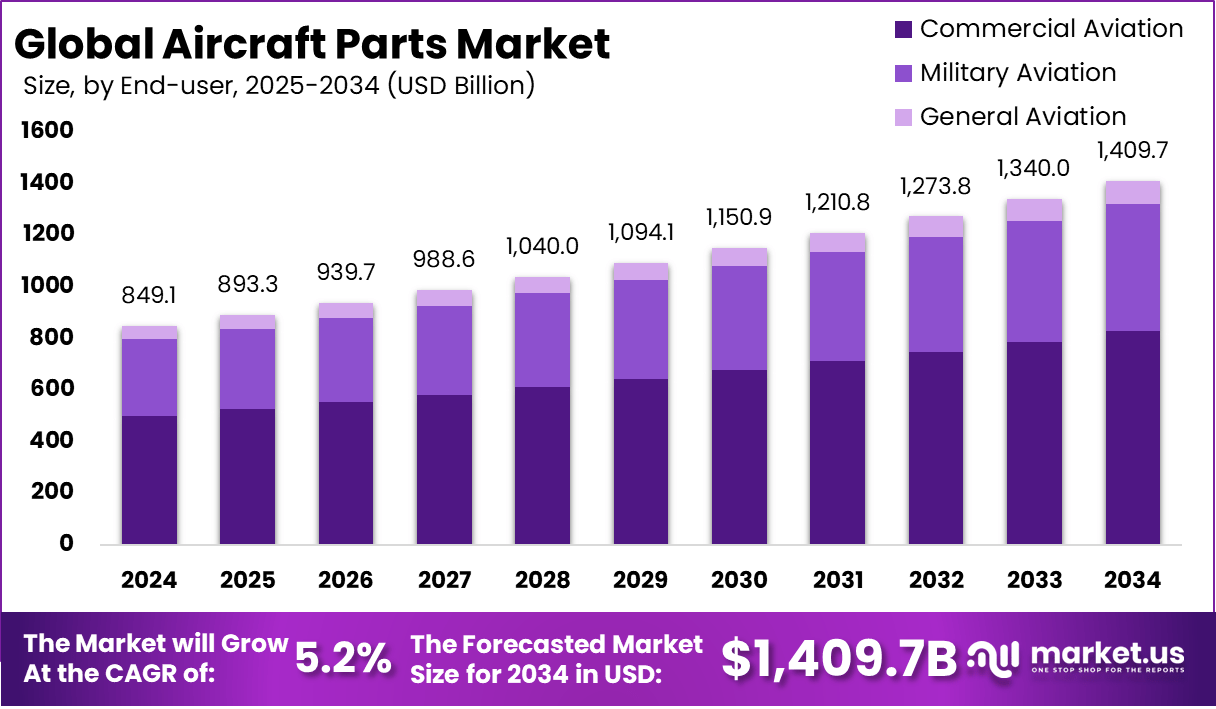
The global Aircraft Parts market is set to grow from USD 849.1 billion in 2024 to USD 1,409.7 billion by 2034, at a CAGR of 5.2% during the forecast period from 2025 to 2034. This robust expansion reflects surging global air travel demand, aging aircraft fleets, and rising investments in aerospace modernization worldwide.
Aircraft parts encompass the full range of components that keep aircraft safe and operational. These include wings, fuselage structures, engines, landing gear, cockpit systems, control surfaces, and interior components. Airlines, military operators, MRO providers, and general aviation companies all depend on a reliable supply of high-quality parts.
Multiple industries actively drive demand across this market. Commercial airlines require continuous part replacement due to high fleet utilization. Military organizations invest in parts for defense modernization programs. General aviation operators and MRO service providers also sustain significant recurring procurement activity across global supply chains.
Get further insight into the global trends shaping the future of the aircraft parts industry. Request Sample
Advanced technologies are reshaping how aircraft parts are designed and produced. Carbon fiber composites now account for approximately 50% of the structural weight in newer aircraft like the Boeing 787. Additive manufacturing (3D printing), smart sensors, and predictive maintenance platforms are improving part performance, reducing waste, and lowering lifecycle costs for operators.
Regulatory frameworks from the FAA, EASA, and ICAO mandate rigorous inspection and maintenance cycles that consistently drive parts demand. Governments are also increasing defense aerospace budgets. India’s Defence Acquisition Council, for example, approved capital acquisition proposals worth Rs 145 billion, including procurement programs that support military aviation parts requirements.
Related industry data reinforces this market’s scale and momentum. According to the OEC, aircraft parts represent 0.27% of total world trade, with the United States importing USD 13.3 billion worth annually. The global MRO market exceeds USD 80 billion per year and is projected to reach USD 120 billion by 2030, creating a powerful sustained pull for replacement parts and components.
Key Takeaways
- The global Aircraft Parts market grows from USD 849.1 billion in 2024 to USD 1,409.7 billion by 2034 at a CAGR of 5.2%.
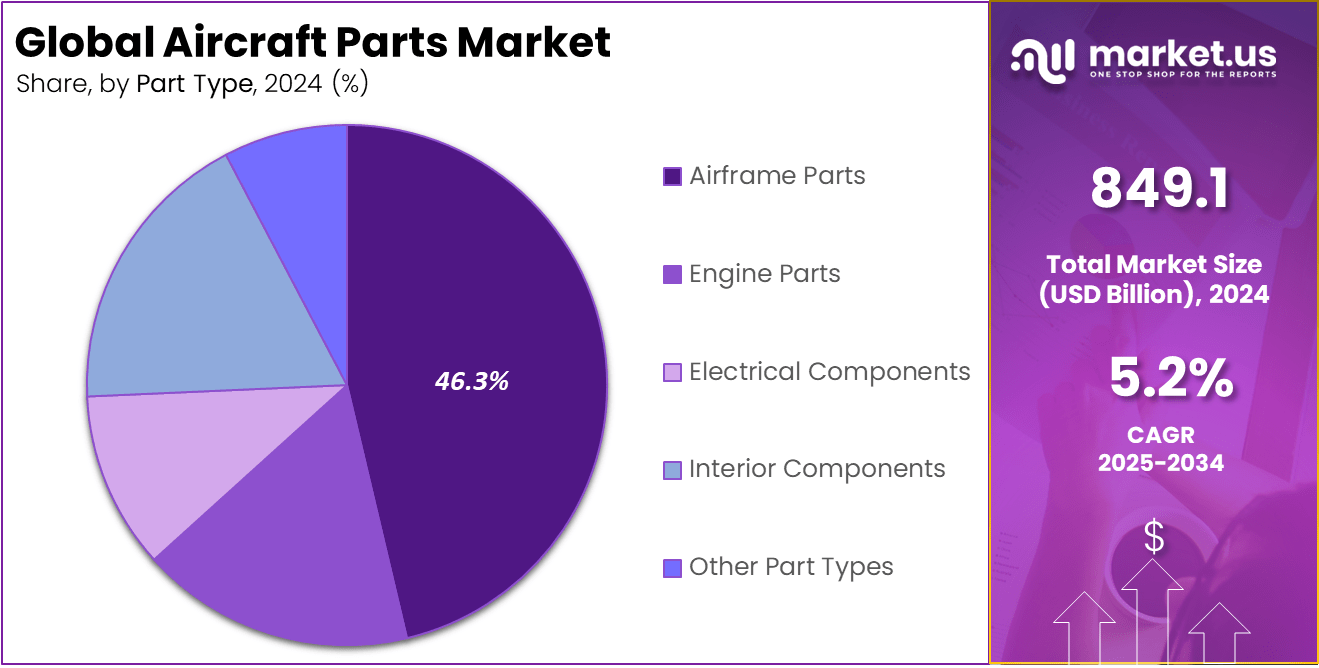
- Airframe Parts lead the part type segment with a 46.3% market share in 2024, driven by mandatory safety inspections and structural maintenance requirements.
- Commercial Aviation dominates the end-use segment with 58.8% of market share in 2024, reflecting high fleet utilization and frequent part replacement cycles.
- The US Aircraft Parts market was valued at USD 228.6 billion in 2024, growing at a CAGR of 5.9%, supported by major players like Boeing and GE Aviation.
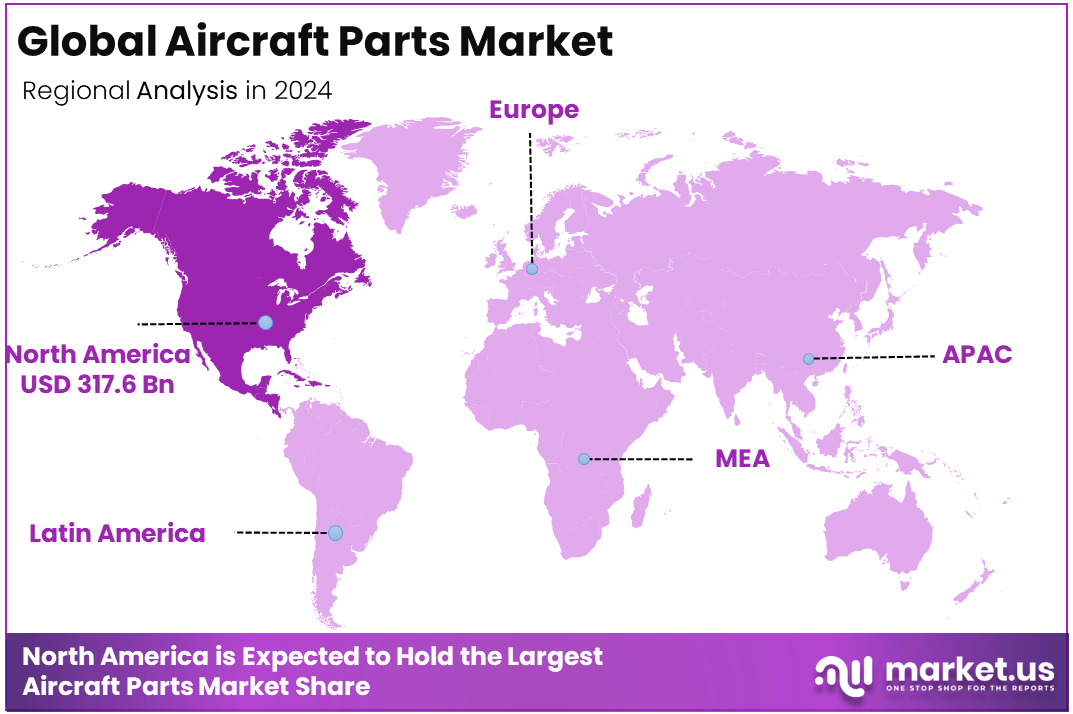
- North America leads all regions with a 37.4% global market share in 2023, backed by a strong aerospace supply chain and innovation ecosystem.
- India’s aerospace sector grows at nearly 20% per year, with aircraft parts representing more than 96% of the country’s aerospace export value (DSIR).
- The global 3D-printed aircraft parts market is projected to reach USD 3 billion by 2030, at a CAGR of over 20%.
Market Segmentation Overview
Airframe Parts lead the part type segment with a 46.3% share in 2024. Regulatory requirements from the FAA and EASA mandate regular inspection and maintenance of structural components, creating consistent demand. Airlines frequently outsource airframe maintenance to specialized MRO providers, further sustaining procurement volumes for wings, fuselage panels, and structural assemblies.
Commercial Aviation captures more than 58.8% of end-use market share in 2024. Airlines operate aircraft across multiple daily flights, accelerating wear and increasing part replacement frequency. The integration of predictive maintenance and IoT sensors now helps operators identify part degradation in real time, enabling proactive replacement strategies that increase overall component procurement activity.
Military Aviation represents a significant secondary end-use segment, supported by rising global defense budgets and fleet modernization programs. General Aviation also contributes steady demand, particularly in North America and Europe, where private and charter fleets require ongoing maintenance support. Both segments benefit from increasing government investment in aerospace safety and capability upgrades.
Drivers
Surging global air traffic powerfully drives aircraft parts demand. According to DGCA, Indian domestic airlines carried 1,464.02 lakh passengers between January and November 2024, up 5.91% year-on-year. Higher passenger volumes push airlines to expand fleets and increase maintenance frequency, directly boosting procurement of engines, airframe components, and interior replacement parts.
Aging aircraft fleets across commercial and military sectors generate sustained aftermarket demand. As aircraft accumulate flight hours, the frequency of required maintenance, repair, and overhaul operations increases significantly. Airlines and defense agencies must replace worn components to maintain airworthiness, driving steady revenue for parts manufacturers and MRO service providers across all major global markets.
Use Cases
Commercial airlines deploy advanced parts procurement strategies to manage high-utilization fleets efficiently. Carriers like Vietnam Airlines use predictive maintenance platforms — such as the Airbus Skywise system — to monitor component health across up to 65 A321 Family aircraft in real time. Early detection of wear reduces unplanned downtime and optimizes when replacement parts are ordered and installed.
Moreover, military operators depend on aircraft parts suppliers to support active fleet readiness and modernization. Defense procurement programs fund upgrades to aging platforms and integration of new technologies. Reliable parts availability ensures that military aircraft remain mission-capable, maintaining national security readiness while supporting long-term fleet sustainment contracts for manufacturers and MRO organizations.
Get further insight into the global trends shaping the future of the aircraft parts industry. Request Sample
Major Challenges
Supply chain disruptions represent a critical restraint for the aircraft parts industry. Delays in raw material availability halt production lines and push back delivery timelines for essential components. Airlines face extended aircraft grounding periods, increasing operational costs. Logistics disruptions further inflate parts prices, straining procurement budgets and forcing operators to seek costlier alternative sourcing strategies.
Additionally, strict regulatory compliance requirements create substantial cost and complexity burdens for manufacturers. The FAA, EASA, and ICAO require rigorous testing, documentation, and quality assurance processes for every certified part. Meeting these standards demands advanced manufacturing capabilities and dedicated quality control teams, raising production costs and extending time-to-market for new or upgraded aircraft components.
Business Opportunities
Aftermarket MRO services represent one of the most significant growth opportunities in the aircraft parts market. The global MRO sector exceeds USD 80 billion annually and is forecast to reach USD 120 billion by 2030. Parts manufacturers that establish long-term supply agreements with MRO providers can secure recurring, predictable revenue streams well beyond initial aircraft production and delivery cycles.
Consequently, additive manufacturing opens major new opportunities for agile parts production. The global 3D-printed aircraft parts market is projected to reach USD 3 billion by 2030, growing at over 20% CAGR. Companies that invest in certified additive manufacturing capabilities can reduce lead times, lower inventory costs, and rapidly produce complex components for both legacy fleets and next-generation aircraft programs.
Regional Analysis
North America dominates the global Aircraft Parts market with a 37.4% share in 2023. The US market alone was valued at USD 228.6 billion in 2024, underpinned by major aerospace leaders including Boeing, Lockheed Martin, and GE Aviation. A well-established supply chain, continuous R&D investment, and large commercial and military fleets sustain the region’s leadership position throughout the forecast period.
Asia-Pacific is rapidly emerging as a high-growth region. India’s aerospace industry expands at nearly 20% per year, with aircraft parts comprising over 96% of aerospace export value. China is expanding MRO capacity through major agreements like Collins Aerospace’s partnership with HNA Aviation Group. Strong fleet growth and government aerospace investment across India, China, and Southeast Asia will drive significant regional market share gains through 2034.
Recent Developments
- July 2024 — Flitetec unveiled its OEMRepair Hub service at the Farnborough International Airshow, targeting electro-mechanical, avionics, door lock, and latch component repair and overhaul for OEM-supplied equipment across EASA/CAA-certified operations.
- February 2024 — Collins Aerospace and HNA Aviation Group signed an MRO agreement under which Collins Aerospace will provide maintenance, repair, and overhaul services to HNA’s subsidiaries, one of China’s largest domestic and international air service operators.
- November 2023 — Vietnam Airlines signed a long-term agreement with Airbus for the Skywise Predictive Maintenance digital solution, covering up to 65 A321 Family aircraft (A321ceo and A321neo) to enhance fleet reliability and reduce unplanned maintenance events.
Conclusion
The global aircraft parts market is on a strong upward trajectory, supported by accelerating air travel demand, fleet expansion, and rising defense budgets. Aging aircraft fleets worldwide create sustained aftermarket opportunities, while technological advances in composites, additive manufacturing, and predictive maintenance continue to reshape how parts are produced and managed across the aviation industry.
Airframe parts and commercial aviation dominate current market activity, reflecting where operational pressure and regulatory requirements are most concentrated. North America maintains regional leadership through its aerospace innovation ecosystem and established supply chain. Asia-Pacific is emerging as the next major growth engine, led by India and China’s rapidly expanding aviation sectors and manufacturing ambitions.
Companies that invest in certified additive manufacturing, strategic MRO partnerships, and digital maintenance platforms will be best positioned to capture the market’s next growth phase. Suppliers that can ensure fast, reliable delivery of certified parts will gain competitive advantage as global fleet sizes expand. The global Aircraft Parts market is forecast to reach USD 1,409.7 billion by 2034.
Looking for data tailored to your specific market, region, or business need? Request a custom report or consultation — write to us at [email protected]