










Introduction
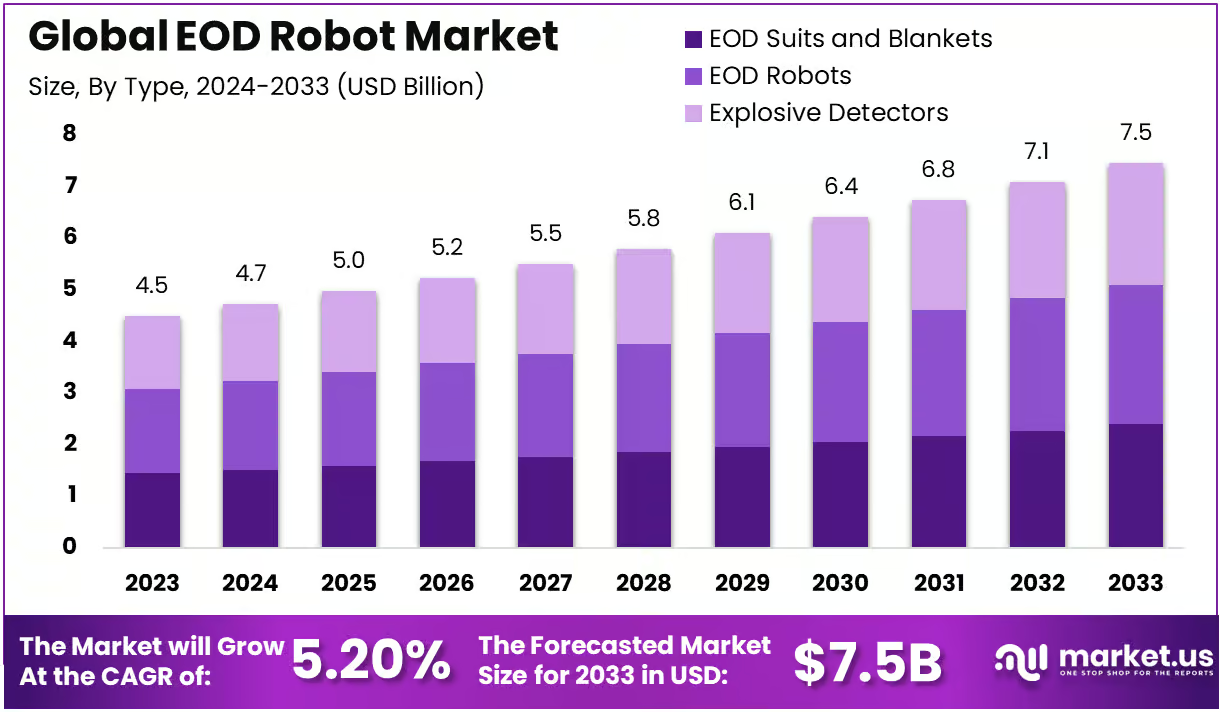
The global EOD Robot Market is projected to grow from USD 4.5 billion in 2023 to approximately USD 7.5 billion by 2033, registering a CAGR of 5.20% during 2024 to 2033. Growth is driven by increasing defense spending, rising threats from explosive devices, and the urgent need to enhance personnel safety through robotic intervention.
Request For Sample Report Here @ https://market.us/report/eod-robot-market/request-sample/
Market Overview
According to Market.us, the EOD Robot Market is steadily advancing as defense forces and security agencies increasingly adopt robotic solutions to manage explosive threats. The market is benefiting from the rising frequency of asymmetric warfare and the growing use of improvised explosive devices in conflict zones and urban environments.
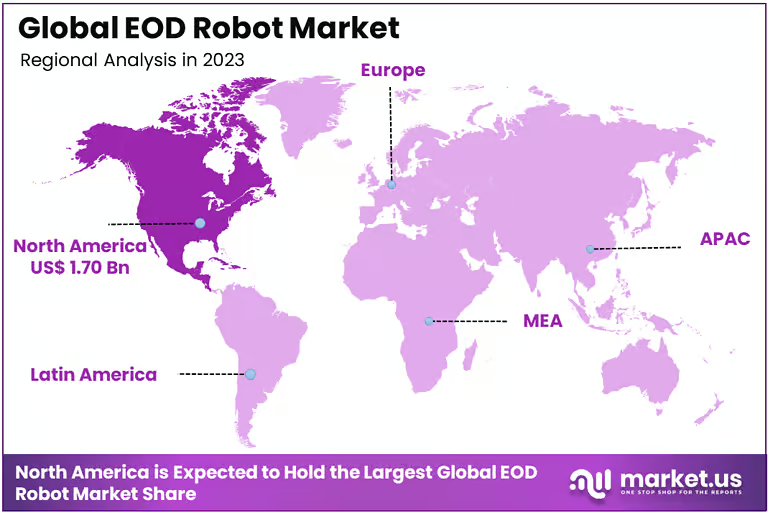
In 2023, North America dominated the market with a 37.8% share, generating USD 1.70 billion in revenue. This dominance is attributed to strong defense budgets, early adoption of advanced robotics, and continuous investments in autonomous technologies. Meanwhile, other regions are gradually increasing adoption as governments strengthen their counter-terrorism and disaster response capabilities.
The market is also witnessing a shift toward more compact, portable, and multi-functional robotic systems. These advancements are enabling better deployment flexibility across military, law enforcement, and emergency response scenarios. As technology evolves, EOD robots are becoming more reliable, precise, and capable of operating in highly complex environments, further strengthening their importance in modern security frameworks.
Key Takeaways
- The market is expected to reach USD 7.5 billion by 2033 from USD 4.5 billion in 2023
- CAGR estimated at 5.20% during 2024 to 2033
- North America dominated with 37.8% share in 2023
- North America revenue stood at USD 1.70 billion
- Rising adoption across the defense and homeland security sectors
- Increasing demand for remote-controlled and semi-autonomous systems
Connect with expert @ [email protected]
Report Scope
| Report Features | Description |
|---|---|
| Market Value (2023) | USD 4.5 Bn |
| Forecast Revenue (2033) | USD 7.5 Bn |
| CAGR (2024-2033) | 5.20% |
| Largest Market | North America |
| Base Year for Estimation | 2023 |
| Historic Period | 2019-2022 |
| Forecast Period | 2024-2033 |
| Report Coverage | Revenue Forecast, Market Dynamics, Competitive Landscape, Recent Developments |
| Segments Covered | By Type (EOD Suits and Blankets, EOD Robots, Explosive Detectors, Other Types), By End User (Military, Law Enforcement) |
| Regional Analysis | North America (US, Canada), Europe (Germany, UK, Spain, Austria, Rest of Europe), Asia-Pacific (China, Japan, South Korea, India, Australia, Thailand, Rest of Asia-Pacific), Latin America (Brazil), Middle East & Africa(South Africa, Saudi Arabia, United Arab Emirates) |
| Competitive Landscape | iRobot Corporation, Northrop Grumman Corporation, QinetiQ Group plc, L3Harris Technologies, Inc., Cobham plc, Teledyne FLIR LLC, Med-Eng Holdings ULC (Cadre Holdings, Inc.), Reamda Ltd., Scanna MSC, NABCO Systems LLC, United Shield International Ltd., ABP, Westminster International Ltd. |
| Customization Scope | We will provide customization for segments and at the region/country level. Moreover, additional customization can be done based on the requirements. |
| Purchase Options | We have three licenses to opt for: Single User License, Multi-User License (Up to 5 Users), Corporate Use License (Unlimited User and Printable PDF) |
How AI is Reshaping the Future of the EOD Robot Market?
Artificial intelligence is significantly enhancing the capabilities of EOD robots by enabling smarter decision-making and improved operational efficiency. AI-powered vision systems allow robots to detect, classify, and assess explosive threats with higher accuracy, reducing the burden on human operators. This is especially important in high-risk environments where quick and accurate decisions are critical.
The market is categorized by application, where the military and defense segment leads significantly, accounting for nearly 60% of the overall revenue in 2023. The law enforcement and public safety segment comes next, holding close to 25% share, driven by rising deployment of these robots for bomb disposal and handling explosive risks in densely populated areas. Meanwhile, the commercial and industrial segment, which includes uses such as safeguarding airports, ports, and other vital infrastructure, contributes around 15% of the market.
In terms of EOD robot types, remote-operated systems remain the most widely adopted, capturing over 70% of the market, as they enable operators to manage operations from a secure distance. Additionally, robots equipped with advanced sensing capabilities, including thermal imaging, radar, and infrared technologies, account for roughly 40% of the market, supporting improved detection and disarmament accuracy. At the same time, autonomous robots are steadily gaining momentum, with their share projected to reach 30% by 2033 as advancements enhance reliability and affordability.
Companies such as Northrop Grumman are leveraging AI to improve object recognition and threat identification, allowing robots to operate more independently. QinetiQ has integrated advanced sensor fusion technologies that combine visual, thermal, and lidar data to enhance navigation and situational awareness. These advancements enable robots to function effectively in low-visibility and complex terrains.
AI is also improving robotic manipulation capabilities. Machine learning algorithms help robots learn from previous operations, enabling more precise handling of hazardous materials. Additionally, predictive maintenance powered by AI is reducing downtime by identifying potential issues before they lead to system failures.
The integration of AI with edge computing is further transforming the market. EOD robots can now process data locally, reducing reliance on external communication networks. This is particularly beneficial in military operations where connectivity may be limited. As AI technology continues to advance, EOD robots are expected to become increasingly autonomous, enhancing both safety and efficiency.
Segmentation Deep Dive
By Type
Tracked robots dominate the market due to their ability to operate in rough and uneven terrains. The EOD Robots segment held a dominant market position, capturing more than 36.3%. These robots provide high stability and can carry heavier payloads, making them suitable for military operations in challenging environments. Their robust design ensures reliable performance in debris-filled and hazardous areas.
Wheeled robots are gaining popularity in urban and controlled environments where speed and maneuverability are essential. These robots are easier to deploy and maintain, making them ideal for law enforcement and emergency response applications. The growing focus on portability and rapid deployment is supporting the expansion of this segment.
By Application
Defense remains the largest application segment, driven by increasing investments in military modernization and the need to counter explosive threats. EOD robots are widely used in combat zones for detecting and neutralizing explosive devices, significantly reducing risks to personnel.
Law enforcement is emerging as a strong growth area, particularly in urban settings where security threats are evolving. Police and security agencies are adopting EOD robots for bomb disposal, surveillance, and hazardous material handling. Additionally, these robots are being used in disaster response scenarios, including search and rescue operations.
By End-User
Military end-users dominate the market due to continuous investments in unmanned systems and advanced defense technologies. The military segment held a dominant market position, capturing more than 57.5%. Governments are prioritizing the safety of soldiers by deploying robotic solutions in high-risk operations. This trend is expected to continue as defense strategies evolve.
Homeland security agencies are also playing a significant role in market growth. These agencies are increasingly investing in EOD robots to enhance their response capabilities and ensure public safety. The need for quick and effective threat neutralization is driving adoption in this segment.
Regional Analysis
North America leads the EOD Robot Market, accounting for 37.8% of the global share in 2023, with revenue reaching USD 1.70 billion. The region’s leadership is supported by high defense spending, strong technological infrastructure, and early adoption of advanced robotic systems. The presence of major defense contractors and continuous innovation in robotics and AI further strengthen the region’s position.
The region also benefits from ongoing military modernization programs and increasing investments in autonomous technologies. Law enforcement agencies in North America are actively adopting EOD robots to enhance public safety and improve response times. Additionally, strong collaboration between government and private sector players is fostering innovation and expanding the capabilities of robotic systems.
Market Leaders
- Northrop Grumman Corporation
- QinetiQ Group
- iRobot Corporation
- Teledyne FLIR LLC
- L3Harris Technologies
- ECA Group
- Kongsberg Gruppen
- Cobham plc
- Endeavor Robotics
- Harris Corporation
Recent Developments
- In 2025, Northrop Grumman introduced advanced robotic systems focused on improving autonomy and real-time threat detection capabilities for explosive ordnance disposal missions.
- In 2024, QinetiQ enhanced its TALON robotic platform with improved mobility and control systems, enabling better performance in complex operational environments.
- In 2025, Teledyne FLIR launched next-generation EOD robots equipped with high-resolution imaging and thermal sensing technologies, enhancing detection accuracy.
- In 2024, L3Harris Technologies developed modular robotic systems designed to support multiple mission requirements, improving flexibility and deployment efficiency.
- In 2025, Kongsberg Gruppen expanded its robotics capabilities through strategic investments aimed at strengthening its position in defense automation technologies.
Conclusion
The EOD Robot Market is on a steady growth path, driven by increasing security concerns and the need to protect human lives in high-risk environments. The integration of advanced technologies such as AI and sensor systems is transforming the capabilities of these robots, making them more efficient and reliable.
As defense and security agencies continue to invest in modernization, EOD robots are expected to play a critical role in future operations. The market presents strong long-term potential for stakeholders looking to capitalize on advancements in robotics and defense technologies.

Sources