


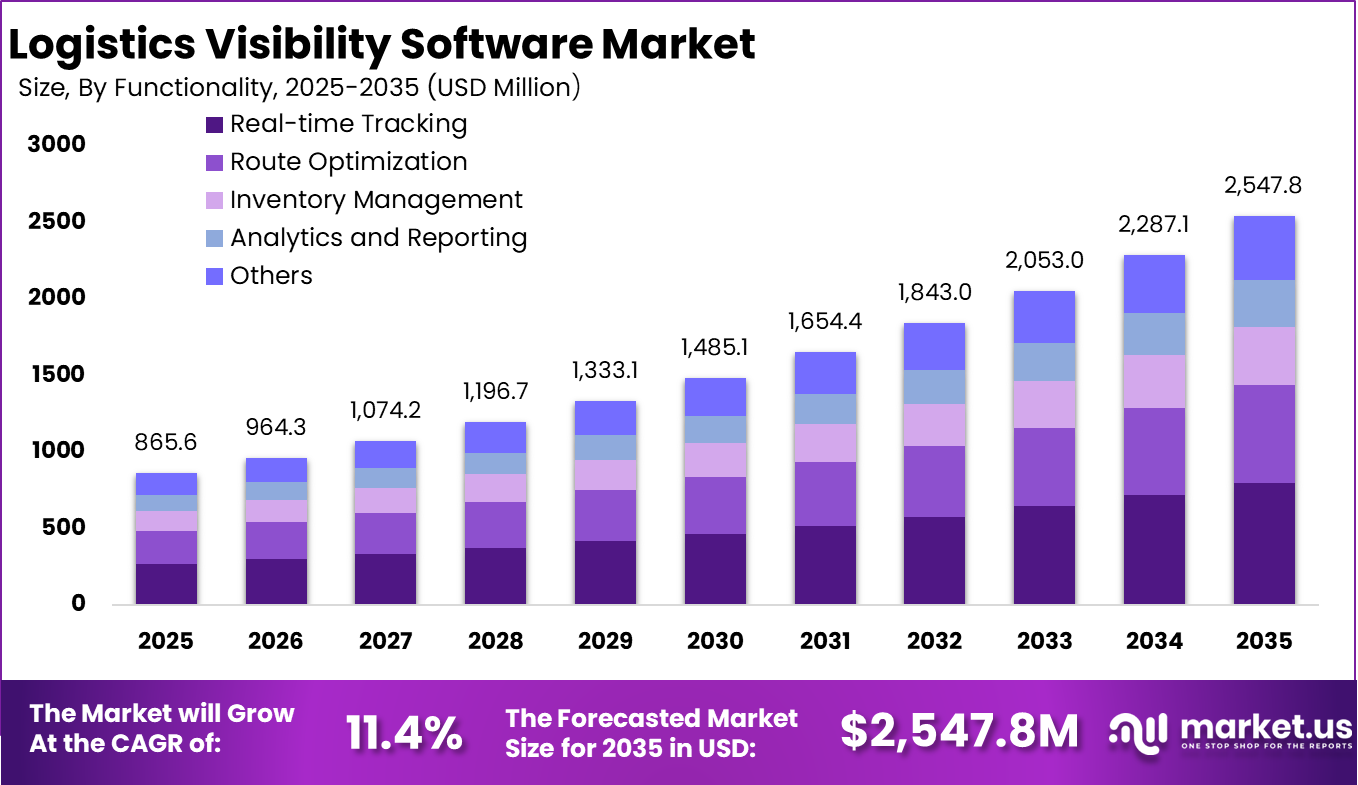
The global Logistics Visibility Software Market is projected to grow from USD 865.6 million in 2025 to around USD 2,547.8 million by 2035, expanding at a solid CAGR of 11.4% (2025–2035) as enterprises race to gain real‑time control over increasingly complex, disruption‑prone supply chains.
Demand is being propelled by explosive e‑commerce growth, rising customer expectations for accurate ETAs, and the need for end‑to‑end shipment tracking and exception management, making visibility platforms a strategic core of modern logistics operations.
Market Overview
According to Market.us, the global Logistics Visibility Software Market will increase from USD 865.6 million in 2025 to approximately USD 2,547.8 million by 2035, registering a healthy 11.4% CAGR over the forecast period. This growth trend reflects the shift from fragmented, siloed tracking tools to integrated, cloud‑based platforms that aggregate data from transportation systems, telematics, warehouse systems, and IoT devices to deliver a single, real‑time view of goods in motion and at rest.
North America currently dominates the market, accounting for more than 37.35% of global revenue and generating about USD 323.3 million in 2025, supported by mature logistics infrastructure, high technology adoption, and sustained investment in digital supply chain transformation. Within this region, the United States alone contributes USD 284.1 million in 2025, with a robust growth rate of 9.36%, driven by dense freight networks, large retail and manufacturing bases, and strong uptake of advanced visibility tools by shippers, 3PLs, and retailers.
Key Takeaways
- The global logistics visibility software market was valued at USD 865.6 million in 2025.
- The market is forecast to reach USD 2,547.8 million by 2035.
- From 2025 to 2035, the global logistics visibility software market is expected to grow at a compound annual growth rate of 11.4%.
- In 2025, North America accounted for 37.35% of the global logistics visibility software market, showing its strong position in this industry.
- The logistics visibility software market in North America generated USD 323.3 million in revenue in 2025.
- In the same year, the U.S. logistics visibility software market was valued at USD 284.1 million.
- The U.S. market recorded a growth rate of 9.36% in 2025, reflecting steady demand for visibility and tracking solutions.
- Within the functionality segment, real-time tracking held a market share of 31.48% in 2025, making it one of the key capabilities driving software adoption.
- Around 67% of organizations now rely on digital dashboards to achieve end-to-end supply chain visibility.
- In terms of process tracking coverage, about 60% of organizations track in-transit shipments, while 85% track delivered goods.
- Visibility across warehouse inventory stands at 40%, showing that inventory monitoring still has room for improvement.
- Around 75% of organizations use visibility tools to monitor processing activities, highlighting the growing focus on operational transparency across the supply chain.
Request Sample Report @ https://market.us/report/logistics-visibility-software-market/request-sample/
Segmentation Deep Dive
By Type (Functionality)
Market.us highlights that within the functionality landscape, real‑time tracking is the single largest component, accounting for 31.48% of the market in 2025. This dominance reflects the fact that, for many organizations, the first and most critical step toward supply chain digitization is gaining continuous visibility into where shipments are, whether they are on schedule, and which orders are at risk.
Key functional categories include:
- Real‑time tracking (31.48%) – Provides continuous location and status updates, supported by integrations with GPS devices, carrier systems, and IoT sensors; it dominates because it directly addresses late delivery pain points and customer service expectations.
- Predictive ETA and analytics – Uses AI and historical data to forecast arrival times and identify congestion patterns; this segment is expanding as shippers seek to move from reactive fire‑fighting to proactive planning.
- Exception management & alerts – Automates the detection and escalation of delays, missed scans, or route deviations; adoption is accelerating because it reduces manual monitoring and improves on‑time performance.
- Control tower dashboards & reporting – Offers centralized, KPI‑driven visibility across modes and regions; growth is driven by C‑suite demand for integrated, real‑time management of global logistics networks.
By Application
Logistics visibility software spans several application areas, with transportation monitoring and multi‑modal tracking emerging as the primary use cases.
- Transportation & shipment tracking: This is the core application, covering road, rail, ocean, and air shipments, and is growing fastest because it directly improves on‑time delivery, carrier performance management, and freight cost control.
- Last‑mile and e‑commerce delivery: Visibility platforms like FarEye and Locus focus on last‑mile tracking, customer notifications, and route optimization, supporting the high‑frequency delivery requirements of online retailers and parcel networks.
- Warehouse and yard visibility: Though currently less penetrated (with only about 40% inventory visibility coverage), this segment is gaining momentum as companies look to synchronize inbound/outbound flows and avoid yard congestion.
- Inventory and order visibility across networks: Integrations with ERP, WMS, and OMS systems provide end‑to‑end order and inventory tracking, helping planners match supply with demand more precisely, especially in omnichannel environments.
Application segments tied directly to e‑commerce, retail replenishment, and global freight forwarding are seeing particularly strong growth, as these operations face the highest pressure to provide accurate ETAs and proactive communication to both B2B and B2C customers.
By End‑User
The Logistics Visibility Software Market serves a broad set of end‑users, with retail, e‑commerce, manufacturing, and third‑party logistics (3PLs) among the most prominent.
- Retailers and e‑commerce players: They are among the largest adopters because customer experience hinges on accurate delivery promises and real‑time order tracking; visibility platforms support click‑to‑door transparency and exception handling.
- Manufacturers: Industrial companies use visibility software to manage inbound raw materials, inter‑plant transfers, and outbound finished goods, improving line uptime and reducing buffer stock.
- 3PLs, carriers, and freight forwarders: Service providers deploy visibility tools to differentiate their offerings, provide collaborative portals to shippers, and enhance operational efficiency across multi‑client networks.
- CPG, pharma, and cold‑chain operators: These sectors value real‑time condition monitoring and regulatory compliance; visibility platforms coupled with IoT sensors help protect product integrity and reduce spoilage.
Segments that are deeply exposed to omnichannel retail and time‑sensitive goods are expected to grow fastest, as they derive immediate revenue and cost benefits from improved promise reliability and risk mitigation.
Regional Analysis
North America is the leading region in the Logistics Visibility Software Market, with a commanding 37.35% share and revenue of USD 323.3 million in 2025. Several structural advantages explain this leadership: a highly developed logistics network, dense concentration of major retailers and e‑commerce platforms, and widespread adoption of TMS, WMS, and telematics, which makes it easier to integrate data into visibility platforms.
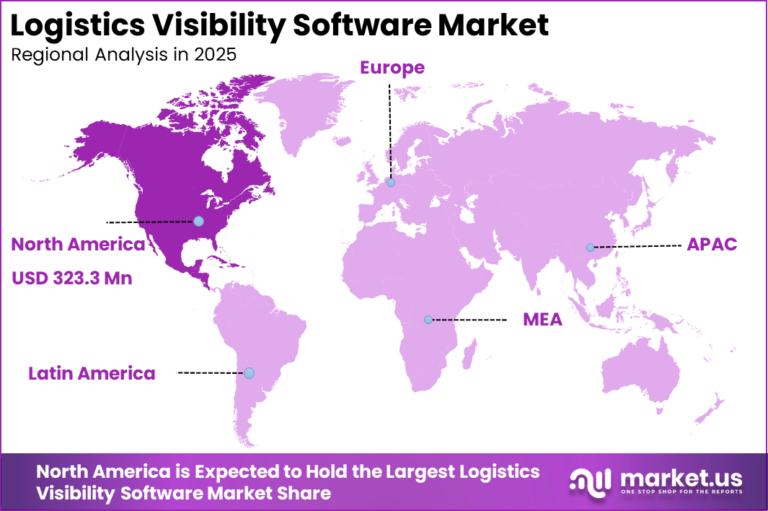
The United States, contributing USD 284.1 million in 2025 at a 9.36% growth rate, is the key driver, powered by large‑scale freight volumes, sophisticated 3PLs, and strong investment in digital transformation from enterprises seeking resilience against disruptions such as port congestion, extreme weather, and labor constraints. Vendors like Manhattan Associates, Project44, FourKites, and others are headquartered or strongly established in North America, reinforcing ecosystem depth and innovation. Additionally, regulatory and customer pressures for better shipment transparency and sustainability reporting push organizations to deploy advanced tracking and analytics tools.
Europe and the Asia Pacific are also important growth regions. Europe benefits from complex cross‑border trade and a strong regulatory focus on transparency, while the Asia Pacific is driven by fast‑growing e‑commerce markets, manufacturing hubs, and rapid logistics infrastructure upgrades. As companies in these regions scale digital supply chain initiatives, adoption of cloud‑based visibility platforms and AI‑enabled control towers is expected to accelerate, narrowing the gap with North America over the forecast period.
Market Leaders
The Logistics Visibility Software Market is led by a mix of specialized real‑time visibility providers, broader supply chain software companies, and enterprise technology giants. Key players include:
- Project44 – Real‑time transportation visibility platform with predictive ETAs and multimodal coverage.
- Blue Yonder – AI‑driven logistics and supply chain platform offering predictive visibility and transportation optimization.
- Descartes Systems Group, Inc. – Focused on compliance, digital documentation, and logistics visibility across borders and modes.
- Manhattan Associates, Inc. – Integrates warehouse, transportation, and visibility capabilities for large retail and logistics networks.
- Infor – Provides cloud‑based logistics visibility solutions embedded in ERP and supply chain suites.
- IBM Corporation – Applies AI, blockchain, and hybrid cloud to enhance supply chain transparency and risk management.
- e2open – Offers end‑to‑end supply chain orchestration with real‑time visibility and collaboration features.
- GEP – Provides procurement and supply chain platforms with embedded visibility and analytics.
- LogiNext, GoComet, Shippeo, FourKites, Overhaul, FarEye, Blume Global, FreightVerify, Trimble Visibility, Trucker Tools Smart Capacity – Specialized and emerging providers focusing on predictive tracking, network coverage, and last‑mile and multimodal visibility.
Recent Developments
Recent product launches and strategic moves underscore how leading vendors are racing to add AI capabilities, expand modal coverage, and deepen ecosystem integration.
- Manhattan Associates – Edge AI Visibility Upgrade (October 2025): Manhattan Associates introduced enhanced cloud‑based visibility software with edge AI capabilities in October 2025, targeting U.S. retailers seeking end‑to‑end shipment tracking and inventory cost reductions, further strengthening North America’s leadership in retail logistics technology.
- Project44 – Collaboration‑Focused Platform Updates (February 2026): In February 2026, Project44 rolled out new features emphasizing real‑time collaboration tools for carriers and shippers, enabling teams to share live shipment data, identify issues earlier, and adjust routes instantly to keep goods flowing smoothly.
- AI‑Driven Route Optimization and Control Towers (2025–2026): Platforms like Locus and LogiNext continued to expand AI‑driven route optimization and control tower capabilities, helping clients reduce transportation costs, improve SLA compliance, and lessen manual tracking efforts.
- Expansion of Multimodal and Global Coverage: Vendors such as FourKites and Project44 have scaled carrier networks and coverage, with FourKites, for example, supporting extensive global carrier and lane data to improve ETA accuracy and end‑to‑end traceability.
- Integration with Broader Supply Chain Suites: Enterprise providers including IBM, Blue Yonder, and e2open have deepened integration between visibility tools and planning, execution, and risk management modules to support holistic, data‑driven decision‑making across global supply chains.
Collectively, these developments point toward a more platform‑centric competitive landscape, where real‑time visibility, AI analytics, and collaborative workflows are bundled into unified offerings for shippers, carriers, and logistics partners.
Conclusion
The Logistics Visibility Software Market is entering a sustained growth phase, with revenues expected to climb from USD 865.6 million in 2025 to about USD 2,547.8 million by 2035, at a steady 11.4% CAGR. As supply chains become more global, digital, and disruption‑prone, visibility software is shifting from an operational “nice‑to‑have” to a strategic necessity for competitiveness, resilience, and customer experience.
For investors and industry leaders, the market offers compelling opportunities at the intersection of e‑commerce, AI, and logistics digitization. Providers that combine broad network coverage, strong integration capabilities, and advanced AI for predictive insights and automation are best positioned to capture outsized value. Enterprises that prioritize early adoption of next‑generation visibility platforms will be better equipped to navigate volatility, optimize working capital, and deliver differentiated service in an increasingly demanding logistics environment.
For more details, connect to – [email protected]